
TL;DR:
- Residential maintenance focuses on aesthetics, comfort, and flexible scheduling.
- Commercial maintenance prioritizes compliance, regular schedules, and specialized services.
- Proper understanding of property type ensures cost-effective, compliant, and outcome-driven outdoor care.
Many property owners and managers assume that outdoor maintenance is broadly the same regardless of whether a site is residential or commercial. That assumption can be costly. The differences between residential and commercial maintenance affect everything from scheduling and compliance to annual spend and long-term property value. Whether you manage a family home in Ranelagh or a retail block in Dublin city centre, understanding these distinctions will help you make smarter decisions, avoid unnecessary expense, and get better results from your maintenance provider.
Table of Contents
- Defining residential and commercial maintenance
- Core service differences: scale, frequency, and specialisation
- Cost frameworks: how pricing and value differ
- Compliance, technology, and outcomes: what really sets them apart
- Our take: what most people get wrong about residential and commercial maintenance
- Finding reliable maintenance for your Dublin property
- Frequently asked questions
Key Takeaways
| Point | Details |
|---|---|
| Different priorities | Residential focuses on comfort and aesthetics while commercial aims to maximise ROI, compliance, and tenant retention. |
| Service scale and expertise | Commercial maintenance demands formal systems, larger teams, and specialist skills compared to residential. |
| Pricing and value | Cost structures vary: commercial properties see higher total spend but benefit from efficiencies; residential centres on curb appeal and resale value. |
| Compliance matters | Commercial maintenance has stricter regulatory requirements and more extensive documentation than residential. |
Defining residential and commercial maintenance
Before comparing the two, it helps to be clear on what each category actually covers.
Residential maintenance refers to work carried out on properties where people live. This includes single-family homes, semi-detached houses, small apartment blocks, and private gardens. The priority here is comfort, aesthetics, and curb appeal and value. Homeowners want their property to look well, feel welcoming, and hold its market value.
Commercial maintenance covers a much broader range of settings. Offices, retail parks, warehouses, managed apartment complexes, and business campuses all fall under this umbrella. The focus shifts from personal comfort to asset performance, tenant satisfaction, regulatory compliance, and return on investment.
Here is a quick overview of what typically falls into each category:
- Residential: Family homes, private gardens, small apartment blocks, holiday lets
- Commercial: Office buildings, retail units, warehouses, managed estates, business parks
- Mixed-use: Large apartment complexes, live-work developments (these blur the line but lean commercial in terms of compliance and scale)
One thing worth noting is that property value maintenance matters in both settings, but the drivers are different. For homeowners, it is about resale price and neighbourhood appeal. For commercial landlords, it is about occupancy rates, tenant retention, and audit-ready documentation.
"Residential maintenance focuses on smaller scale properties like homes, with flexible scheduling, personalised services, and emphasis on curb appeal and homeowner comfort."
The blurring of lines is real. A large managed apartment block in Dublin, for example, may look residential on the surface but operates with commercial-level compliance requirements, multiple stakeholders, and formal service contracts. Scale and regulatory need are what truly separate the two.
Core service differences: scale, frequency, and specialisation
Once you understand the property types involved, the practical differences in how services are delivered become clear.
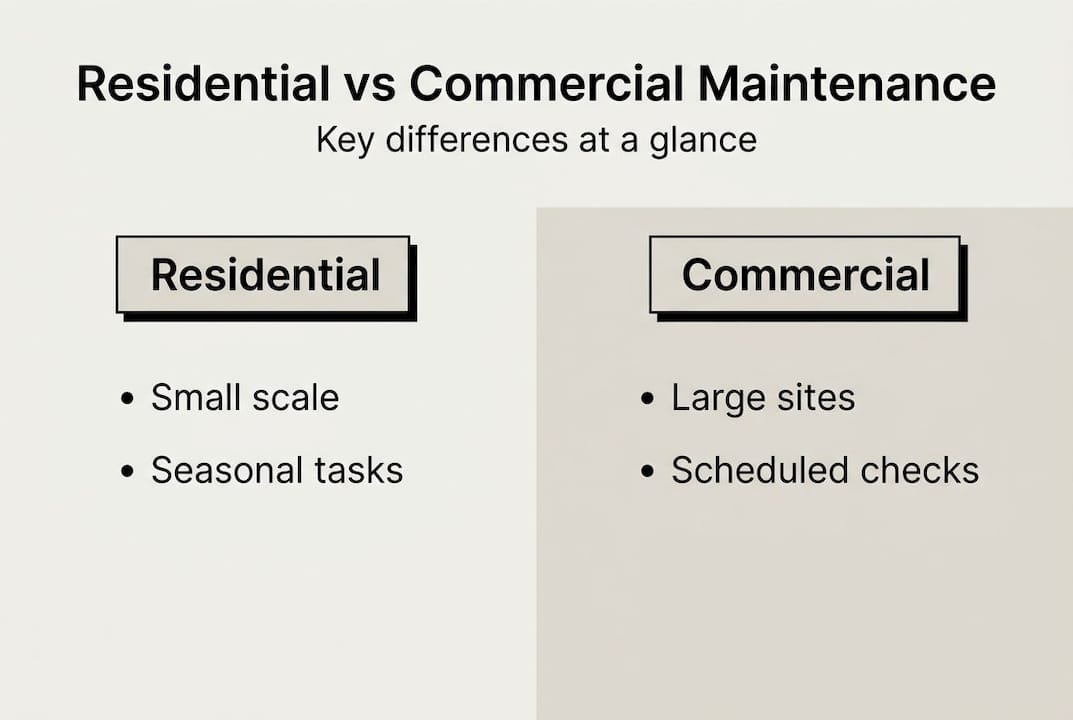
Residential maintenance is typically reactive or seasonal. A homeowner books a lawn cut when the grass gets long, or arranges a power wash before putting the house on the market. Scheduling is flexible and often informal. Services tend to be generalist, with one provider handling a range of outdoor tasks.

Commercial maintenance operates differently. Large sites with multiple tenants, shared facilities, and public-facing areas require regular, scheduled servicing. There is no room for reactive-only approaches when a poorly maintained car park or overgrown entrance affects dozens of tenants or customers daily.
Here is a side-by-side comparison:
| Feature | Residential | Commercial |
|---|---|---|
| Property scale | Small to medium | Medium to large |
| Scheduling | Flexible, seasonal | Regular, contracted |
| Service type | Generalist | Often specialised |
| Reporting | Informal | Formal, documented |
| Compliance needs | Low | High |
| Contract type | Ad hoc or annual | Formal SLA-based |
For commercial maintenance essentials, providers often need to demonstrate qualifications, carry insurance documentation, and submit service reports after each visit. This is standard practice in commercial contracts.
Residential providers, by contrast, focus on quality and consistency rather than formal reporting. Seasonal maintenance tips are more relevant here, with tasks grouped around spring preparation, summer upkeep, and autumn clearance.
Commercial maintenance also leans heavily on predictive maintenance strategies, using planned schedules and condition monitoring to prevent problems before they arise. Residential is often reactive or seasonal; commercial emphasises preventive maintenance, formal contracts, and documented procedures.
Pro Tip: If you manage a mixed-use or large apartment development in Dublin, treat it like a commercial asset. Formal service agreements and scheduled visits will protect you legally and financially.
The numbered steps below outline how a commercial outdoor maintenance programme typically runs:
- Initial site survey and condition report
- Agreement on service schedule and scope
- Regular scheduled visits with sign-off sheets
- Seasonal adjustments to the programme
- Annual review and contract renewal
Cost frameworks: how pricing and value differ
Beyond what happens on the ground, the financial side of maintenance is where residential and commercial properties diverge most sharply.
For residential properties, costs tend to be calculated per visit or per season. A homeowner might spend a few hundred euro on garden maintenance over the year, with occasional larger jobs like hedge removal or power washing added as needed. Annual residential maintenance averages around $8,808 per home, which gives a useful benchmark even when adjusted for the Irish market.
Commercial properties are costed very differently. Spend is typically calculated per square metre or square foot, across the full site. Commercial owners spend approximately $2.14 per sq ft on repairs and maintenance annually, with landscaping adding roughly $0.15 per sq ft on top of that.
Here is a simplified cost comparison:
| Cost factor | Residential | Commercial |
|---|---|---|
| Pricing model | Per visit or season | Per sq ft or contract |
| Typical annual spend | Moderate, variable | Higher, structured |
| Landscaping | Aesthetic focus | Compliance and image |
| Reporting costs | Minimal | Included in contract |
The value of getting the cost model right is significant. Preventive maintenance reduces costs by 25 to 40% and extends asset life by 30 to 50%. For commercial landlords, that is a compelling financial argument for investing in regular, planned maintenance rather than waiting for problems to appear.
For homeowners, the calculation is slightly different. The focus is on protecting and growing resale value. Understanding the difference between maintenance vs repairs is key here. Routine upkeep costs far less in the long run than emergency repairs or cosmetic fixes before a sale.
Dublin-specific factors also play a role. Labour costs, seasonal weather patterns, and local planning considerations all influence what you should expect to pay. A well-structured maintenance scheduling approach helps both homeowners and commercial managers control spend across the year.
Key cost drivers to keep in mind:
- Site size and access complexity
- Frequency of scheduled visits
- Specialist equipment or qualifications required
- Reporting and documentation requirements
- Seasonal variation in workload
Compliance, technology, and outcomes: what really sets them apart
Cost and scale are visible differences. Compliance and technology are less obvious but equally important.
For commercial properties, compliance is not optional. Regular inspections, health and safety documentation, contractor sign-in procedures, and formal records of all maintenance activity are standard requirements. Landlord maintenance responsibilities in Dublin extend well beyond basic upkeep, particularly for managed blocks and commercial tenancies.
Residential maintenance has far fewer formal requirements. A homeowner does not need to file inspection reports or maintain a compliance log. The focus is on practical outcomes: a tidy garden, a clean driveway, and a well-presented exterior.
Technology is another dividing line. Commercial maintenance increasingly uses Computerised Maintenance Management Systems (CMMS) to schedule work, track costs, and generate reports. IoT sensors monitor equipment performance in real time. IoT adoption reduces downtime by up to 78% in commercial environments, making it a genuine operational advantage.
Residential properties rarely use this level of technology. The priority is exterior maintenance for value and comfort, not system monitoring.
Key compliance and technology differences:
- Commercial: Formal inspection records, contractor certification, CMMS platforms, IoT monitoring
- Residential: Flexible scheduling, outcome-focused, minimal documentation
- Both: Benefit from consistent, quality service and clear communication with providers
Pro Tip: Even for residential properties, keeping a simple record of maintenance visits and costs will help when it comes to selling. Buyers and agents notice when a property has been well looked after.
The outcomes also differ. Commercial maintenance drives tenant retention, brand image, and regulatory compliance. Residential maintenance drives resale value, kerb appeal, and day-to-day satisfaction.
Our take: what most people get wrong about residential and commercial maintenance
After years of working across both residential and commercial properties in Dublin, we have noticed one recurring mistake: property managers applying a residential mindset to commercial assets.
It usually looks like this. A manager takes on a commercial block, uses the same informal approach they would for a family home, skips the formal scheduling, and ends up with reactive, expensive fixes rather than a planned programme. The cost savings they thought they were making disappear quickly.
The reverse also happens. Homeowners sometimes over-engineer their maintenance, investing in commercial-style contracts for a single property when a straightforward seasonal plan would serve them far better.
Conventional advice tends to focus on the type of property. Our experience says the more important question is: does your provider understand your specific context? A Dublin-based provider who knows local vs national maintenance considerations will deliver better results than a generalist who applies the same template everywhere.
The best outcomes come from providers who are adaptable, outcome-focused, and genuinely familiar with Dublin's property landscape. Checklists matter less than expertise and accountability.
Finding reliable maintenance for your Dublin property
Knowing the difference between residential and commercial maintenance is only useful if you act on it. Choosing a provider with genuine experience across both settings means you get the right approach for your specific property, whether that is a private home in Clontarf or a managed block in the Docklands.

At Sherry Property Care, we work with homeowners and property managers across Dublin, delivering tailored outdoor maintenance for all property types. From lawn care and hedging to power washing and grounds upkeep, we bring the same meticulous standards to every job. Get in touch today for a free quote and let us put together a plan that fits your property and your budget.
Frequently asked questions
Is preventive maintenance more important for commercial or residential properties?
Preventive maintenance is essential for both, but commercial properties depend on it more heavily for cost control, compliance, and protecting asset value. Commercial maintenance emphasises preventive strategies, formal contracts, and documented procedures in a way that residential rarely does.
Do maintenance costs differ much between residential and commercial properties?
Yes, significantly. Commercial spend averages $2.14 per sq ft annually, while residential costs are calculated per property and tend to be more variable and seasonal.
Can the same maintenance provider handle both residential and commercial properties?
Many providers specialise in one or the other, but those with experience in both are well suited to mixed-use sites and apartment blocks. Providers experienced in both settings can match the right approach to the right property type.
How does compliance impact commercial vs residential maintenance?
Compliance requirements are far stricter for commercial properties, covering inspections, contractor certification, and formal record-keeping. Commercial compliance demands go well beyond what a typical residential property owner needs to manage.