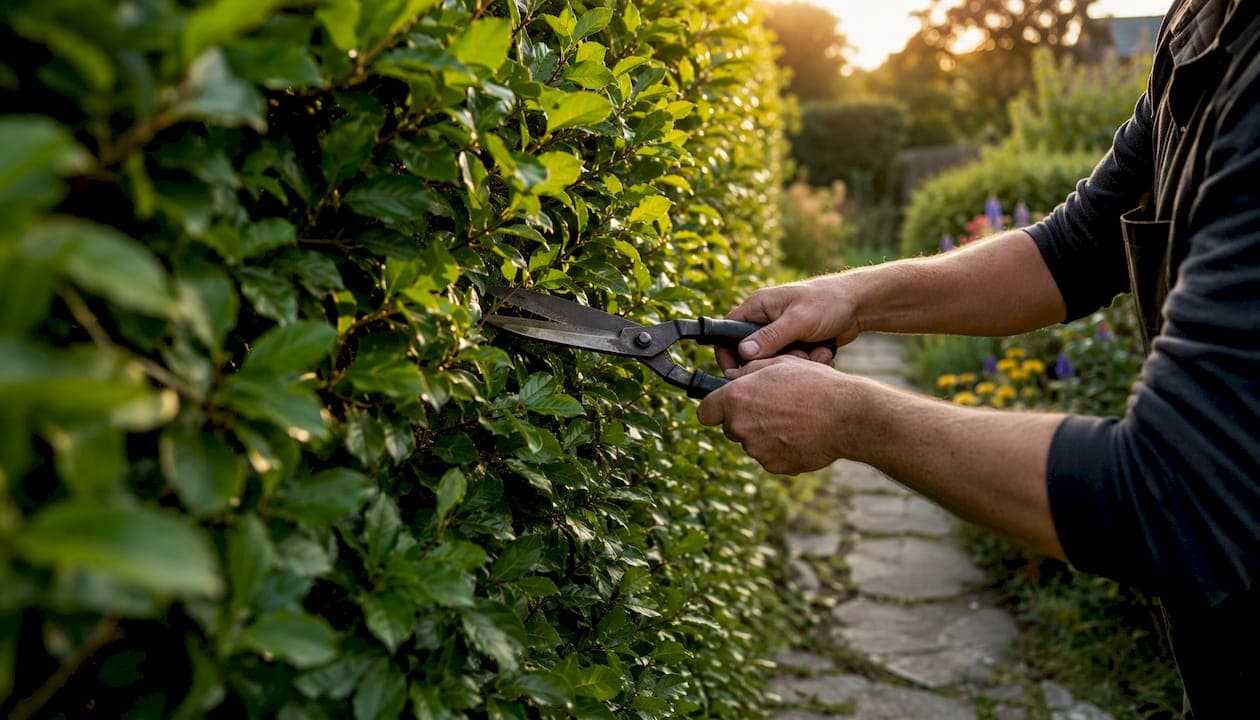
Trim your established beech hedge once a year in late summer, with September being the ideal month for most Irish gardens. The Wildlife Acts 1976–2012 prohibit cutting, grubbing, burning or otherwise destroying hedgerows during the traditional bird nesting season from early spring through late summer to protect nesting birds. Miss that September window and you wait until the following autumn, or plan a dormant-season renovation with care. One annual cut is all an established beech hedge needs.
Key takeaways
Established beech hedges in Ireland should be trimmed once a year in September, after the Wildlife Act nesting-season restriction lifts on 1 September, using sharp hand tools and a battered A-shape profile.
| Point | Details |
|---|---|
| Legal cutting window | Never cut between 1 March and 31 August under the Wildlife Acts 1976–2012. |
| Best trimming month | September gives the best combination of legal compliance and horticultural outcome for beech. |
| Annual frequency | One cut per year is enough for an established beech hedge; more damages long-term structure. |
| Renovation staging | Hard reductions should be spread across two seasons, cutting one face per year to avoid plant stress. |
| Local professional help | Sherrypropertycare provides legal-window scheduling, written quotes and full waste removal for Dublin properties. |
Table of Contents
- Why are beech hedges different from other hedging species?
- What does Irish law say about hedge cutting?
- Month-by-month pruning calendar for beech hedges in Ireland
- How to trim a beech hedge safely and effectively
- How far back can you cut a beech hedge?
- Common problems and pests on beech hedges in Ireland
- What should you do after trimming your beech hedge?
- When should you hire a professional for hedge trimming?
- A practical checklist for Dublin homeowners
- Why September is the right month for your beech hedge
- Sherrypropertycare handles your beech hedge in Dublin
- Sources
- FAQ
Why are beech hedges different from other hedging species?
Beech (Fagus sylvatica) behaves differently from fast-growing alternatives such as griselinia or laurel, and that difference shapes every decision you make about timing and technique.
The key trait is marcescence: beech holds its dead, coppery-brown leaves through winter rather than dropping them cleanly in autumn. That quality makes it a popular choice for year-round screening in Irish gardens. The catch is that marcescence only works reliably when you cut at the right time. Trim too early in summer and the hedge pushes soft new growth that winter frosts can damage. Trim in late summer and the hedge hardens off properly, retaining those brown leaves as a dense screen until spring.
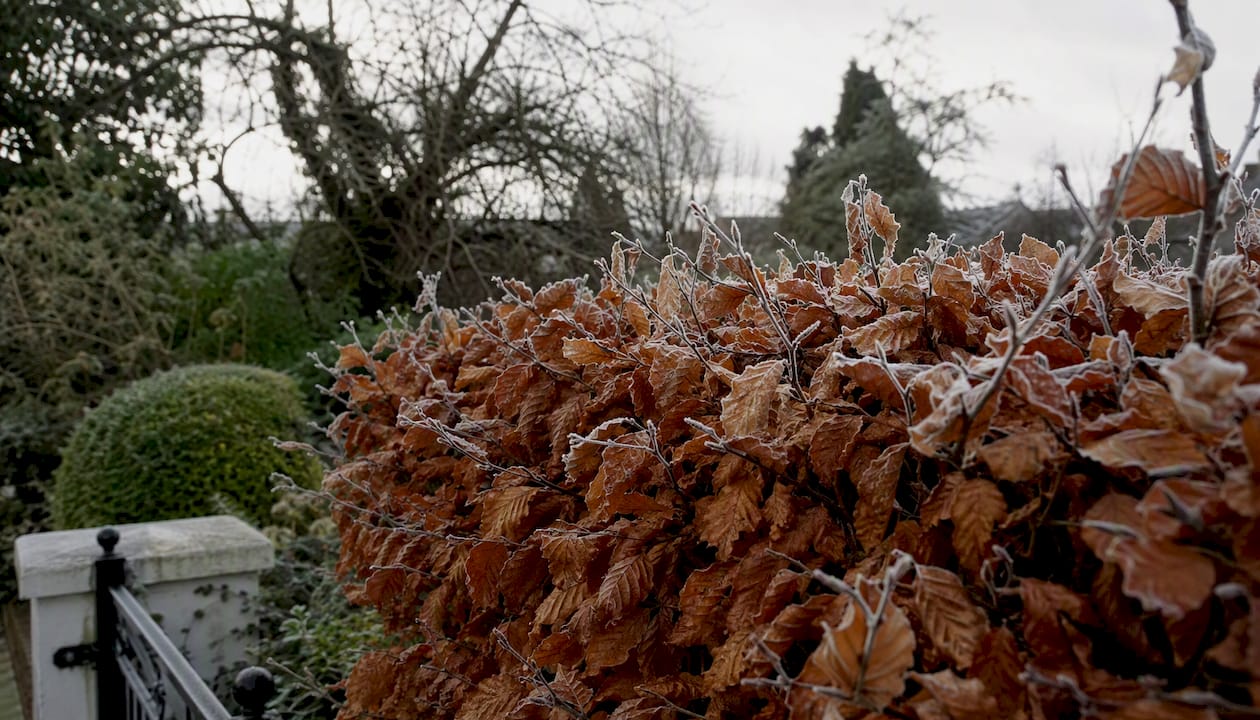
Beech is also relatively slow-growing compared with many hedging species, which is why one annual cut is the norm rather than the two or three cuts that privet hedge maintenance or conifer hedge trimming in Ireland often demands. Over-cutting damages long-term structure. Under-cutting lets the hedge become leggy and thin at the base.
Key characteristics that affect your approach:
- Growth pattern: two flushes per year, a main spring burst and a smaller late-summer push
- Leaf retention (marcescence): brown leaves stay on through winter when the hedge is cut after the summer flush
- Wound healing: cuts made in warm late-summer weather close faster than those made in cold or wet conditions
- Tool sensitivity: beech leaves bruise and brown at the edges when cut with blunt or heavy mechanical trimmers, which is why hand tools matter
What does Irish law say about hedge cutting?
The legal position in Ireland is clear and non-negotiable. Under the Wildlife Acts 1976–2012, it is an offence to cut, grub, burn or otherwise destroy any hedgerow or vegetation growing on or adjacent to a ditch during the bird nesting season, typically from early spring to late summer. The restriction exists to protect nesting birds and their young during the breeding season.
This applies to routine garden trimming as much as it does to agricultural hedgerow removal. There are very limited exemptions, primarily for works that are genuinely necessary to prevent a danger to public safety or to comply with a statutory obligation. If you believe your situation might qualify for an exemption, check directly with your local authority or the Department of Housing, Local Government and Heritage before proceeding.
Practical points to keep in mind:
- Plan for September. It is the first legal month after the nesting season and still warm enough for good wound healing.
- Do not start work in late February hoping to squeeze in a cut before the 1 March deadline. Nesting can begin earlier than expected in mild years.
- Avoid March to August entirely for any cutting, trimming or removal of hedge material, regardless of how overgrown the hedge has become.
- If in doubt, leave it. The fine for breaching the Wildlife Act can be significant, and the reputational damage to a contractor who cuts in season is equally serious.
The same legal window applies whether you are managing beech, laurel hedge maintenance, privet hedge maintenance or conifer hedge trimming in Ireland.
Month-by-month pruning calendar for beech hedges in Ireland
The table below sets out recommended hedge care by month, emphasizing that cutting is generally not advised during the bird nesting season in spring and summer. For established beech hedges, the primary trimming period is late summer to early autumn, with light formative trims on young plants. Management in winter is typically avoided due to slower wound healing and frost risk.
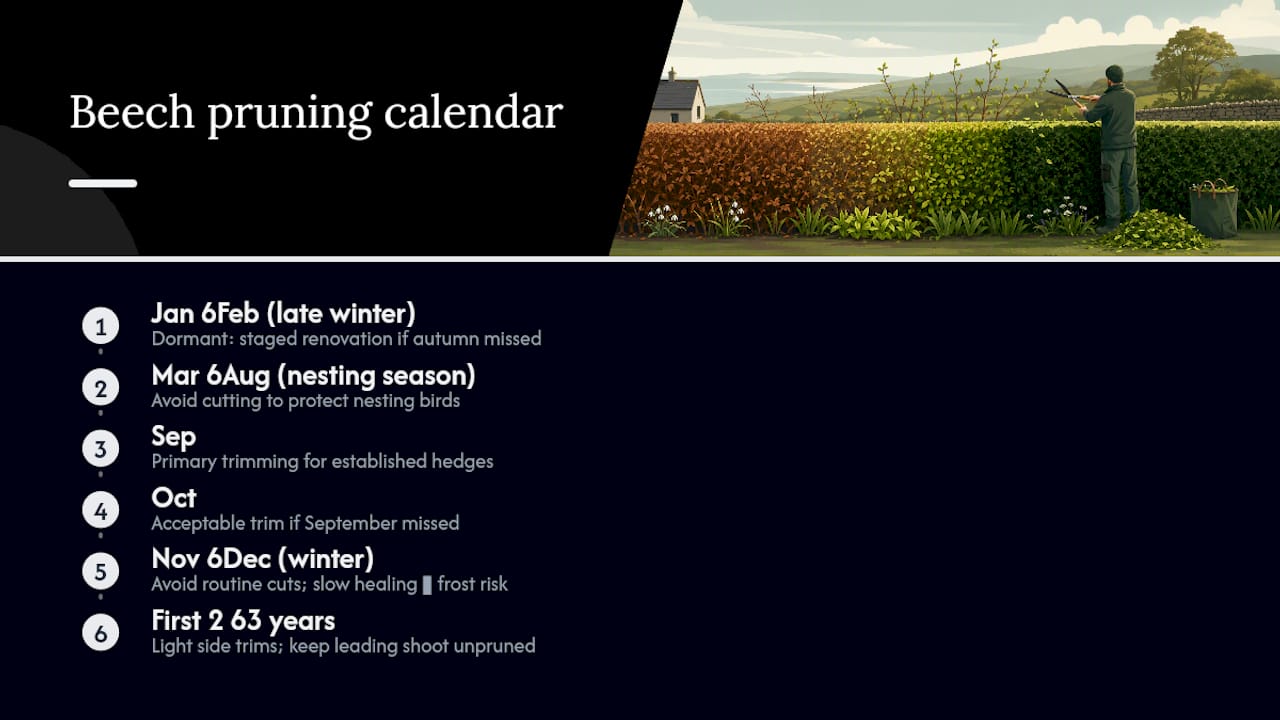
If you miss September, trimming in October still produces acceptable results for an established hedge, according to RHS growing guidance for beech. If you need a hard renovation cut and have missed the autumn window entirely, stage it in late winter while the hedge is dormant, but spread the work across two seasons rather than cutting everything back at once.
Young hedges need a different approach in their first two to three years. Trim the sides lightly to encourage bushy growth, but leave the leading shoot (the top) unpruned until the hedge reaches its target height. Once established, switch to the standard annual September cut.
How to trim a beech hedge safely and effectively
Tools and PPE checklist
Gather everything before you start:
- Sharp bypass secateurs (for detail work and individual stems)
- Loppers (for stems thicker than a finger)
- Pruning saw (for any branch over 2 cm diameter)
- Powered hedge trimmer (for bulk removal of soft growth only, after careful hand cuts)
- Sturdy gloves and safety glasses
- Hard hat if working near a tall hedge with a ladder
- Stable platform ladder or scaffold tower for hedges over 1.5 m
Pro Tip: Sharp secateurs produce cleaner cuts than mechanical trimmers on beech. BBC Gardeners' World recommends using hand tools for the main shaping cut and reserving powered cutters for rapid bulk removal only. Blunt blades bruise the leaf edges and leave the hedge looking brown and ragged within days.
Step-by-step trimming method
- Inspect the hedge before you cut. Even in September, check for late-nesting birds. If you find an active nest, stop and wait until it is vacated.
- Set a string line. Run a taut string along the top of the hedge at your target height. This is the single most effective way to keep the top level across a long run.
- Clear the base. Remove any weeds, debris or self-seeded plants from the base of the hedge so you can work safely and see what you are doing.
- Cut the top first. Work along the string line, removing growth above it. Keep cuts clean and avoid tearing stems.
- Cut the sides. Work from top to bottom on each face. Maintain a slight batter (an A-shape): the base should be marginally wider than the top so that lower branches receive enough light to stay dense.
- Tidy as you go. Remove clippings from the top of the hedge as you work. Piles of wet clippings left on the hedge can cause fungal problems.
- Step back and check. View the hedge from a distance every few metres to catch any unevenness before moving on.
- Clear the base again. Rake all clippings away from the root zone once finished.
When using secateurs for detail work, cut new shoots back to two or three leaves from the base of that shoot. This encourages dense, bushy regrowth rather than long, whippy stems.
Safety checklist before you climb:
- Check the ladder feet are stable on firm, level ground
- Never overreach; move the ladder rather than stretching
- Keep both hands free for cutting; use a tool belt or apron for secateurs
- Have a second person present when working at height
How far back can you cut a beech hedge?
Routine annual trimming removes only the current season's growth, typically 10–15 cm from the surface of the hedge. That is all most established beech hedges need.
For an overgrown hedge that has grown significantly beyond its intended size, a staged renovation is the safe approach:
- Year one: Cut one side face and the top back hard, but leave the other face untouched. This preserves enough leaf area for the plant to photosynthesise and recover.
- Year two: Cut the remaining face back hard once the first side has produced new growth.
- Allow at least 12 months between heavy reductions on the same face. The RHS advises staging renovation across seasons rather than cutting back to bare wood in a single session, which risks severe stress or death of the plants.
Aftercare following heavy cutting:
- Apply a balanced slow-release fertiliser around the root zone in spring after a hard renovation cut
- Mulch the base with a 5–7 cm layer of composted bark to retain moisture and suppress weeds
- Water thoroughly during dry spells in the first growing season after renovation
- Do not trim again until the hedge has produced a full season of new growth
Common problems and pests on beech hedges in Ireland
Beech is generally tough, but a few issues appear regularly in Irish gardens.
- Leaf scorch: Brown, papery leaf edges in summer, usually caused by drought stress or wind exposure. Water during dry periods and consider a windbreak on exposed sites.
- Beech aphids (Phyllaphis fagi): Woolly white colonies on the undersides of leaves in spring and early summer. Heavy infestations cause leaf curl and sticky honeydew. A strong jet of water dislodges colonies; natural predators such as ladybirds usually bring numbers down without intervention.
- Fungal leaf spots: Small dark spots or patches on leaves, often after a wet spring. Good airflow through the hedge reduces risk; avoid cutting when the hedge is wet.
- Winter dieback: Blackened or dead shoot tips after a hard frost, more common on hedges cut too late in autumn when new growth has not hardened off. Prune out dead material in early spring before the legal restriction begins.
- Phytophthora root rot: Yellowing foliage, wilting and progressive dieback from the base upward. This is a serious soil-borne disease with no reliable cure. If you suspect it, call a professional rather than attempting home treatment.
Good airflow, correct pruning timing and avoiding waterlogged soil prevent most of these problems. When you see structural decay, large-scale dieback across multiple plants, or symptoms that suggest root disease, professional assessment is the right call.
What should you do after trimming your beech hedge?
Aftercare in the days and weeks following a cut makes a real difference to how quickly the hedge recovers and how well it looks the following spring.
- Dispose of clippings promptly. Compost healthy material in a hot compost heap or put it through a garden shredder. Do not leave large piles against the base of the hedge.
- Biosecurity note: If the hedge has shown any signs of disease, bag the clippings and dispose of them through your local green waste collection rather than composting on site.
- Water after cutting if the weather is dry. Newly cut hedges lose moisture through their wounds, and dry conditions slow healing.
- Do not apply wound sealants. Modern horticultural guidance is clear: sealants can trap moisture and encourage rot. Clean cuts made with sharp tools heal naturally without any treatment.
- Feed in spring. A balanced granular fertiliser applied around the drip line in March or April supports the flush of new growth that will fill in the cut surface.
- Timing for follow-up trims: For an established hedge, the next cut is the following September. Do not be tempted to tidy up in spring; that risks cutting off the new growth that will form the hedge's surface for the year.
For a step-by-step seasonal maintenance approach tailored to Dublin gardens, planning each task by month keeps the whole property looking its best year-round.
When should you hire a professional for hedge trimming?
Some jobs are straightforward DIY. Others are not, and knowing the difference saves time, money and occasionally a hedge.
Call a professional when:
- The hedge is taller than 2 m and you do not have safe access equipment
- You are planning a hard renovation cut and want the staging managed correctly
- You have spotted signs of structural decay, root disease or large-scale dieback
- The hedge runs along a boundary shared with a neighbour and any dispute about height or position is possible
- You simply do not have the time or tools to do the job properly in the September window
When you contact a contractor, ask these questions:
- Are you fully insured for hedge trimming at height?
- Can you confirm the work will be scheduled within the legal window (September to February)?
- Do you have experience with beech specifically, or mainly with conifer hedge trimming?
- Will you remove all green waste from site, or is disposal my responsibility?
- Can you provide a written quote before starting?
A professional service should deliver a site inspection, a written quote, scheduling within the legal window, and full green waste removal. For a guide to what professional hedge trimming services should include, check the standards before you book.
A practical checklist for Dublin homeowners
Dublin's demand for hedge trimming services peaks sharply in September and October. Book early, ideally in August, to secure a slot in the legal window.
What to expect from a reputable local service:
- A pre-visit inspection to assess the hedge's condition and identify any disease or structural issues
- Scheduling confirmed within the 1 September to 28 February legal window
- A staged renovation plan if the hedge is significantly overgrown, with clear timelines across two seasons
- Full removal and disposal of all green waste from site
- A written quote before any work begins
Booking checklist for Dublin property owners:
- Contact providers in August for September slots
- Ask for local references or examples of beech hedge work specifically
- Confirm the contractor's insurance covers work at height
- Request written confirmation that the scheduled date falls within the legal cutting window
- For hedges on or near a boundary, clarify responsibility for both sides before work starts
For homeowners in Dublin looking at the full picture of hedge care and plant selection, the guide to Dublin hedges for homeowners covers species choice, legal context and maintenance in one place.
Why September is the right month for your beech hedge
The September recommendation is not a convention. It is the point where legal compliance, plant biology and practical results all align.
Cutting in September means the nesting season is over, so you are fully within the law. The hedge has finished its late-summer growth flush, so you are cutting mature wood rather than soft new growth. Wound healing is still active in the warm early-autumn weather, which reduces the risk of disease entering cut surfaces. And for beech specifically, a September cut gives the hedge enough time to harden off before winter, which is what triggers reliable marcescence and keeps those brown leaves on the hedge through the coldest months.
Servicing Dublin gardens through the autumn season, the pattern is consistent: hedges cut in September look better the following spring than those cut in October or later, and they hold their winter leaves more reliably. The Wildlife Act compliance is non-negotiable, but the September timing would be the right choice on horticultural grounds alone.
Respect the nesting season. Plan for September. Your hedge, and the birds that use it, will be better for it.
Sherrypropertycare handles your beech hedge in Dublin
Beech hedge trimming in Ireland requires the right timing, the right tools and a clear understanding of the Wildlife Act. If you would rather leave it to someone who does this every September across Dublin, Sherrypropertycare is ready to help.

The service covers full hedge inspections, legal-window scheduling, staged renovation plans for overgrown hedges, and complete green waste removal from your property. Every job is quoted in writing before work begins. Whether you have a single garden hedge or a full boundary to manage, you get a personalised quote based on your specific property.
Send a photo of your hedge and get a written quote from Sherrypropertycare at Sherrypropertycare. No obligation, no guesswork about timing.
Sources
- How often to trim hedges in Ireland: By hedge type – The Irish Gardener
- How to grow beech / RHS Growing Guide
FAQ
What month do you prune beech hedges in Ireland?
September is the recommended month. It is the first legal month after the Wildlife Act nesting-season restriction ends on 31 August, and it gives beech hedges the best chance of retaining their brown leaves through winter.
When is it legal to cut a beech hedge in Ireland?
Hedge cutting is legally permitted between 1 September and 28 February. The Wildlife Acts 1976–2012 prohibit cutting, grubbing or burning hedgerows between 1 March and 31 August.
What is the best way to trim a beech hedge?
Use sharp bypass secateurs for the main shaping cut rather than heavy mechanical trimmers, which bruise beech leaves. Set a string line for a level top, cut from top to bottom on each face, and maintain a slightly wider base than top so the lower branches stay dense and well-lit.
How far back can you cut a beech hedge?
For routine annual trimming, remove only the current season's growth, roughly 10–15 cm from the surface. For a hard renovation, the RHS recommends staging the work across two seasons, cutting one face and the top in year one and the remaining face in year two, allowing at least 12 months between heavy reductions.