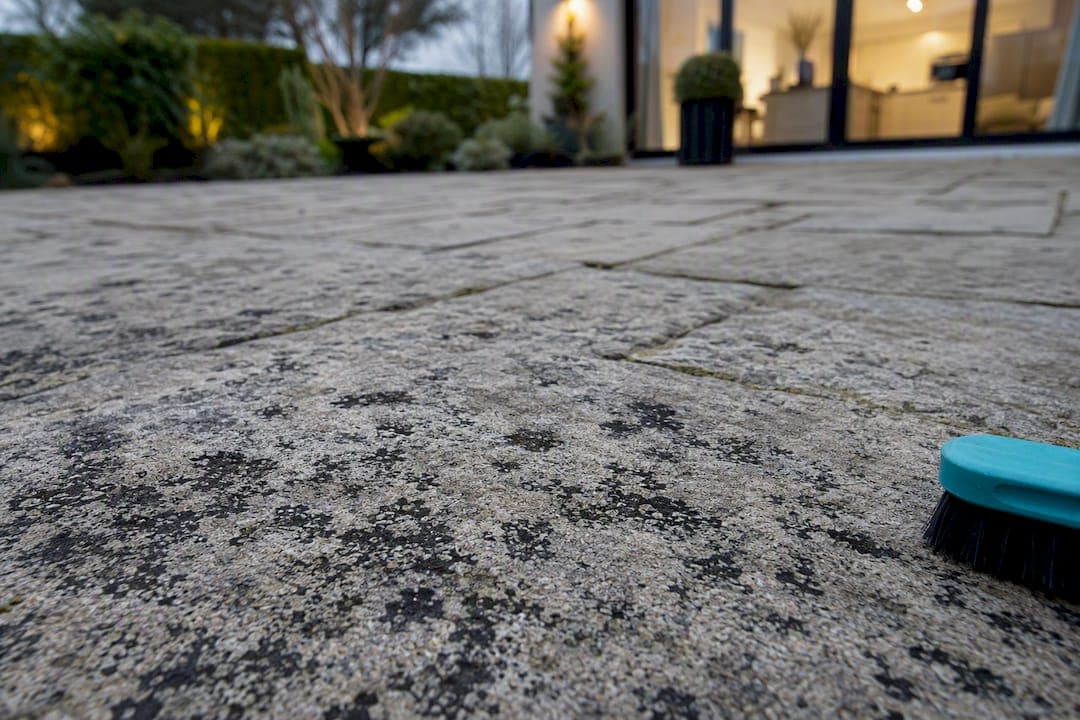
Black spots on patios are usually lichen, not dirt or mould, and the reliable fix is a specialist biocidal black-spot treatment left to dwell for several hours, followed by gentle agitation and a low-pressure rinse. Jet washing first strips the visible growth but leaves the roots intact, so spots return faster. Porous stone often needs a second application, and sealing once the surface is clean and dry helps keep it that way.
TL;DR:
- Black lichen embeds deep into porous stone and concrete by sending hyphae into the pores, making surface washing ineffective.
- Specialist biocidal gels or long-dwell sodium hypochlorite solutions are essential for killing deeply embedded lichen without damaging the surface.
- Dwell time should be tailored to the severity of growth, ranging from 1 to 3 hours for recent spots to overnight for longstanding, entrenched patches.
- Pressure washing can remove surface spots but often leaves hyphae intact, causing quick regrowth and risking surface damage.
- Sealing the patio after cleaning helps prevent future growth, but only if applied after the surface is fully dry and live lichen is removed.
Table of Contents
- What causes black spots on patios and why washing alone fails
- What you need before you start: products, tools and safety
- How do you remove black spots from a patio step by step?
- Does the removal method change by patio surface?
- How do you stop black spots coming back?
- Why trust this guide on patio black spot removal
- How do you choose a professional black spot removal service?
- What does professional black spot removal typically cost?
- When should you hire a professional instead of doing it yourself?
- What most advice on black spot removal gets wrong
- Get professional black spot removal in Dublin
- Sources
- FAQ
What causes black spots on patios and why washing alone fails
Those black spots are almost always crustose lichen, a slow-growing organism that sends tiny root-like threads, called hyphae, down into the pores of stone and concrete. It doesn't sit on the surface like dirt. It grows into it, which is why scrubbing with washing-up liquid barely touches it.
Lichen isn't the same problem as green algae, black mould in shaded corners, or an oil stain from a barbecue. Algae responds to a simple wash. Oil needs a degreaser. Lichen needs something that kills the organism at depth, which is why gel and thixotropic biocides with long dwell times are the trade standard rather than a generic patio cleaner.
Certain conditions make lichen far more likely:
- North-facing patios that stay damp and shaded for most of the day
- Areas under trees or hedges where leaf litter holds moisture against the stone
- Poor drainage that leaves puddles sitting on the surface after rain
- Older, more porous paving with rougher, more absorbent surfaces
Reaching for the pressure washer first is the most common mistake homeowners make. High pressure blasts away the visible black colouring, but the hyphae embedded in the stone survive, and the force of the water can roughen the surface, opening up more pores for the next generation of lichen to grip onto.
What you need before you start: products, tools and safety
Get the right kit together before you open a single bottle. You'll typically need one of two chemistries:
- Specialist black-spot gel or biocide — clings to vertical and textured surfaces, gives hyphae time to break down, and often includes a mild bleaching action to restore colour.
- Sodium hypochlorite solution with a surfactant — effective at killing lichen, but risks fading or etching stone if the dilution is too strong, so measured mixing matters more than with a ready-made gel.
You'll also want a garden sprayer or watering can for even application, a stiff nylon brush (never wire), a hose or low-pressure washer for rinsing, and gloves plus eye protection. Cover nearby plant beds and block off drains before you start, since run-off from biocidal products can harm soil life and waterways.
Pro Tip: Always test any product on a small, hidden corner of the patio first. Some sandstones and reconstituted slabs react differently to the same chemical, and a patch test costs you five minutes, not a discoloured patio.
How do you remove black spots from a patio step by step?
Once you've got the right product and PPE ready, the sequence matters as much as the chemical itself.
- Prepare the surface. Sweep off loose debris, moss, and leaf litter. Lightly dampen the stone rather than soaking it. A pre-dampened surface absorbs less product into the body of the stone, keeping the active chemical concentrated where the lichen actually lives.
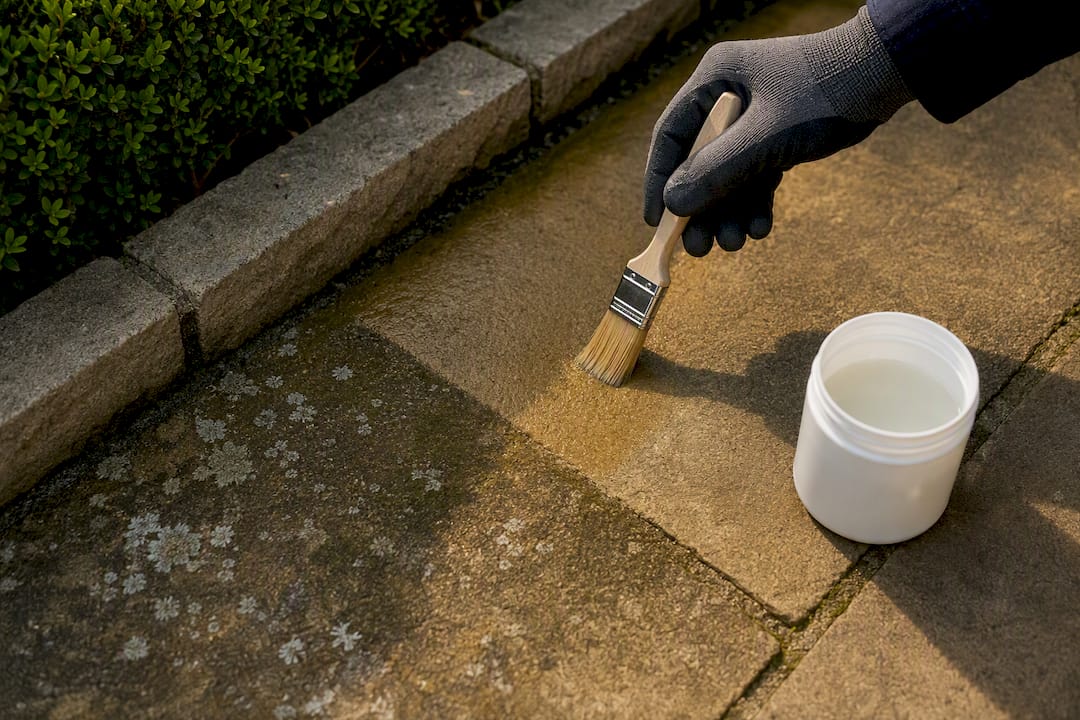
- Apply the treatment. Follow the label for dilution or use neat, depending on the product. Gel formulas are usually the better choice on textured or sloped paving because they cling rather than run off.
- Let it dwell. This is the step most homeowners rush, and it's the one that decides whether the job actually works. Light or recent growth usually needs 1 to 3 hours. Established, deep-rooted black spots often need overnight dwell, up to 24 hours.
- Agitate. Once dwell time is up, work over the spots with a stiff nylon brush to loosen the dead material.
- Rinse gently. Use a hose or a soft, low-pressure wash rather than a jet washer on full power. The goal is to flush away residue, not to blast the stone.
- Assess and repeat if needed. Let the patio dry fully, usually a day, before judging the result. Dead lichen often continues to fade over the following days as it dries out completely.
Manufacturer guidance on many specialist products recommends a 2 to 4 hour contact time as a baseline for average cases, extending that for older or heavily embedded growth. On very porous stone or long-neglected patios, expect to need two applications spaced a day or two apart rather than one heroic dose. If you'd rather not deal with the equipment, our guide to power washing patios safely covers where pressure washing still has a place, and where it doesn't.
Does the removal method change by patio surface?
It does, and getting this wrong is how patios end up damaged rather than clean.
- Sandstone is highly porous, so expect a longer dwell time and a real chance you'll need a second application. Because porous stone like Indian sandstone is the hardest to fully clear, sealing promptly after a successful clean pays off more here than on any other surface.
- Limestone is acid-sensitive. Avoid acidic cleaners entirely and go easy on the concentration of any oxidising bleach-based product, since limestone etches more readily than sandstone or concrete.
- Concrete is denser and usually only needs one treatment, but patch-test anyway. Some concrete paving is dyed or has a surface finish that reacts to strong chemicals.
- Porcelain rarely gets true lichen. Dark patches in porcelain paving are more often algae growing in the grout lines rather than the tile itself, so test any cleaner on the glazed face before treating the joints.
- Block paving needs the chemical worked into the block faces while the jointing sand is protected as much as possible. After rinsing, check the joints and follow proper re-sanding guidance, since aggressive rinsing can wash sand out and leave gaps for weeds and fresh lichen to establish.
How do you stop black spots coming back?
A successful clean is only half the job if the patio is left exposed to the same damp, shaded conditions that grew the lichen in the first place.
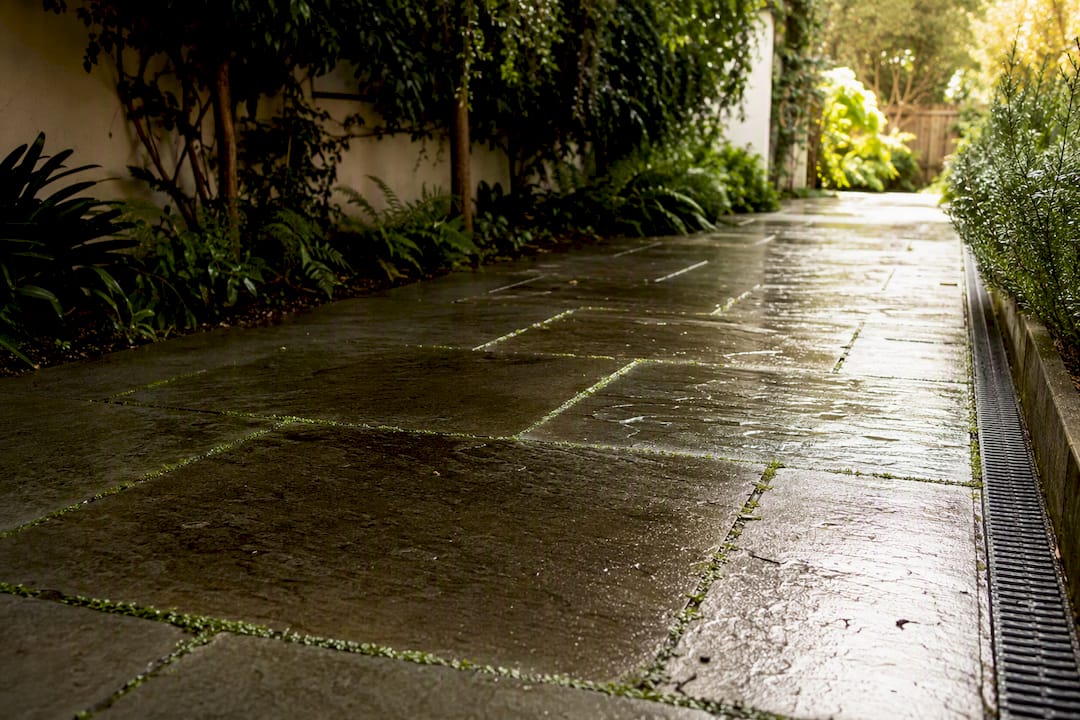
Penetrating sealers work by reducing the porosity of the stone, closing off the pores that lichen hyphae need to grip and burrow into. Wait at least 48 hours after the final rinse, and confirm the surface is completely dry, before sealing. Sealing over even slightly damp stone traps moisture underneath and can cause the sealer to fail early. Never seal over live growth. It locks the lichen in rather than out.
Beyond sealing, a few habits keep the interval between treatments much longer:
- Sweep leaves and debris off the patio regularly, especially in autumn
- Trim back overhanging branches and hedges to let light and air reach shaded corners
- Improve drainage where puddles regularly sit on the surface
- Reseal every one to three years depending on foot traffic and exposure, checking the manufacturer's guidance for your specific product
Pro Tip: Sealing after a successful treatment meaningfully extends the gap before you need to repeat the whole process, particularly on porous stone that would otherwise blacken again within a season. For general upkeep between treatments, our piece on why regular floor maintenance matters covers the drainage and cleaning habits that make the biggest difference.
Why trust this guide on patio black spot removal
This guide reflects the trade practice Sherrypropertycare applies on real Dublin driveways and patios, not a theoretical checklist. Every material behaves differently under a biocidal treatment, and that judgement comes from repeated jobs on sandstone, limestone, concrete, and block paving across varying levels of neglect.
If you'd rather read on before deciding what to do yourself, a few related guides go deeper on specific methods:
- Soft wash versus power wash: which approach suits which surface
- Re-sanding block paving: protecting joints after a clean
Sherrypropertycare offers onsite biocidal treatment, soft wash rinsing, and sealing as part of its grounds and patio care work for properties across Dublin. If your patio has resisted a DIY attempt, a bespoke quote based on photos of the affected area is the quickest way to get a professional opinion on what it will actually take.
How do you choose a professional black spot removal service?
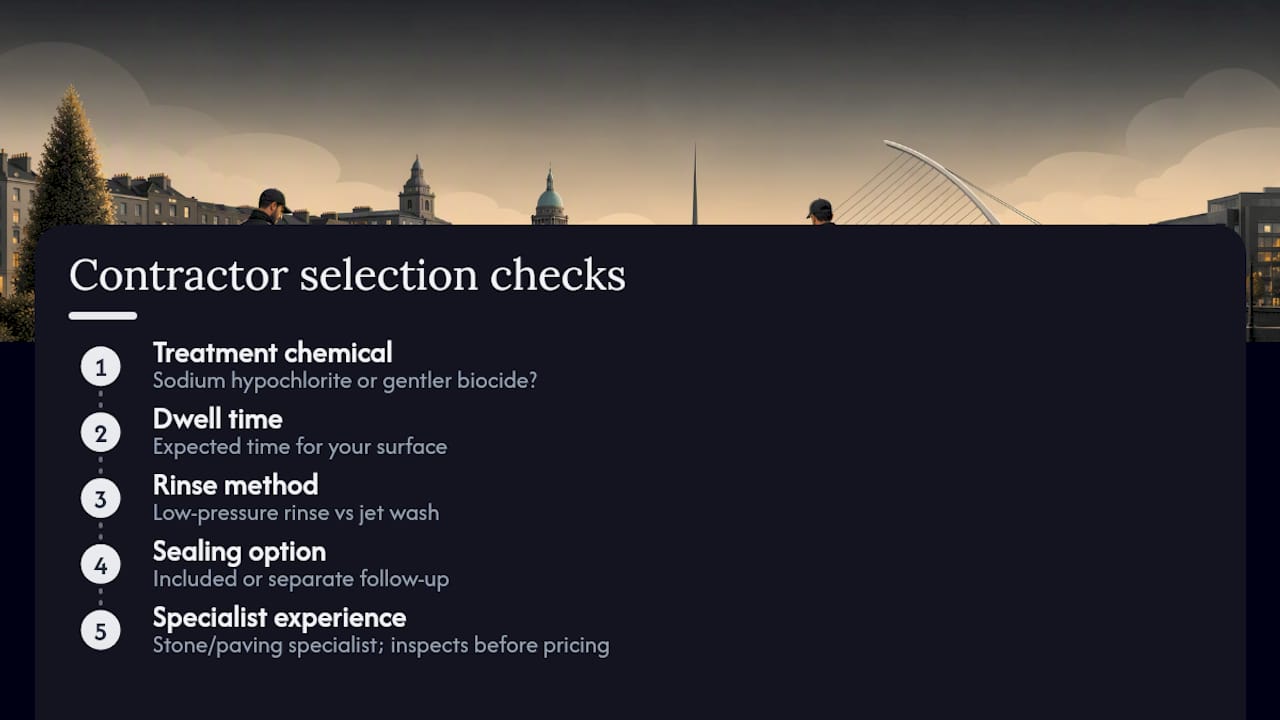
Pricing should always follow an inspection, not precede one. Reputable operators price from photos or a site visit rather than quoting a flat figure over the phone, because sandstone with deep-set, decade-old lichen takes far longer to treat than a concrete patio with light surface growth.
Ask direct questions before booking anyone. What product will they use, and will it involve sodium hypochlorite or a gentler biocide? What's the expected dwell time for your specific surface? Do they rinse at low pressure, or default to a jet wash? Will they offer sealing as part of the job, or as a separate follow-up? A contractor who can't answer these without checking isn't specialised in stone and paving, even if they do general cleaning work.
Certifications worth asking about include British Association of Landscape Industries (BALI) membership or equivalent trade body registration, along with public liability insurance, since chemical treatments carried out badly can damage a driveway or a neighbour's boundary planting.
Red flags are fairly consistent across the trade. Watch for anyone who leads with pressure washing as the primary method rather than a supporting rinse step, quotes a price with no inspection at all, or can't explain what chemical they're using and why. A general commercial cleaner listing patio cleaning services alongside dozens of other jobs is worth a closer look at their specific paving experience, not just their overall reviews.
What does professional black spot removal typically cost?
Pricing for professional patio black spot removal varies mainly with three factors: the size of the patio, the severity and age of the growth, and the surface material itself. A small concrete patio with light, recent lichen is a straightforward one-visit job. A large, heavily colonised sandstone patio that needs two applications and a sealer afterwards is a different scale of work entirely.
Most professional quotes bundle the treatment, agitation, and rinse into a single price, with sealing offered as an optional add-on once the surface has dried out. Because porous stone frequently needs a second application spaced a day or so after the first, some quotes build in a return visit as standard rather than charging it separately, which is worth asking about directly.
The honest answer on cost is that nobody can give you an accurate figure without seeing the patio. This is exactly why Sherrypropertycare asks for photos before quoting: a quote based on guesswork tends to be wrong in one direction or the other, either underselling the labour on a badly affected surface or overcharging for what turns out to be a light, one-visit job.
When should you hire a professional instead of doing it yourself?
A few signals suggest DIY has reached its limit. If the black spots cover more than a small section and have clearly been there for several seasons, the hyphae are likely embedded deeply enough that a household-strength product won't shift them, no matter how long you leave it dwelling.
Sandstone and limestone carry real risk of permanent damage from an incorrect dilution or the wrong chemical family, and a botched DIY attempt on natural stone is far harder to fix than lichen ever was. If your patio has already had one unsuccessful DIY treatment, that's usually a sign the product, dilution, or dwell time was wrong, and repeating the same mistake with more product rarely helps.
Practical constraints matter too. Treating a large patio properly, with correct dwell time and a careful low-pressure rinse, takes real time and the right equipment, particularly on sloped or multi-level paving. If drainage or run-off management is complicated by nearby beds, ponds, or a shared boundary, professional containment reduces the chance of chemical damage spreading beyond the patio itself.
What most advice on black spot removal gets wrong
The gap between generic cleaning advice and what actually works comes down to one word: patience. Most guides treat black spot removal as a cleaning problem, when it's closer to a pest control problem. You're not washing something off. You're killing an organism embedded in stone, and that takes contact time, not force.
The conventional instinct to reach for the pressure washer first is understandable but backwards. It gives instant visual satisfaction, and then the spots return within months because the roots were never addressed. Overcooking the chemical is the opposite mistake. More concentrated bleach doesn't kill lichen faster; it just increases the odds of etching or fading the stone before the dwell time has done its work.
If there's one thing worth prioritising above everything else in this guide, it's matching dwell time to the severity of the growth rather than the size of the job. A large patio with light, recent lichen needs the same one to three hour dwell as a small patch of the same age. An old, deeply established patch of black spot, however small, may need the full overnight treatment. Get that judgement right and sealing afterwards becomes a genuine long-term fix rather than a hopeful add-on.
— gerard
Get professional black spot removal in Dublin
Sherrypropertycare is the practical alternative to trial-and-error DIY treatment for black spot removal on patios across Dublin: no guesswork on dilution ratios, no risk of etching sandstone with an over-strength mix, and no repeat trips to the shop for a product that didn't work the first time.
Our team carries out onsite biocidal treatment with proper dwell time, a low-pressure soft wash rinse, and sealing once the surface is fully dry, with repeat visits built in where porous stone needs a second pass. Getting a quote is simple: send us photos of the affected area and a brief description of the surface (sandstone, concrete, block paving, or otherwise), and we'll come back with pricing based on what your patio actually needs rather than a generic day rate. If your patio in Dublin has black spots that a DIY attempt hasn't shifted, request your bespoke quote through Sherrypropertycare and let us take it from here.
Sources
- Black spots on my patio: what are they and how do I remove them?
- How to use sodium hypochlorite on patio slabs
- How to remove black spot and prevent regrowth
- How to remove black spots from patios without pressure washing
FAQ
How do you remove black spots from a concrete patio?
Apply a specialist black-spot biocide or a correctly diluted sodium hypochlorite solution, leave it to dwell for 1 to 3 hours on light growth, then agitate with a stiff brush and rinse at low pressure. Concrete is denser than sandstone, so one treatment is usually enough.
Why do patios get black spots?
Black spots are typically crustose lichen that thrives in damp, shaded conditions, particularly on north-facing patios, under trees, or wherever drainage is poor. The organism sends hyphae into the pores of the stone, which is why surface cleaning alone doesn't remove it.
Will bleach get rid of black spots on a patio?
Diluted sodium hypochlorite can kill lichen effectively, but using it too concentrated risks fading or etching the stone, so controlled dilution and a surfactant matter more than raw strength. Household bleach mixed casually tends to underperform against established growth compared with a purpose-made product.
Does Jeyes Fluid remove black spots on patios?
General household disinfectants like Jeyes Fluid aren't formulated as biocidal lichen treatments and typically lack the dwell time and clinging gel formula that specialist black-spot removers use. They may lift light surface dirt but rarely shift embedded lichen on their own.
How long should black spot remover be left on a patio?
Dwell time depends on how established the growth is: recent or light black spots usually need 1 to 3 hours, while deep-rooted or long-standing patches often need overnight, up to 24 hours. Rushing this step is the most common reason DIY treatments fail.