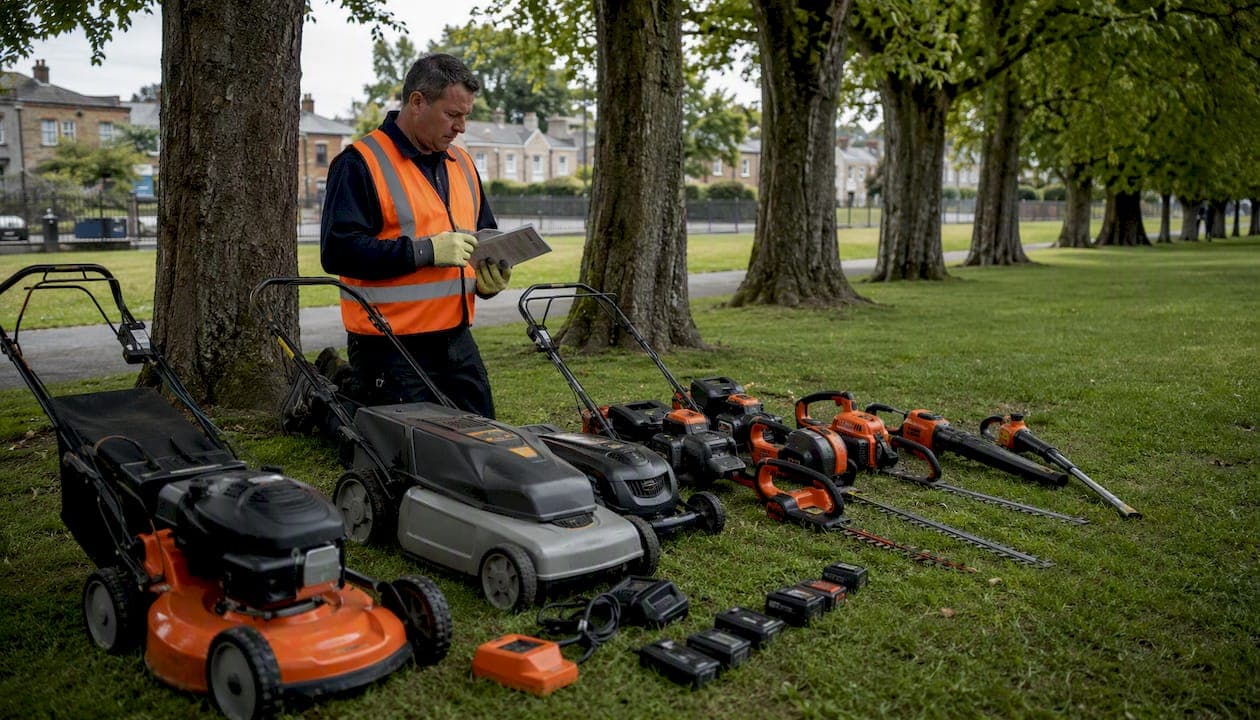
TL;DR:
- Most Dublin property owners should hire professional grounds-maintenance contractors instead of owning equipment. Buying commercial tools is only cost-effective for large estates with high utilization, while leasing suits growing or uncertain demand. PUWER and machinery regulations make operators legally responsible for equipment safety and maintenance, so most property managers prefer to outsource these responsibilities.
For most Dublin property owners and managers, hiring a professional grounds-maintenance contractor is the most practical choice. Buying commercial-grade equipment only makes financial sense when you can justify high utilisation across a large estate. Leasing suits businesses with growing or uncertain demand. Under PUWER (Provision and Use of Work Equipment Regulations 1998) and the Supply of Machinery (Safety) Regulations 2008, whoever operates the equipment carries legal responsibility for its suitability, maintenance and operator training — a burden most property owners are not equipped to manage alone.
TL;DR:
- Hire a professional (such as Sherrypropertycare) for small plots, noise-sensitive sites, or where compliance overhead is a concern.
- Buy commercial-grade only when annual utilisation is high; ride-on mowers should meet the ≥ 76 cm (30 in) cutting-width benchmark for professional efficiency.
- Lease when you need predictable costs and want to upgrade equipment as your portfolio grows.
Table of Contents
- How do the main equipment classes compare at a glance?
- What tools does every professional grounds-maintenance service need?
- How do you compare models and choose the right supplier?
- Battery, petrol or corded: which power source suits your site?
- What are your legal obligations under PUWER and the Machinery Regulations?
- Does buying equipment actually save money for Dublin properties?
- How should property managers run equipment day to day?
- Key takeaways
- A practical view on equipment decisions for Dublin grounds maintenance
- Sherrypropertycare: professional grounds maintenance across Dublin
- Useful UK sources, regulations and further reading
- FAQ
How do the main equipment classes compare at a glance?
| Equipment class | Best for | Power source | Cutting width / capacity | Duty cycle | Noise / emissions | Typical purchase price | Maintenance burden | Transport / storage | Attachments |
|---|---|---|---|---|---|---|---|---|---|
| Ride-on / commercial mower | Large turf | Petrol / battery | ≥ 76 cm (30 in) | Full day with refuel | High / moderate | — | High — dealer servicing | Trailer + secure shed | Mulch, collector, roller |
| Walk-behind rotary / cylinder | Small–medium lawns | Petrol / battery / corded | 30 cm minimum cutting width | 1–4 hrs | Moderate / low | — | Moderate | Van or trailer | Scarifier, roller |
| Commercial hedge trimmer | Ornamental beds & hedges | Battery / petrol | — | 1–3 hrs battery | Low–moderate | — | Low–moderate | Van storage | Extended reach pole |
| Backpack blower | Seasonal cleanup, paths | Petrol / battery | N/A | 2–6 hrs | Moderate / low | — | Low | Van storage | None |
| Aerator / scarifier | Lawn renovation | Petrol / electric | — | Half day | Moderate | — | Moderate | Trailer or van | Scarifier cassette |
| Pressure washer | Patios, paths, power washing | Corded / petrol | N/A | Continuous (corded) | Moderate | — | Low–moderate | Van storage | Surface cleaner, lance |
| Multi-attachment system | Mixed small-site tasks | Petrol / battery | Varies by head | 2–5 hrs | Low–moderate | — | Low | Van storage | Trimmer, edger, blower, tiller |
Ownership model summary:
- Ride-on mowers: buy only for large commercial estates with daily use; hire for everything else.
- Walk-behinds and hedge trimmers: buy or lease if you manage multiple sites regularly; hire for occasional use.
- Aerators and scarifiers: hire or outsource — low seasonal use rarely justifies ownership.
- Pressure washers: buy a mid-range corded unit for regular patio and path work; hire petrol units for heavy jobs.
What tools does every professional grounds-maintenance service need?
Commercial grounds-maintenance services rely on a broader toolkit than most property owners realise. Here are the core categories and why the commercial-grade versions matter for Dublin properties:
- Ride-on and zero-turn mowers: Commercial ride-ons with a professional-grade cutting width handle professional workloads efficiently. Residential models wear out quickly under daily use and lack the dealer-support networks that keep a professional crew productive.
- Walk-behind rotary and cylinder mowers: Rotary suits general turf; cylinder delivers a finer, striped finish for prestige lawns. Commercial decks use heavier-gauge steel and carry longer warranties.
- Commercial hedge trimmers: Extended-reach pole trimmers let operators work safely from the ground on tall hedges, reducing ladder risk on Dublin's terraced and apartment-block sites.
- Backpack blowers: Faster and more ergonomic than handheld units for clearing paths and car parks after leaf fall or grass cutting.
- Aerators and scarifiers: Aerators improve soil health; scarifiers remove thatch — both are seasonal tools that separate basic lawn cutting from genuine long-term grounds management.
- Pressure washers: Standard kit for patio cleaning, path maintenance and power washing on Dublin's older stone and brick surfaces.
- Multi-attachment systems: One power unit drives a trimmer, edger, blower or tiller head — practical for compact vans and mixed urban sites.
Pro Tip: Battery tools are now standard for noise-sensitive and emission-regulated sites, while petrol remains the choice for heavy-duty, long-duration cutting. A blended fleet — petrol ride-on mower plus battery handhelds — covers most Dublin scenarios without sacrificing performance or breaching local noise restrictions.
How do you compare models and choose the right supplier?
Evaluating equipment on total cost of ownership rather than sticker price consistently favours commercial-grade machines for high-utilisation sites. Here is a practical checklist:
- Match equipment to your service profile. List every task you need to perform, then confirm each machine covers it. A residential vs commercial property has very different duty-cycle demands.
- Prioritise dealer support and parts availability. A mower sitting idle waiting for a spare part costs more than the part itself.
- Check warranty terms in writing. Request the service schedule, warranty duration and spares lead time before committing.
- Assess operator ergonomics. Anti-vibration handles, adjustable controls and seat suspension reduce fatigue and injury risk on longer Dublin jobs.
- Confirm trailer fit and gate clearance. Many Dublin properties have narrow access; verify machine width against your smallest gate before purchase.
Key specs to compare directly:
- Cutting width: wider = fewer passes per job, faster turnaround on large turf.
- Engine power / battery voltage: higher voltage delivers more torque and broader attachment compatibility.
- Deck construction: fabricated steel decks outlast pressed steel on commercial sites.
- Run time / refuel time: battery runtime determines how many sites you can complete before a recharge stop.
- Attachment compatibility: shared battery platforms across trimmers, blowers and hedge cutters reduce both cost and van weight.
Battery, petrol or corded: which power source suits your site?
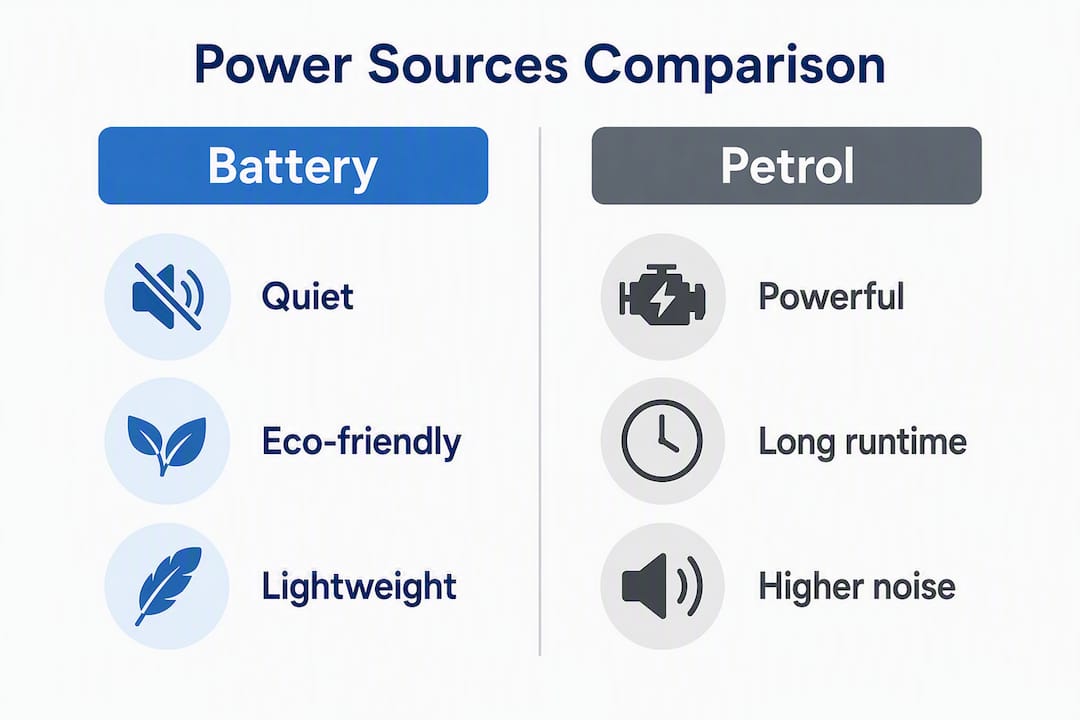
Professional suppliers consistently recommend a blended strategy: battery handhelds for noise-sensitive work, petrol for heavy-duty tasks.
Battery (Li-ion):
- Low noise output — suitable for early-morning starts at Dublin apartment blocks, hospitals and schools.
- Zero local emissions — no fumes in enclosed courtyards or basement-level gardens.
- Less routine servicing (no oil, filters or spark plugs).
- Runtime limits apply; shared battery platforms across tools reduce cost and charging complexity.
Petrol:
- Highest power output for heavy-duty cutting and long-duration jobs.
- Refuel anywhere — no dependency on mains power or charging infrastructure.
- Higher noise and emissions; may conflict with Dublin residential noise restrictions before 8 AM.
Corded electric:
- Continuous power with no runtime limit — ideal for pressure washers and static workshop tools.
- Mobility is restricted by cable length; unsuitable for large open sites or areas without mains access.
Scenario guide:
- Early-morning apartment complex maintenance: battery handhelds only.
- Large open park or sports ground: petrol ride-on mower with battery trimmers.
- Hospital or school grounds: full battery fleet where possible; petrol only for heavy cutting outside restricted hours.
- Patio and path cleaning: corded pressure washer for continuous use; petrol unit for remote sites.
What are your legal obligations under PUWER and the Machinery Regulations?
Under PUWER, employers and dutyholders must ensure work equipment is suitable for its intended purpose, maintained in efficient working order, and that operators receive adequate information, instruction and training before use. Maintenance operations must be organised to avoid unnecessary risk.
The Supply of Machinery (Safety) Regulations 2008 place design and construction responsibility on manufacturers, but operators and service providers must keep equipment safe throughout its working life. For property owners and managers, the practical obligations are:
- Confirm equipment is appropriate for the task and site conditions before use.
- Keep a maintenance log per machine — service dates, faults found and remedial action taken.
- Retain operator training records; untrained use is a legal breach, not just a safety risk.
- Carry out pre-use inspections and record findings.
- Arrange planned maintenance at manufacturer-specified intervals.
If you outsource to a contractor, ask for:
- Evidence of operator training and certification.
- Current public liability and employers' liability insurance.
- Maintenance logs and service history for equipment used on your site.
- Confirmation of compliance with HSE mobile work equipment guidance.
Good maintenance practice for property owners reduces both legal exposure and equipment downtime.
Does buying equipment actually save money for Dublin properties?
The decision rule is straightforward: compare annual utilisation hours against total cost of ownership (purchase price, fuel or charging costs, servicing, depreciation and storage) versus the cost of hiring a professional.
| Ownership model | Best suited to | Typical cost driver | Hidden costs to budget |
|---|---|---|---|
| Buy outright | High-utilisation commercial estates | Purchase + servicing + storage | Trailer, secure shed, staff training, PUWER compliance |
| Lease | Growing portfolios, uncertain demand | Monthly lease payment | Service contract, insurance, operator training |
| Hire a professional | Most residential and small commercial sites | Per-visit or contract fee | None — contractor carries compliance burden |
Scheduled maintenance and maintenance logs materially reduce surprise breakdowns and extend equipment life — a cost that owners carry but contractors absorb internally. Common hidden ownership costs include trailer upgrades, secure ventilated storage, annual servicing contracts and the time cost of PUWER record-keeping.
For most Dublin landlords managing one to three properties, the annual cost of professional grounds-maintenance contracts is lower than the combined capital, storage and compliance cost of owning commercial-grade equipment. The best property maintenance services handle all of this on your behalf.
Buy vs hire decision rules:
- Own if you manage a large commercial estate with daily mowing needs and dedicated grounds staff.
- Lease if your portfolio is growing and you want to upgrade equipment without capital commitment.
- Hire a professional for all other scenarios — particularly where PUWER compliance, noise restrictions or seasonal-only use applies.
How should property managers run equipment day to day?
Practical operations come down to three areas: storage, maintenance and scheduling.
- Storage: keep equipment in a secure, ventilated space with a designated battery-charging area away from flammable materials. Petrol must be stored in an approved container.
- Transport: confirm your vehicle and trailer combination meets the machine's weight and width requirements; check gate clearance at every new Dublin site.
- Daily checks: inspect blades, belts, fluid levels and safety guards before each use; log any defects immediately.
- Seasonal maintenance: full service at the start and end of the cutting season; blade sharpening every 20–25 operating hours.
- PPE: operators should wear hearing protection, safety footwear, eye protection and gloves as a minimum.
- Scheduling: avoid early-morning petrol equipment use in residential areas; battery tools give you flexibility on start times.
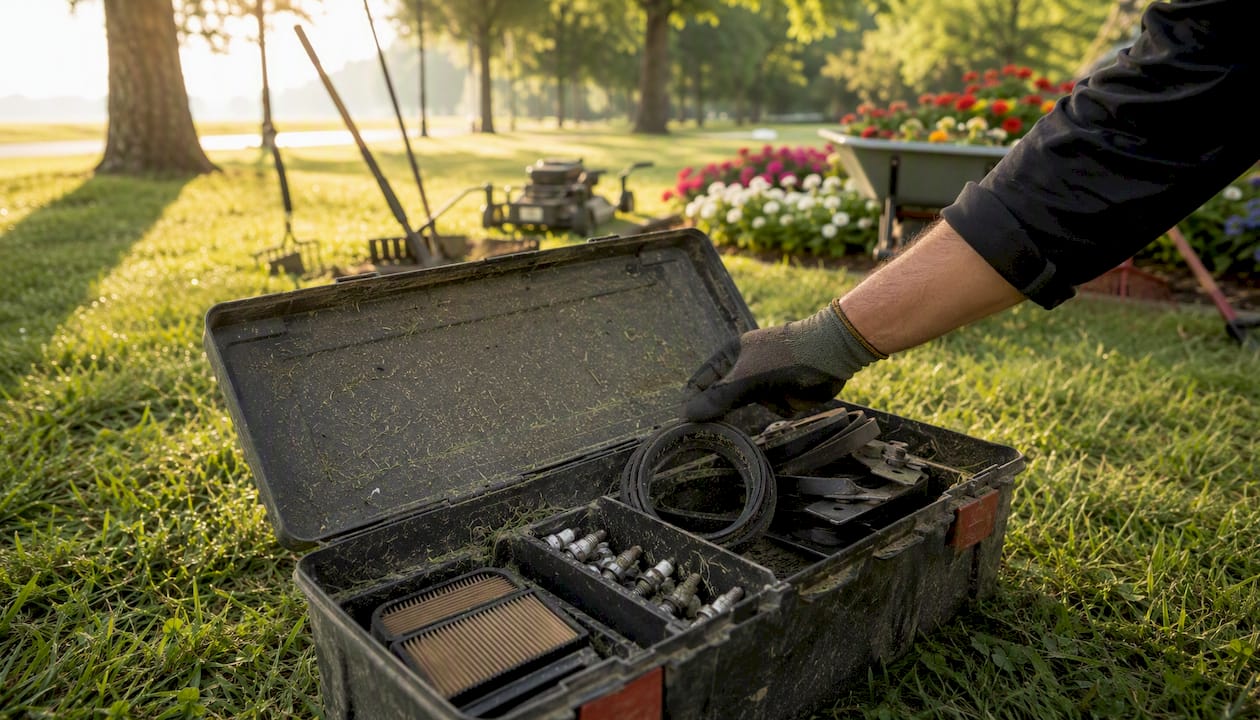
Pro Tip: Keep a small spares kit in your van: a spare blade set, drive belt, air filter and spark plugs. Battery platforms that share cells across tools also reduce the number of spare batteries you need to carry, cutting both weight and cost.
Key takeaways
For most Dublin properties, hiring a professional grounds-maintenance contractor is more cost-effective and legally straightforward than owning or leasing commercial equipment.
| Point | Details |
|---|---|
| Hire beats buy for most sites | Ownership only makes financial sense for large commercial estates with daily, high-utilisation needs. |
| Commercial-grade spec matters | Ride-on mowers should meet the ≥ 76 cm (30 in) cutting-width benchmark for professional efficiency. |
| PUWER compliance is non-transferable | Whoever operates the equipment is legally responsible; always request training records and maintenance logs from any contractor. |
| Blended fleets work best in Dublin | Battery handhelds for noise-sensitive sites, petrol for heavy cutting — most professional crews run both. |
| Sherrypropertycare covers Dublin | Sherrypropertycare provides trained operators, commercial-grade equipment and full compliance for residential and commercial properties across Dublin. |
A practical view on equipment decisions for Dublin grounds maintenance
The conventional wisdom says that owning your equipment gives you control. For a large commercial estate with a full-time grounds team, that holds. For the vast majority of Dublin landlords and property managers, it does not.
The real cost of ownership is rarely the purchase price. It is the storage space you cannot spare, the servicing appointment that falls during your busiest letting period, and the PUWER paperwork that nobody on your team has time to maintain properly. Battery platforms have genuinely changed the calculus for noise-sensitive urban sites — an early-morning apartment block job that would have generated complaints with a petrol blower is now straightforward with a good Li-ion backpack unit. But that still requires the right machine, a trained operator and a maintenance log behind it.
What actually works for most Dublin properties is a professional contractor who already carries all of that overhead. The equipment decision has already been made, the compliance is handled, and you get a consistent result without the capital outlay. The cases where ownership wins are narrower than most people assume.
Sherrypropertycare: professional grounds maintenance across Dublin
Sherrypropertycare is the direct alternative to managing your own equipment and compliance burden for grounds maintenance in Dublin. Rather than investing in commercial-grade machinery, storage, servicing and PUWER record-keeping, you get trained operators, the right tools for your site, and a customised quote based on your property's actual needs.

Services cover lawn care, hedge trimming, aeration, scarification, patio cleaning and power washing — the full range of tasks covered in this guide, handled by a team that already meets noise restrictions and carries the necessary insurance and training records. Whether you manage a single residential property or a commercial estate across Dublin, Sherrypropertycare can carry out a site survey and provide a clear, no-obligation quote.
Request a quote for your Dublin property and let Sherrypropertycare handle the equipment, compliance and scheduling for you.
Useful UK sources, regulations and further reading
- PUWER Approved Code of Practice and Guidance L22 (HSE) — the primary reference for employer duties on work equipment suitability, maintenance and operator training.
- The Provision and Use of Work Equipment Regulations 1998 (legislation.gov.uk) — full statutory text of PUWER.
- The Supply of Machinery (Safety) Regulations 2008 (legislation.gov.uk) — manufacturer and operator obligations for machinery safety.
- HSE mobile work equipment guidance — specific requirements for self-propelled and remote-controlled equipment, including rollover protection and operator vision.
- Husqvarna UK commercial landscaping equipment — reference for commercial turf and grounds-care equipment ranges available in the UK market.
Retain a copy of the service schedule and warranty terms for every machine on site, and request the same documentation from any contractor before work begins.
FAQ
What does PUWER require from Dublin property owners?
PUWER requires that any work equipment used on your property is suitable, properly maintained and operated only by trained personnel. If you hire a contractor, ask for evidence of training records and maintenance logs.
What cutting width should a commercial ride-on mower have?
A professional ride-on mower should have a cutting width of at least 76 cm (30 in) to handle commercial workloads efficiently. Narrower residential models wear out quickly under daily professional use.
When does buying grounds-maintenance equipment make financial sense?
Ownership makes sense for large commercial estates with daily, high-utilisation needs and dedicated grounds staff. For most Dublin landlords managing a small number of properties, hiring a professional contractor is more cost-effective once storage, servicing and compliance costs are factored in.
Which power source is best for noise-sensitive Dublin sites?
Battery (Li-ion) tools are the practical choice for early-morning starts at apartment blocks, hospitals and schools, as they produce significantly lower noise and zero local emissions compared to petrol equivalents.
What should you ask a grounds-maintenance contractor before hiring them?
Ask for current public liability insurance, evidence of operator training and certification, maintenance logs for equipment used on your site, and confirmation that their fleet meets the relevant PUWER and Machinery Regulations requirements. Sherrypropertycare can provide all of this on request.