
Grounds maintenance is the planned, ongoing care of every outdoor area attached to a property, including lawns, planted beds, trees, hard standing and drainage. For a property manager, it is normally delivered by an in-house team, a contractor, or a hybrid of both, and the three things to check first are worker and visitor safety, visible presentation standards, and a contract that spells out scope in plain, measurable terms.
TL;DR:
- Detailed site mapping and measurable standards ensure clear scope and reduce disputes between property managers and contractors.
- Seasonal work should be scheduled based on weather and growth patterns, with contingency plans for weather disruptions and safety priorities in winter.
- Performance tracking through photographic evidence and documented visits strengthens enforcement and simplifies contract renewals.
- Clear communication with clients involves regular, visual updates and specified response times for reactive issues to build trust.
- Focusing on a precise, output-based specification and thorough record-keeping offers better control than merely setting visit frequencies.
Table of Contents
- What does grounds maintenance for property managers actually cover?
- What tasks and seasonal schedule should managers plan for?
- How do you write a grounds maintenance specification and contract?
- How do you manage suppliers and check quality on site?
- Practitioner tips from a grounds maintenance professional
- Common challenges and how to fix them
- How should managers communicate with clients about grounds work?
- What actually matters in a grounds maintenance contract
- Get a tailored grounds maintenance quote from a professional grounds maintenance provider
- Sources
- FAQ
What does grounds maintenance for property managers actually cover?
Grounds maintenance for property managers means more than "someone cuts the grass." It is a defined package of outdoor services tied to a specific site, with clear boundaries on who does what and how often. Tractian's definition of grounds maintenance frames it as ongoing, planned care across lawns, planted beds, pathways, car parks, drainage and related hard surfaces, split between routine tasks and seasonal ones.
That distinction between routine and seasonal work matters when you are building a specification. Routine tasks (mowing, litter picking, weed control) happen on a fixed cycle. Seasonal or specialist tasks (major tree work, drainage clearance, autumn leaf clearance) happen at specific points in the year and often need different skills or equipment.
Before you write a single clause into a contract, map the site properly. An annotated plan with measurements for every area saves arguments later, because "the grounds" is not one thing. It is a collection of distinct spaces, each with its own upkeep needs:
- Lawns and amenity grass — measured in square metres, with a stated cutting height and frequency band.
- Planted beds and shrub borders — weeding, pruning, mulching and seasonal planting where relevant.
- Trees — inspection, pruning, and removal or works that need a qualified arborist.
- Hard standing — paths, car parks and patios needing sweeping, weed control and occasional power washing.
- Drainage runs and gullies — clearance to prevent standing water and surface damage.
- Litter and waste areas — bin stores, communal bin collection points and general site tidiness.
Responsibility often splits along a line between routine maintenance (grass, hedges, litter) handled on a standard visit, and specialist works (tree surgery, drainage repairs, hard surface reinstatement) quoted separately. Get that split written down. A vague scope is the single most common cause of disputes between managers and contractors, because "maintenance" means something different to every supplier who quotes for it.
What tasks and seasonal schedule should managers plan for?
Grounds work follows the seasons, not the calendar month, so a sensible schedule bends around growth rates and weather rather than fixed dates. Year-round programmes consistently beat reactive call-outs on cost and appearance, because planned commercial grounds maintenance preserves asset value and reduces long-term costs compared with fixing problems after they appear.
A practical year, broken into the four main phases, looks like this:
- Spring (March to May) — first cuts as growth resumes, edging, bed clearance, early weed control, and inspection of winter storm damage.
- Summer (June to August) — peak mowing frequency, hedge trimming outside bird nesting season, irrigation checks, and litter management at its highest demand.
- Autumn (September to November) — reduced cutting frequency, major leaf clearance, drainage inspection ahead of winter rain, and bulb or shrub planting.
- Winter (December to February) — reduced routine visits, tree inspection for storm risk, gritting or ice management on paths, and structural hedge or tree work while plants are dormant.
Cutting heights and timing windows are where vague contracts fall apart. A well-specified lawn might call for grass kept within a specific height range in the growing season, with visits more frequent in peak summer and less frequent in winter. Hedge trimming windows usually avoid the main bird nesting period, typically during spring and summer months, unless a specific safety or access issue forces an exception.
Pro Tip: Build a "wet weather" contingency clause into your seasonal plan. Ask your contractor how a missed visit due to weather gets rescheduled, not just whether it does.
Winter also needs a safety-first mindset that differs from summer priorities. Path gritting, storm-damage tree checks and drainage clearance ahead of heavy rain protect people and the building fabric, even though the grounds look less "busy" than in June. A property manager who only measures success by how green the lawn looks in August will miss half the job.
How do you write a grounds maintenance specification and contract?
A specification is the document that turns "keep the grounds tidy" into something you can measure, price and enforce. Without one, you are relying on goodwill, and goodwill does not survive a change of contractor or a change of site manager.
Well-drafted contracts specify service schedules, measurable performance standards, site maps and clear exclusions, which is exactly what reduces disputes later, according to guidance on ground maintenance contracts for property managers. Your specification should include:
- A site map showing every area covered, with measurements and reference numbers matching the task list.
- A task list by area, stating exactly what happens on each visit type.
- Frequencies, expressed as a range or minimum (e.g. "grass cut fortnightly, March to October").
- Materials and equipment standards, including any restrictions on chemical treatments near watercourses or play areas.
- Exclusions, naming anything not covered so nobody assumes it is included by default.
Performance standards work best when they describe the finished result rather than a checklist of inputs. That output-based approach is a pattern seen across public sample grounds maintenance specifications, which set measurable standards like grass sward length by season and hedge trimming windows rather than simply listing hours worked. It gives you something to check against on a site visit, and it removes room for argument about whether a visit "counted."
Contract terms that protect both sides should cover duration and renewal (commonly one to three years, with an annual price review), insurance requirements, health and safety obligations, and a variation procedure for extra works outside the base scope.
A short extract might read:
That kind of clause gives both sides a shared, checkable standard, which is worth far more than a paragraph of general reassurance.
How do you manage suppliers and check quality on site?
Good supplier management comes down to three habits: agreeing the right measures, inspecting consistently, and knowing when to escalate. Recording photographic evidence on each visit and keeping time-stamped reports is one of the clearest ways to improve supplier performance and simplify contract renewals, because it turns "the grounds looked fine last time I checked" into a documented record you can point to.
Useful KPIs to track include:
- Visit compliance — were scheduled visits completed on time and at the agreed frequency?
- Presentation standard — does the site meet the sward length, weed-free and litter-free benchmarks in the spec?
- Response time for reactive issues like fallen branches or blocked drains.
- Rectification turnaround when a visit is flagged as substandard.
Structure inspections around a simple routine: a walk-round with a checklist matching the specification's task list, dated photographs of key areas, and a short written note logged against each visit. Build a defined rectification window into the contract, commonly a short but reasonable timeframe for minor issues, with an escalation route to a contract manager if the same fault repeats.
Some jobs need a specialist, not a general contractor. Significant tree works or anything raising a safety concern should go to a qualified arborist, and blocked or damaged drainage runs often need a dedicated drainage contractor rather than a groundskeeper trying to solve it on a routine visit. Grounds maintenance manager roles typically require specific competence in plant care, machinery and safety, so it is reasonable to ask any supplier for evidence of relevant training before you sign.
Practitioner tips from a grounds maintenance professional
Working across grounds contracts, the same specification gaps come up again and again. Cutting frequency gets stated, but cutting height often does not, which leaves both sides guessing what "cut" actually means. Hedge timing gets left out entirely, so a contractor trims at the wrong point in the season and nobody notices until a resident complains.
Briefing landlords and tenants works best kept short: what happens on each visit, how often, and who to contact if something is missed. Long explanations get skimmed. A one-page summary of the specification, shared with residents at the start of the season, prevents most of the queries that would otherwise land on a manager's desk mid-contract.
Common challenges and how to fix them
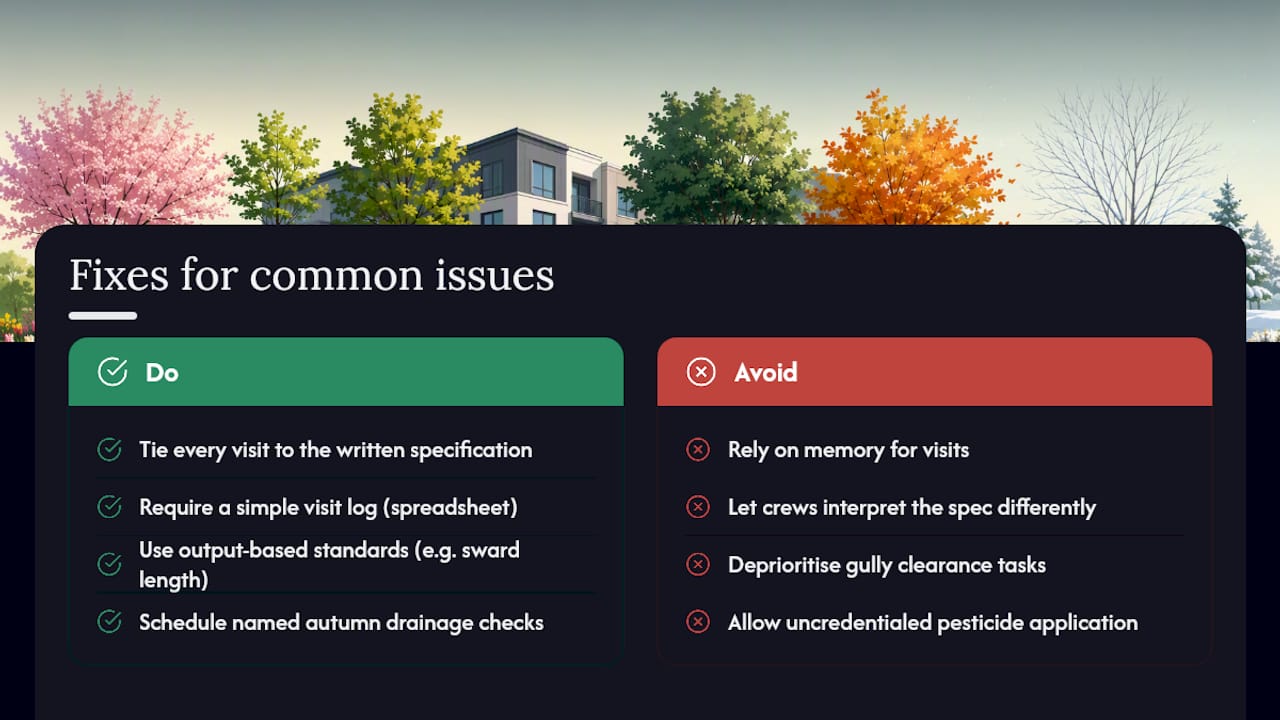
Missed visits are the most frequent complaint managers raise, usually caused by a supplier working from memory rather than a documented schedule. Fix it by tying every visit to the written specification and asking for a simple visit log, even a basic spreadsheet, so gaps are visible before they become a pattern.
Inconsistent presentation standards between visits, where the grounds look sharp one week and neglected the next, almost always trace back to different crew members interpreting the spec differently. Output-based standards (a stated sward length, a weed-free border) close that gap because they leave less room for personal judgement.
Drainage problems tend to surface at the worst time, usually after the first heavy autumn rain, because gully clearance gets deprioritised against more visible tasks like mowing. Building drainage checks into the autumn schedule as a named task, not an afterthought, avoids the flooded car park phone call. CIRIA's guidance on civil infrastructure is a useful reference point when aligning grounds drainage work with wider sustainable drainage expectations on larger sites.
Chemical treatments raise a different challenge: liability. Confirm any contractor applying pesticides or weedkillers can evidence proper training, since safe pesticide handling courses exist precisely because misapplication near watercourses or public areas creates real risk. Ask for the certificate before the first treatment, not after a complaint.
How should managers communicate with clients about grounds work?
Landlords and residents rarely want a detailed maintenance log. They want to know the site is being looked after and who to ask if it is not. A short, regular update, monthly is usually enough, covering what was done, what is scheduled next, and any issues flagged, keeps queries from piling up.
Visit reports work best when they are visual rather than written. A dated photograph of a freshly cut lawn or a cleared drain tells a resident more in three seconds than a paragraph of text ever will. Pair that with a brief written note against each report so there is a record if a dispute ever arises later.
For larger sites with multiple stakeholders, a simple shared log, even a basic spreadsheet accessible to the managing agent and the client, cuts down on repeated phone calls asking "has the grass been done yet." It also gives you a paper trail if a contractor's performance needs to be reviewed at renewal.
Set expectations early about response times for reactive issues. A fallen branch or blocked drain reported by a tenant needs a stated turnaround, not an open-ended "we'll get to it." Committing to a number, even a modest one like 48 hours for non-urgent issues, builds trust faster than any amount of reassurance.
What actually matters in a grounds maintenance contract
Most guidance on this subject focuses on frequency: how often the grass gets cut, how often the hedges get trimmed. That is the wrong starting point. Frequency without a measurable output standard tells you nothing about quality, and quality is what a resident or landlord actually notices.
The specification is doing more work than most managers give it credit for. A contract that states a sward length and a weed-free standard is enforceable in a way that "regular mowing" never is. That is not a paperwork exercise, it is the difference between a supplier who can be held to a standard and one who can always claim they did their best.
The other underrated habit is documentation. A photograph and a timestamp on every visit turns a vague sense that "the grounds have gone downhill" into evidence you can act on at contract renewal. Managers who skip this step are negotiating from a weaker position every single time.
Prioritise the specification and the record-keeping before you worry about which contractor to hire. Get those two things right, and supplier choice becomes a much smaller problem to solve.
— gerard
Get a tailored grounds maintenance quote from a professional grounds maintenance provider
If you manage residential or commercial property and want grounds maintenance that runs on a clear schedule rather than guesswork, a professional provider can handle the full range: lawn care, hedge trimming, landscaping, patio and garden cleaning, and power washing for hard standing.

Getting a quote is straightforward. Send photos of the areas needing attention, a rough site plan if you manage a larger property, and your preferred visit frequency. From there, expect a proposed visit plan matched to your site, a written quote, and ongoing reporting so you always know what has been done and when the next visit falls. It works the same way whether you are overseeing a single block or a small portfolio.
For background on setting up a maintenance routine before you contact a contractor, this guide to maintenance audits for landlords and managers is a useful starting point. When you are ready, request your personalised quote through the Sherry Property Care landing page.
Sources
For further reading when drafting your own specification, the following are worth bookmarking:
- Grounds Maintenance: Definition
- Ground Maintenance Contracts: Guide for Property Managers in 2025
- Grounds maintenance specification (sample PDF)
- The case for year‑round commercial grounds maintenance
- Grounds maintenance manager (Lantra)
Always check current local regulations on pesticide use and waste disposal before finalising a contract.
FAQ
What services are included in grounds maintenance?
Grounds maintenance typically covers lawn cutting, hedge and shrub care, tree inspection or works, hard standing cleaning, drainage clearance, and litter management, with specialist works like arboriculture often quoted separately.
What is the role of a property manager in grounds maintenance?
A property manager sets the specification, selects and oversees the contractor or in-house team, checks performance against agreed standards, and manages communication with landlords and tenants.
How often should grounds maintenance visits happen?
Frequency varies by season. Lawns are commonly cut weekly to fortnightly in peak growing months and monthly or less in winter, with hedges trimmed once or twice yearly outside nesting season.
Who should carry out grounds maintenance work?
Routine tasks can be handled by an in-house team or a general contractor, while specialist work such as significant tree surgery or drainage repairs should go to a qualified arborist or drainage specialist. Providers cover the full routine range for such properties.
What should a grounds maintenance contract include?
A solid contract includes a site map, a detailed task list, stated frequencies, measurable performance standards, exclusions, insurance requirements, and a clear variation procedure for extra works.