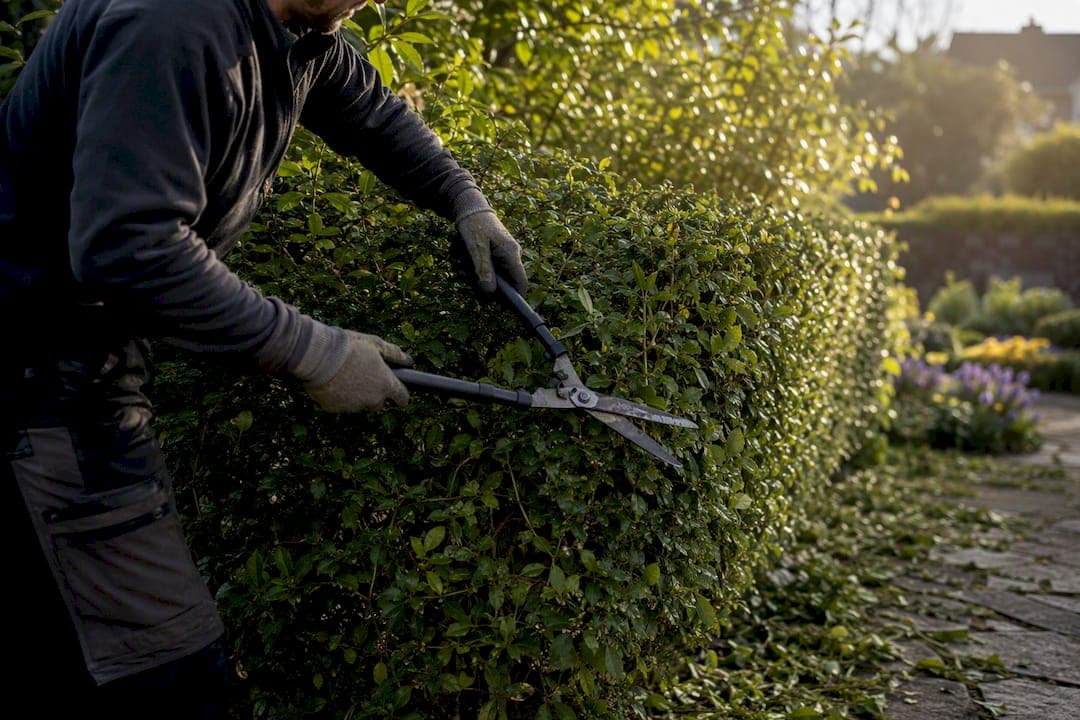
If you're planning to cut a hedge in Ireland, the law gives you one clear window: 1 September to 28 February. Between 1 March and 31 August, cutting, grubbing, burning or otherwise destroying hedgerow vegetation is prohibited under Section 40 of the Wildlife Act 1976. Some official guidance phrases this slightly differently, but the practical rule for landowners never changes: nesting season is off limits.
Here's what to do right now:
- Book hedge trimming for the permitted window, September through February.
- Stop work immediately if you spot an active nest, even outside the closed season.
- Never burn hedge cuttings or vegetation during March to August.
- Check guidance from the National Parks and Wildlife Service or talk to Sherrypropertycare if you're unsure whether your job qualifies for an exemption.
Key Takeaways
Lawful hedge cutting in Ireland runs from 1 September to 28 February, with Section 22 protecting nests and eggs year round regardless of the season.
| Point | Details |
|---|---|
| Know the closed season | Cutting, grubbing or burning hedgerow vegetation is banned from 1 March to 31 August under Section 40. |
| Nest protection never stops | Section 22 makes disturbing an active nest an offence at any time of year, exemption or not. |
| Exemptions are narrow | Road safety, genuine emergencies and limited agriculture/horticulture works apply, but none override nest protection. |
| Keep records | Photos, contractor insurance and written quotes protect you if NPWS or the local authority ever queries a job. |
| Book professional help | Sherrypropertycare schedules Dublin hedge trimming within the legal window and checks for nests before cutting begins. |
Table of Contents
- What the law says: Section 40, Section 22 and nesting protection
- When can you legally cut a hedge outside the closed season?
- What are a landowner's duties under the Roads Act?
- What penalties apply for illegal hedge cutting in Ireland?
- How to trim hedges without harming wildlife
- A Dublin homeowner's practical hedge cutting checklist
- Do you need to tell your neighbours before cutting a hedge?
- Hedge cutting near protected habitats and Natura 2000 sites
- Do you need signage when cutting hedges legally?
- Why the conventional advice on hedge cutting misses the point
- Book hedge cutting with Sherrypropertycare in Dublin
- Sources
- FAQ
What the law says: Section 40, Section 22 and nesting protection
Section 40 of the Wildlife Act 1976 makes it an offence to cut, grub, burn or otherwise destroy vegetation growing in hedges or on uncultivated land between 1 March and 31 August. The Irish Statute Book sets out the statutory wording, and NPWS guidance confirms that permitted trimming generally runs from 1 September to 28 February.
That's only half the picture. Section 22 of the same Act protects wild birds' nests and eggs at all times, not just during the closed season. Cut a hedge in November and disturb an occupied nest, and you can still fall foul of the law.
NPWS guidance is direct on this point: vegetation removal is permitted from September to February, but wilfully destroying or disturbing a nest or eggs remains an offence regardless of the calendar date.
Enforcement isn't theoretical. NPWS brought 31 prosecutions under Section 40 in a single year, and the Department of Housing, Local Government and Heritage regularly issues public reminders as the closed season approaches. If you're a Dublin landowner assuming nobody checks, that assumption is wrong.
When can you legally cut a hedge outside the closed season?
Exemptions exist, but they're narrower than most people assume, and none of them override Section 22's nest protection.
- Road safety — Section 70 of the Roads Act 1993 allows felling, lopping or trimming to remove a genuine hazard to road users, such as a hedge blocking sightlines at a junction.
- Ordinary agriculture or horticulture — routine farming or garden management can qualify, but this exemption is riskier than it sounds. Guidance from the Department treats it cautiously, and if the work disturbs an active nest, a Section 22 prosecution is still possible.
- Development and construction works — permitted where planning consent covers the works, though sites within a Special Area of Conservation or Special Protection Area may need an Appropriate Assessment before any vegetation is touched.
- Genuine emergencies — a fallen branch blocking access, storm damage, or similar. Burning vegetation is never permitted during the closed season, emergency or not.
Relying on the horticulture exemption for a summer tidy-up is the mistake we see most. Plan the non-urgent work for the permitted window instead.
What are a landowner's duties under the Roads Act?
If your hedge borders a public road, the Roads Act places a duty on you to prevent hazards, meaning overgrown branches obscuring signage or visibility are your responsibility to fix, not the council's. Where trimming is genuinely urgent for safety and falls within the closed season exemption, proper traffic management matters. Louth County Council's guidance on hedge, verge and tree cutting notes that failing to manage traffic safely during roadside works can create additional liability if an accident follows.
Before any work near a public road, here's a sensible sequence:
- Contact your local authority to confirm whether the works need notification or a permit.
- Photograph the hazard and the hedge before cutting, to have a record if questioned later.
- Keep written quotes and correspondence from any contractor engaged.
- Confirm the contractor carries public liability insurance and understands nest-check obligations.
- If the site sits near a designated habitat, contact NPWS or the local authority before proceeding.
Pro Tip: Keep a simple folder, digital or paper, with dated photos and contractor correspondence for every hedge job. If a complaint is ever made, that record is the difference between a five-minute conversation and a formal investigation.
What penalties apply for illegal hedge cutting in Ireland?
Breaching Section 40 is a criminal offence, and enforcement is active rather than nominal. Press coverage has reported fines ranging from roughly €1,000 to €6,000 for illegal cutting during the closed season, alongside NPWS's 31 prosecutions in a recent year.
For farmers, there's a second layer of risk. Removing or damaging hedgerows without following Teagasc's conditionality guidance can trigger penalties under CAP conditionality rules, plus a requirement to replant a specified length of replacement hedgerow. Complaints are typically handled by NPWS, with An Garda Síochána and local authorities involved where road safety or public land is affected.
How to trim hedges without harming wildlife
Cutting everything back in one go, right at the start of September, is legal but not necessarily the best approach for the hedge or the birds relying on it. Staggering trimming along a long boundary, doing sections in different years, preserves nesting cover and leaves berries for wildlife over winter.
Practical habits worth adopting:
- Cut on a triangular profile (wider at the base) to keep the hedge dense and thorny at ground level, which supports more nesting species long term.
- Leave some standing dead wood where it's safe to do so; it's valuable habitat for insects and small birds.
- Check Teagasc's advice on hedge dormancy, which recommends working while hedges are genuinely dormant, typically deeper into the September to February window rather than right at its edges.
- Where hedgerow removal is unavoidable, follow the replacement-length rules under CAP conditionality rather than assuming a like-for-like swap is optional.
Pro Tip: If you're planning new hedging alongside maintenance work, choosing species suited to Irish conditions pays off within a couple of seasons. Our guide to privacy hedge plants for Irish gardens covers what actually thrives here.
A Dublin homeowner's practical hedge cutting checklist
Gerard at Sherrypropertycare has walked plenty of Dublin gardens where the hedge looks fine in July and the owner just wants it "sorted" before the closed season starts. The legal answer is always the same: wait, or prove the exemption genuinely applies.
Before hiring anyone, ask for:
- Confirmation the contractor checks for active nests before cutting.
- Evidence of public liability insurance.
- A written quote specifying the work and timing.
- Traffic management competence, if the hedge borders a road.
A typical Dublin garden timeline looks like this: book the job in late August for a September start, request a pre-cut nest check on the day, and schedule any replacement planting for the same visit if hedges are being thinned rather than simply shaped.
Do you need to tell your neighbours before cutting a hedge?
There's no statutory requirement in Ireland for a homeowner to formally consult neighbours before trimming a hedge on their own property. That said, a boundary hedge is rarely a one-sided matter in practice, and a quick conversation avoids most disputes before they start.
If the hedge sits directly on a boundary line, both sides technically have an interest in it, and cutting only your face of it while leaving the other side untouched often looks patchy and can spark a disagreement about who's responsible for what. A short heads-up, especially if machinery, ladders, or access to their side of the garden is involved, tends to smooth this over.
Where the work is happening near a shared driveway, footpath, or public road, informing neighbours becomes more practical than optional. Green waste, branches, or temporary access restrictions affect anyone using that space, and a courteous note through the letterbox costs nothing.
There's one scenario where consultation moves closer to a genuine obligation: disputes over hedge height between neighbouring residential properties can fall under local authority mediation processes in some circumstances, separate from the wildlife legislation covered elsewhere in this guide. If a hedge dispute has already escalated, that's a conversation for your local authority rather than a DIY fix.
For routine maintenance, though, the practical rule is simple: cut within the legal window, be considerate about noise and debris, and give neighbours reasonable notice when the work will affect them directly.
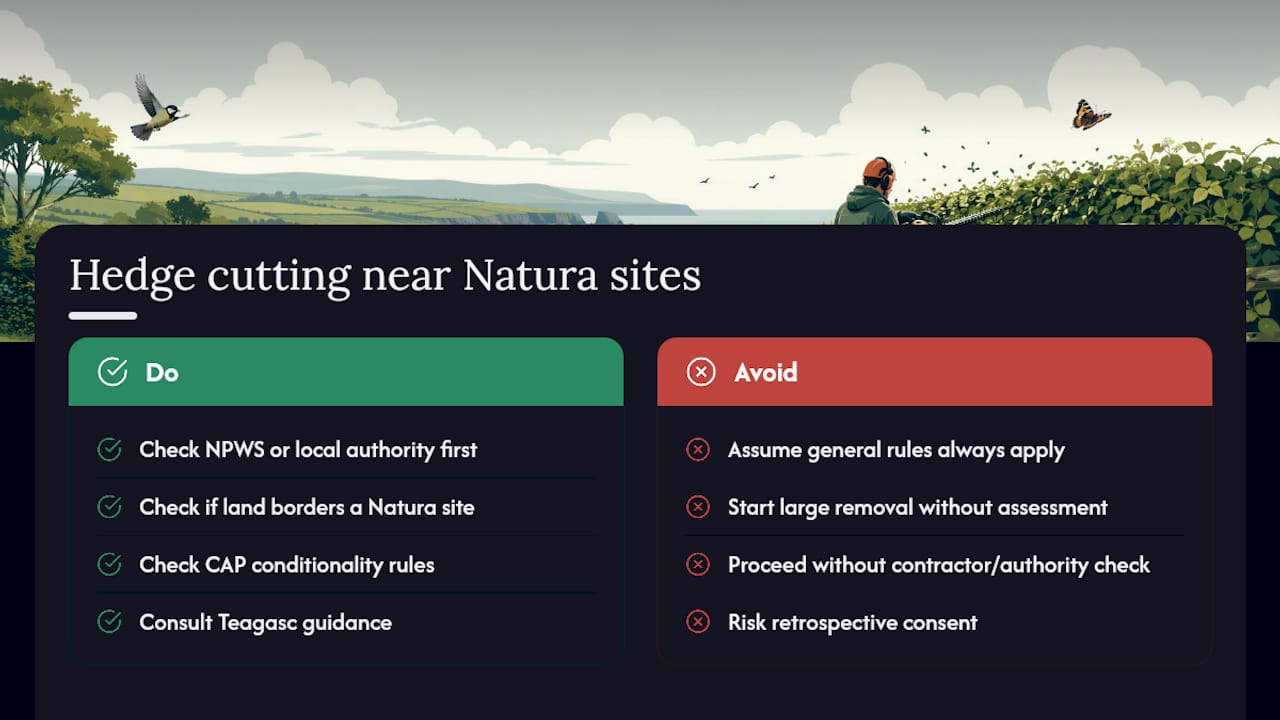
Hedge cutting near protected habitats and Natura 2000 sites
Standard Section 40 rules apply everywhere in Ireland, but land within or adjacent to a Natura 2000 site, meaning a Special Area of Conservation (SAC) or Special Protection Area (SPA), carries an extra layer of scrutiny that many landowners don't expect.
Hedgerows within these designated sites often form part of the qualifying habitat the designation exists to protect, not just incidental boundary features. Works that would be routine on an ordinary property, including some activities that would qualify for the standard exemptions covered earlier, may require an Appropriate Assessment before they can proceed if there's a risk of significant effect on the protected habitat or the species it supports.
This matters most for development works, larger-scale removal, or any job that goes beyond straightforward trimming. If your property borders a designated site, or you're not sure whether it does, the sensible first step is checking with NPWS or your local authority before committing to a contractor or a start date. Assuming the general rules apply without checking is the most common way landowners in these areas end up needing retrospective consent, which is a far more difficult and costly process than asking beforehand.
Farmers operating land within or near these designations should also check whether CAP conditionality rules impose additional retention requirements on hedgerows specific to that site, on top of the general replacement-length obligations that apply nationally. Teagasc's guidance on hedgerow removal rules is the right starting point for confirming what applies to a specific parcel of land.
Do you need signage when cutting hedges legally?
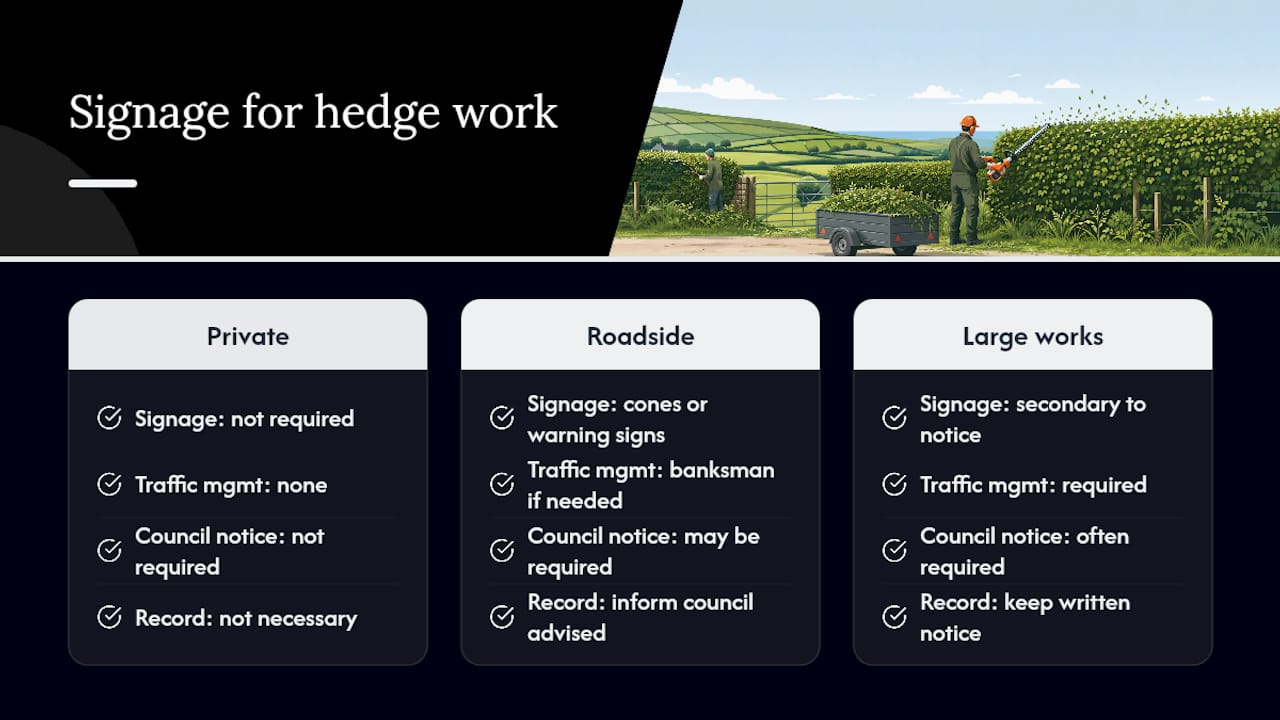
There's no general legal requirement for a homeowner or landowner to erect public signage simply because they're trimming a hedge during the permitted September to February window. For most residential and small commercial jobs in Dublin, a professional contractor working safely on private property needs no formal notification to the public at all.
The picture changes once the work affects a public road or footpath. If cutting, machinery, or debris temporarily restricts a footpath or affects sightlines for road users, standard traffic management practice, cones, warning signs, or a banksman where appropriate, becomes a practical necessity even without a specific bylaw naming hedge work. This ties directly into the landowner's duty under the Roads Act to prevent hazards: signage that warns approaching traffic of temporary works is part of discharging that duty responsibly, not an optional courtesy.
Local authorities may also require notification, rather than public signage, before roadside works commence, particularly where a road opening licence or a temporary road closure is involved. That's a conversation to have with the council directly rather than something to assume either way.
For larger-scale agricultural or development works near a public road, particularly anything Section 70 covers as a safety exemption, keeping a written record of when the local authority was informed matters more than any sign posted on site. If a query or complaint arises later, that record demonstrates the work was carried out with proper regard for public safety, not carried out quietly and hoping nobody noticed.
Why the conventional advice on hedge cutting misses the point
Most guidance on hedge cutting in Ireland treats the closed season as a box to tick: avoid March to August, done. That's not wrong, but it's incomplete, and it lets people underestimate the real exposure, which is Section 22.
The dates matter less than the habit of checking. A landowner who cuts in October without glancing for a late nest carries real legal risk, while one who cuts in July after confirming no birds are present, under a genuine exemption, is on firmer ground than the calendar alone suggests. The law is built around outcomes for wildlife, not a rigid timetable.
The other gap in typical advice is enforcement literacy. Fines and prosecutions get reported as headlines, but few homeowners realise that a written record, photos, contractor insurance, a dated quote, is what actually protects them if a complaint is made. That's not paperwork for its own sake. It's the difference between a quick explanation and a drawn-out investigation.
If there's one priority for Dublin landowners: choose contractors who treat nest checks as routine, not as an afterthought when asked.
— gerard
Book hedge cutting with Sherrypropertycare in Dublin
Sherrypropertycare handles the legal timing so you don't have to track statutory dates yourself. We schedule hedge trimming within the permitted September to February window, check for active nests before any cutting starts, and keep the kind of written records that protect you if a query ever comes from the local authority or NPWS.

That matters because getting this wrong isn't just a fine risk, it's the stress of an unexpected complaint landing on your desk months after the job's done. We serve residential and commercial properties across Dublin, from routine boundary trimming to larger grounds maintenance jobs, always with a customised quote based on your property. If you've read this far wondering whether your hedge job qualifies for the permitted window, or whether an exemption genuinely applies, send us a photo of the hedge and we'll give you a straight answer along with a quote. Get in touch through Sherrypropertycare to book your slot before the September rush fills up.
Sources
- Bird nesting season and vegetation removal (NPWS guidance FAQ)
- Irish Statute Book: Wildlife Act 1976 — Section 40
- Gov
- Teagasc — Hedgerow removal rules and regulations (conditionality guidance)
FAQ
What months are you not supposed to cut hedges in Ireland?
You should not cut, grub or burn hedgerow vegetation between 1 March and 31 August, the closed season set out under Section 40 of the Wildlife Act 1976.
What month should you trim your hedges?
The safest months are deeper into the permitted window, September to February, when hedges are dormant and nesting activity has ended for the year.
What months can you not cut trees in Ireland?
The same closed season, 1 March to 31 August, applies to vegetation on uncultivated land generally, though larger tree works can also require separate tree preservation order checks with your local authority.
Is hedge cutting illegal in Ireland?
Hedge cutting itself isn't illegal, but cutting during the closed season without a valid exemption is an offence, and NPWS has pursued prosecutions with fines reported between roughly €1,000 and €6,000. Booking work within the permitted window with a contractor like Sherrypropertycare removes that risk entirely.