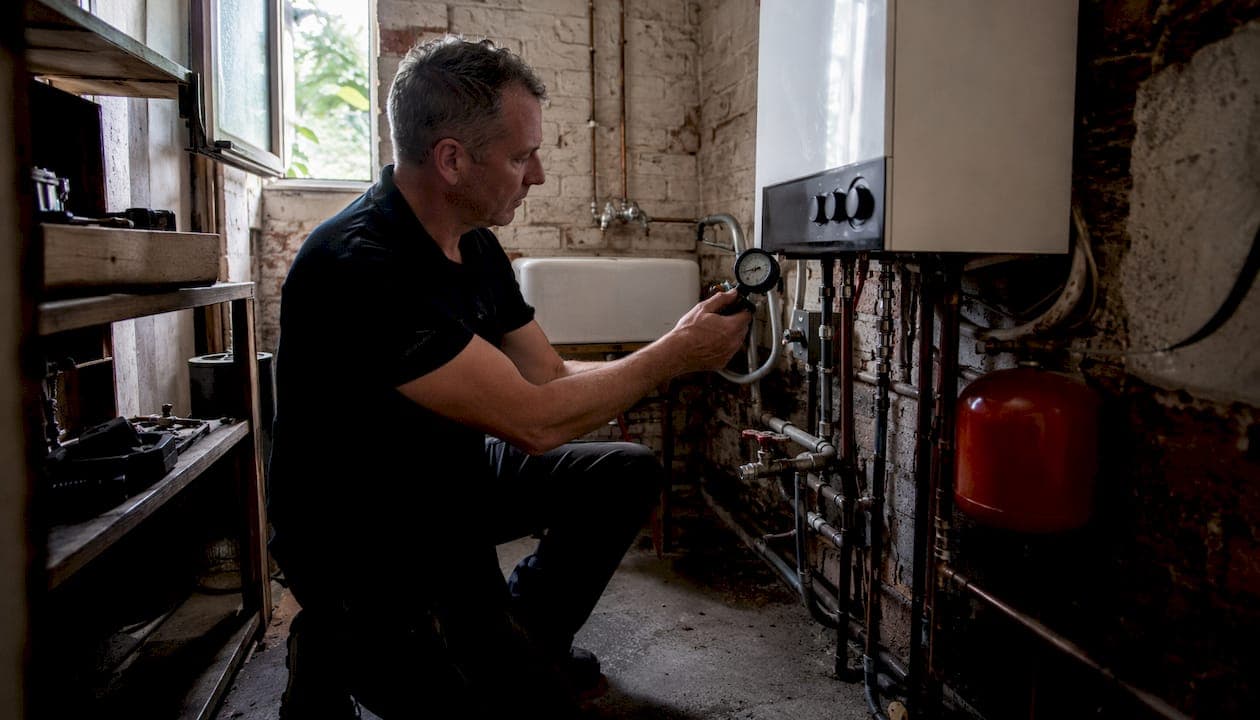
An annual service by a Gas Safe registered engineer, combined with a short seasonal checklist and a few simple DIY checks, is the most reliable way to keep a property heating system safe, efficient, and legally compliant. For Dublin property owners and managers, that means acting before winter arrives, not during it.
Act on these now:
- Check boiler pressure when the system is cold. The correct range is 1.0–1.5 bar; anything outside that needs attention before you switch the heating on for the season.
- Clear the area around the boiler. Nothing stored nearby, no obstructions to ventilation.
- Test your carbon monoxide alarm. If it has not been tested recently, do it today.
- Note the date of the last boiler service. If it was more than 12 months ago, book a Gas Safe engineer now.
- Budget for the service. A typical annual boiler service costs £79–£120 and takes around 40–60 minutes.
Landlords have an additional legal duty. Under the Landlord and Tenant Act 1985 and the Gas Safety (Installation and Use) Regulations 1998, you must keep heating systems in proper working order and carry out annual gas safety checks. The Energy Saving Trust recommends annual servicing to maintain efficiency and keep manufacturer warranties valid.
Table of Contents
- What should you check at the start and end of each heating season?
- What does a proper heating maintenance schedule look like?
- How do you carry out safe DIY heating checks?
- What are landlords legally required to do under UK law?
- When should you call a Gas Safe engineer?
- How can you cut heating bills without losing comfort?
- How does heating upkeep fit into wider property maintenance?
- Key takeaways
- A property maintenance perspective
- Useful sources
- FAQ
What should you check at the start and end of each heating season?
Autumn and start of heating season
- Bleed radiators before switching the heating on fully. Cold tops or gurgling sounds mean trapped air.
- Check boiler pressure when cold (1.0–1.5 bar). Re-pressurise if it has dropped.
- Test the thermostat and programmer. Set a schedule that matches occupancy.
- Run the heating for 15–20 minutes and walk the property. Cold spots on radiators signal sludge or air.
- Confirm the carbon monoxide alarm is within its test date.
Winter
- Keep the boiler area clear throughout the season.
- Monitor pressure every couple of weeks. A steady drop suggests a small leak.
- Listen for banging, whistling, or gurgling. These need a professional look.
Spring and end of season
- Reduce running hours gradually as temperatures rise.
- If radiators were consistently cold at the bottom despite a warm boiler, schedule a system flush before next winter.
- Log any repairs or faults noticed during the season.
Pro Tip: Book your Gas Safe engineer visit in late summer or early autumn. Winter demand pushes waiting times up sharply, and an autumn appointment means any faults are fixed before the first cold snap.
For a broader seasonal property checklist, the seasonal property maintenance tips resource from Sherrypropertycare covers what to schedule and when across the whole property.
What does a proper heating maintenance schedule look like?
A full annual service covers combustion checks, heat exchanger inspection, filter cleaning, controls testing, and a written service certificate. It takes around 40–60 minutes. Repair work, if needed, is charged separately.
| Task | Frequency | Who does it | Typical cost |
|---|---|---|---|
| Annual boiler service | Yearly | Gas Safe engineer | £79–£120 |
| Gas Safety Certificate (CP12) | Yearly (landlords) | Gas Safe engineer | Varies by area |
| Pressure check | Monthly | Property staff | No cost |
| Radiator bleeding | Start of season / as needed | Property staff | No cost |
| Thermostat and controls check | Seasonal | Property staff | No cost |
| Magnetic filter clean | Annually (during service) | Gas Safe engineer | Often included |
| Radiator balancing | Every 2–3 years or when uneven | Gas Safe engineer | Varies |
| System flush (powerflush) | Every 3–5 years | Gas Safe engineer | Varies |
Statistic: A typical annual boiler service usually costs between £79 and £120 and takes about 40 to 60 minutes. Skipping it risks voiding the manufacturer warranty and missing small faults that become expensive winter breakdowns.
Focusing only on the boiler is a common mistake. Neglecting wider system elements such as magnetic filters, radiator balancing, and sludge removal causes efficiency drops even when the boiler itself passes its service.
How do you carry out safe DIY heating checks?
Property staff can safely handle a handful of tasks without specialist training. Everything else stays with a Gas Safe engineer.
Checking boiler pressure
- Wait until the system is fully cold. Checking while the boiler has been running gives a falsely high reading and can lead to unnecessary venting.
- Locate the pressure gauge on the boiler front panel.
- The needle should sit in the typical range of about 1.0 to 1.5 bar when cold. Below this means re-pressurising is needed.
- To re-pressurise, open the filling loop valve slowly until the gauge reaches 1.2–1.3 bar, then close it immediately.
- Re-check after bleeding radiators, as bleeding lowers system pressure.
Bleeding a radiator
- Switch the heating off and allow radiators to cool.
- Place a cloth under the bleed valve.
- Insert a radiator key and turn anti-clockwise by about 90 degrees.
- A hiss means air is escaping. When water runs steadily, close the valve.
- Check boiler pressure afterwards and re-pressurise if needed.
Testing thermostats and programmers
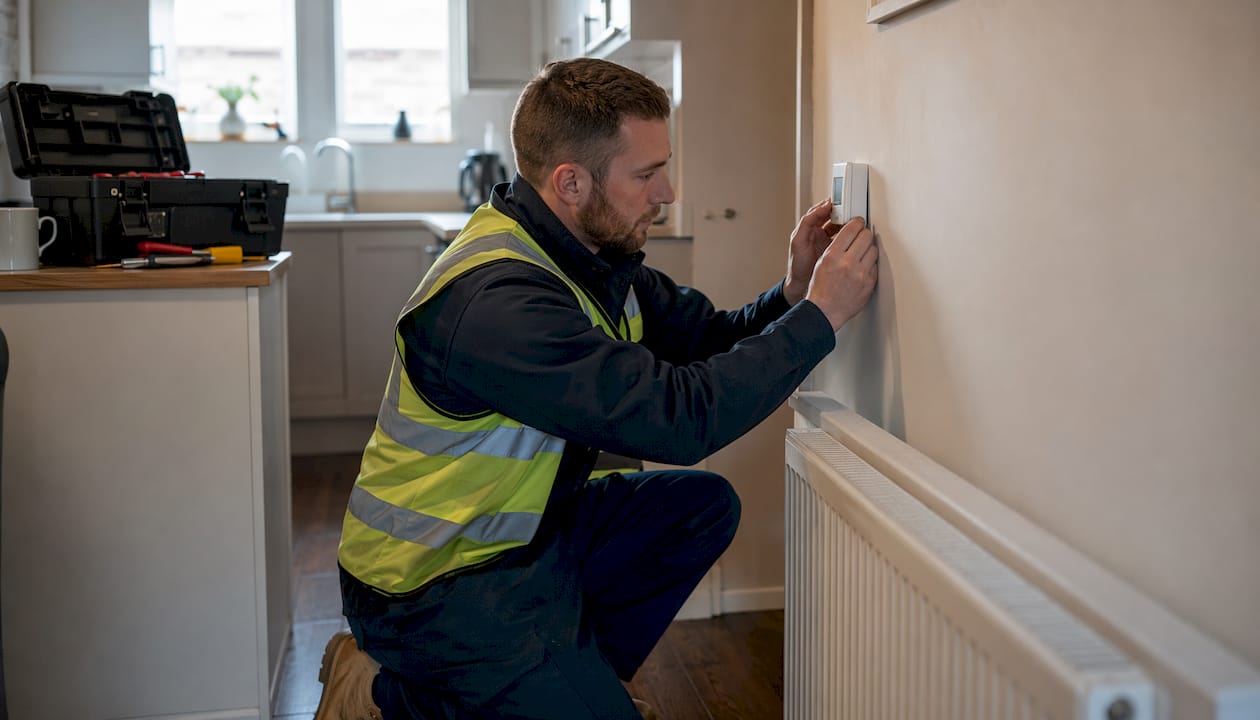
- Set the thermostat above the current room temperature and confirm the boiler fires.
- Check the programmer clock is correct, especially after power cuts.
- Replace thermostat batteries every six months.
Safety rules — never cross these lines:
- Always isolate electrical power before touching controls or wiring.
- Never open sealed combustion chambers or gas connections.
- Never attempt gas repairs yourself. Call a Gas Safe registered engineer.
For a broader overview of what homeowners can safely handle themselves, the HVAC maintenance guide from Sherrypropertycare is a practical starting point.
What are landlords legally required to do under UK law?
A Gas Safety Check is a pass/fail inspection confirming the appliance is safe to use right now. A full boiler service goes further: it cleans the heat exchanger and burner, checks the expansion vessel, tests controls, and produces a service record. Most manufacturers require that service record to keep the warranty valid. Booking both together saves on call-out fees and satisfies both the legal and warranty requirements in one visit.
Landlord compliance checklist:
- Obtain a CP12 certificate every 12 months from a Gas Safe engineer.
- Provide a copy to existing tenants within 28 days of the check.
- Give new tenants a valid certificate before they move in.
- Keep every gas safety certificate for at least two years.
- Fit and test a carbon monoxide alarm in every room with a gas appliance.
- If a tenant refuses access, document every contact attempt in writing.
For more on landlord duties in Dublin and the UK, the landlord maintenance responsibilities guide from Sherrypropertycare covers the key obligations clearly.
When should you call a Gas Safe engineer?
Call immediately if you notice any of these:
- A smell of gas anywhere near the boiler or pipework. Switch off the gas supply at the meter and ventilate the property before calling.
- The carbon monoxide alarm activates. Evacuate, then call the Gas Emergency Service on 0800 111 999.
- Repeated unexplained pressure loss over a short period.
- Persistent pilot light failure or ignition problems.
- Sudden complete loss of heat and hot water.
- Banging, kettling, or persistent gurgling that does not clear after bleeding.
For rental properties, industry practice is to restore heating or provide a temporary solution within 24–48 hours in winter. If parts are delayed beyond that, provide plug-in electric heaters to keep the property habitable.
Tell the engineer:
- Date of the last service and any error codes displayed.
- Exact symptoms and when they started.
- Whether vulnerable occupants are present.
- Whether you want radiator balancing, a magnetic filter clean, or a powerflush assessed at the same visit.
How can you cut heating bills without losing comfort?
Modest changes to controls and behaviour deliver the most accessible savings.
- Set a schedule. Programme the heating to match actual occupancy rather than running continuously.
- Lower the flow temperature on combi boilers where safe. Many modern boilers run efficiently at lower flow temperatures without reducing comfort.
- Use thermostatic radiator valves (TRVs) to avoid overheating unused rooms. Check TRV pins at the start of each season; they seize over summer.
- Thermostat discipline. According to the Energy Saving Trust, raising the thermostat by just 1°C increases heating bills by around 10%.
Longer-term measures worth planning:
- Radiator balancing for even heat distribution.
- Magnetic filter installation and annual cleaning to reduce sludge.
- Pipe insulation in lofts and outbuildings to retain heat and prevent freezing.
- Draught-proofing doors and windows to reduce heat loss.
A well-serviced system running clean water is also a more efficient one. Systems with clean water can run noticeably more efficiently and reduce strain on the boiler.
How does heating upkeep fit into wider property maintenance?
Regular heating maintenance reduces emergency callouts and protects property value, in the same way that consistent grounds maintenance keeps external assets in good condition. Both are planned, scheduled, and far cheaper than reactive repairs.
Practically, aligning boiler servicing with seasonal grounds visits reduces access disruption. A single planned maintenance day can cover a heating check, a grounds inspection, and any minor repairs, rather than three separate visits.
- Combine autumn heating checks with pre-winter grounds preparation.
- Add heating pressure and thermostat checks to the same job sheet as seasonal lawn and hedge work.
- Use a maintenance log that covers both internal systems and external grounds, so nothing slips between visits.
Sherrypropertycare works with property owners and managers across Dublin to plan and coordinate exactly this kind of joined-up maintenance. The planned maintenance examples resource shows how to structure a schedule that covers the full property.
Pro Tip: Add a heating pressure check and carbon monoxide alarm test to the same job sheet as your seasonal grounds inspection. Two minutes per visit, and nothing gets missed.
Key takeaways
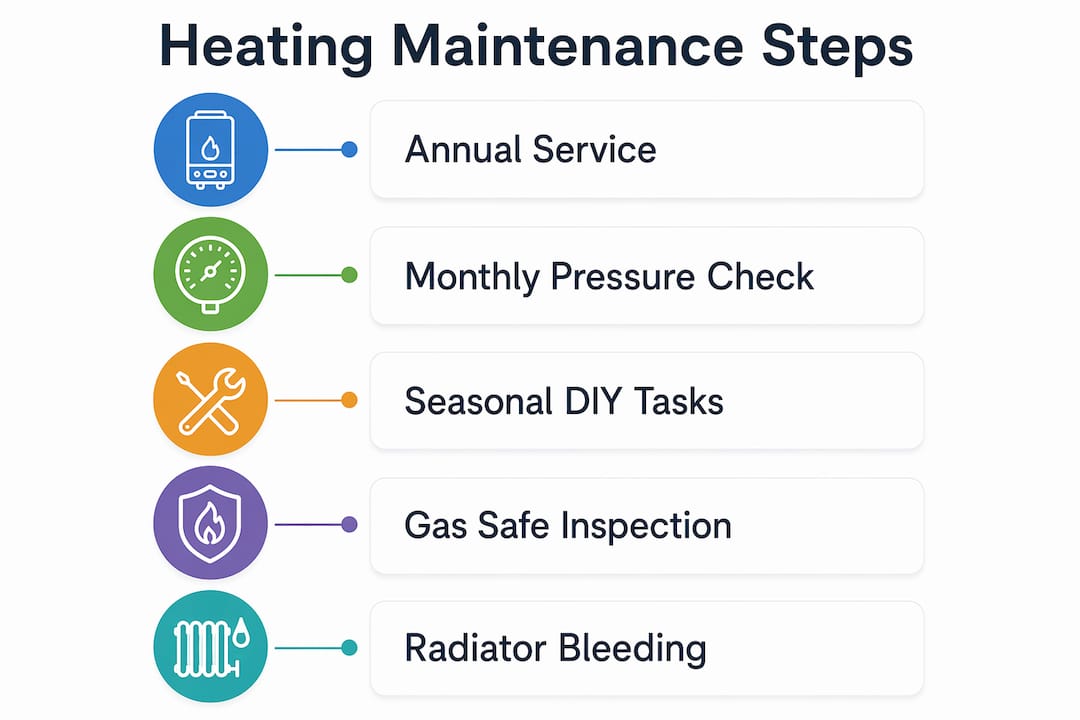
A Gas Safe annual service, combined with monthly pressure checks and seasonal DIY tasks, is the most cost-effective way to keep a UK heating system safe, efficient, and legally compliant.
| Point | Details |
|---|---|
| Annual service is non-negotiable | Book a Gas Safe engineer yearly; typical cost is £79–£120 and the visit takes 40–60 minutes. |
| Check pressure when cold | Correct cold system pressure is 1.0–1.5 bar; always check before the boiler has been running. |
| Landlords have legal duties | The Gas Safety (Installation and Use) Regulations 1998 require a CP12 certificate every 12 months. |
| Seasonal checks prevent breakdowns | Bleed radiators, test thermostats, and clear the boiler area before each heating season. |
| Thermostat discipline saves money | Raising the thermostat by 1°C can increase heating bills; the Energy Saving Trust reports this impact is significant. |
A property maintenance perspective
The heating faults that cause the most disruption are almost never sudden. They build quietly over one or two seasons: a magnetic filter that was never cleaned, a radiator that was never bled, a pressure drop that was noticed but not logged. By the time the boiler stops working on a cold January morning, the warning signs were there months earlier.
Scheduled servicing is not a luxury. For landlords, it is a legal baseline. For owner-occupiers, it is the difference between the typical £79–£120 annual service and a far more expensive emergency callout if faults go unnoticed. Small, regular checks genuinely do prevent costly winter emergencies, and landlords who plan ahead can reasonably expect prompt repairs when things do go wrong.
Sherrypropertycare helps property owners and managers in Dublin coordinate planned maintenance across the whole property, from grounds and gardens to building upkeep. If you want to build heating checks into a broader maintenance schedule, get in touch for a tailored plan.
Useful sources
- Energy Saving Trust: Boiler service explained — Covers why annual servicing matters, what a service should include, and the link between servicing and warranty validity.
- HSE: Maintenance of gas appliances and flues — Primary UK government source for landlord duties, Gas Safe engineer requirements, and legal maintenance obligations.
- Which?: Why you need an annual boiler service — Practical guidance on what to ask an engineer and how annual servicing prevents winter breakdowns.
- British Gas: Boiler service and maintenance — Explains what a service covers, including controls testing, visual checks, and the service certificate.
- HomeServe: Is a boiler service worth it? — Sets realistic expectations on service duration (40–60 minutes) and potential additional repair costs.
FAQ
How often should a boiler be serviced in the UK?
Once a year, by a Gas Safe registered engineer. Annual servicing maintains efficiency, keeps the manufacturer warranty valid, and satisfies landlord legal obligations under the Gas Safety (Installation and Use) Regulations 1998.
What is the correct boiler pressure for a central heating system?
The correct cold system pressure is 1.0–1.5 bar. Always check the gauge when the system is cold; a hot reading is falsely high and can lead to unnecessary venting.
Are landlords legally required to service the boiler every year?
Landlords must obtain a Gas Safety Certificate (CP12) every 12 months under UK law. While a full service is not separately mandated by name, the Landlord and Tenant Act 1985 requires heating systems to be kept in proper working order, and a full annual service is the standard way to evidence that.
How quickly must a landlord fix a broken boiler in winter?
Industry practice is to restore heating or provide a temporary solution within 24–48 hours in winter. If a repair takes longer, landlords are expected to supply alternative heating such as plug-in electric radiators to keep the property habitable.
Can a property owner bleed radiators themselves?
Yes. Bleeding radiators is a safe DIY task: switch the heating off, let radiators cool, use a radiator key to release trapped air, and re-check boiler pressure afterwards. Never attempt gas repairs or open sealed combustion parts.