TL;DR:
- For Dublin properties, especially older solid-wall houses, professional intervention is recommended for above-ground or failing render work, while DIY is feasible for ground-level surfaces. Proper preparation, breathable paint selection, and suitable weather conditions are critical for long-lasting exterior paint jobs, with preparation taking up the majority of the effort. Coordinating cleaning, repair, and painting through experienced contractors ensures durability, cost savings, and compliance with regulations.
For most Dublin properties, particularly older solid-wall or rendered houses, hiring a professional is the right call for anything above ground-floor level or where the render shows signs of failure. If you are managing a straightforward ground-floor wall or garden outbuilding, a DIY approach is feasible. The single most important technical rule: breathable paint on pre-1919 solid walls and lime render. Using an impermeable acrylic on these substrates traps moisture and causes internal damp.
Quick TL;DR:
- Paint only in dry weather above 5°C, ideally May through September in Dublin
- Match the paint system to the substrate: breathable silicone or mineral silicate for older masonry, microporous for timber
- Expect a moderate lifespan from standard acrylic, longer durability from silicone-based systems, and the longest from mineral silicate systems
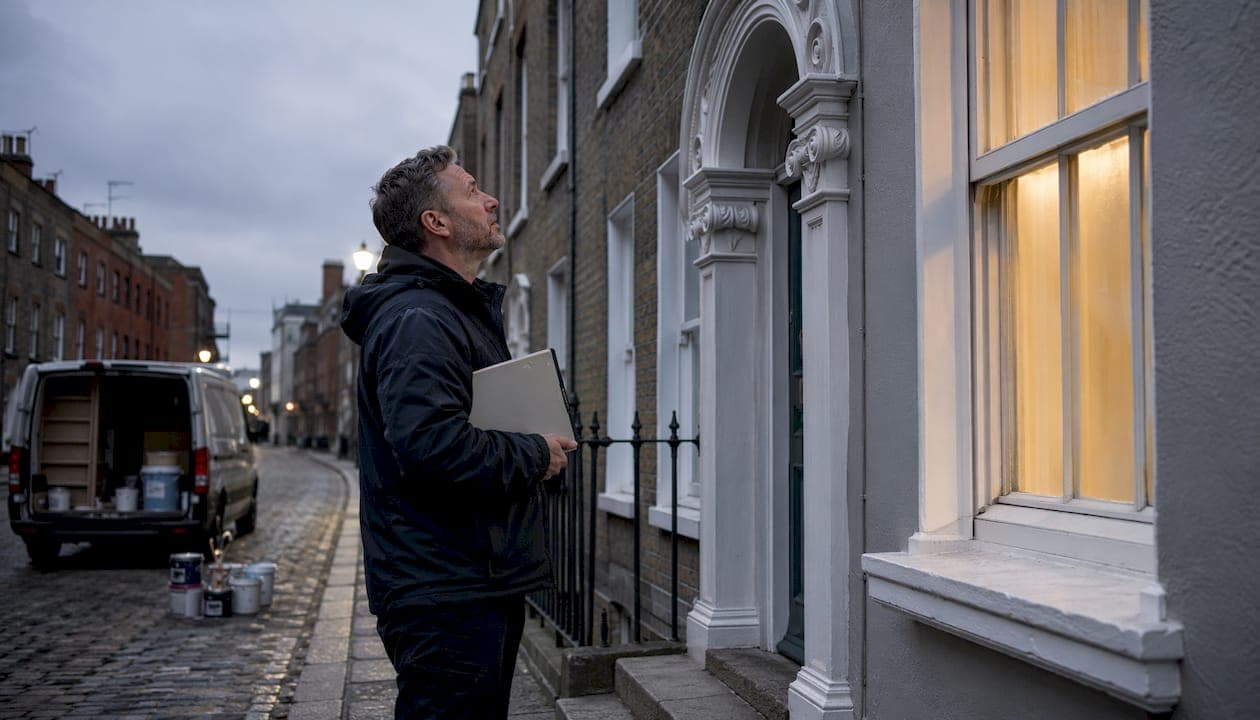
Pro Tip: Before buying a single tin of paint, tap the render with your knuckles. A hollow sound means blown render beneath. Paint will not bond to detached render, and painting over it only delays a more expensive repair.
Table of Contents
- What tools and materials do you need for exterior painting?
- How to paint exteriors: the step-by-step process
- How do you choose the right paint system for your substrate?
- What are the weather rules and safety requirements for exterior painting?
- When should you hire a professional painter?
- How do you spot and fix common exterior paint failures?
- What are the low-VOC and environmentally friendly paint options?
- How does application technique change by exterior material?
- How do you repair exterior surface damage before painting?
- Key takeaways
- Why substrate checks matter more than paint brand
- Sherrypropertycare: exterior preparation and cleaning in Dublin
- Useful sources
- FAQ
What tools and materials do you need for exterior painting?
Masonry and joinery tools:
- Long-pile rollers for rough render; short-pile rollers for smooth surfaces
- Masonry brushes (100mm and 150mm) for edges and reveals
- Extension poles for ground-floor reach
- Airless sprayer is recommended for large flat elevations (garden sprayers are less effective for masonry films)
- Ladders for ground-floor only; scaffold or harness for anything higher
Consumables and PPE:
- Fungicidal wash and soft brush or pressure washer
- Exterior filler, render repair mortar, stabilising primer (for friable patches only)
- Masking tape, dust sheets, plastic sheeting for windows and paths
- Gloves, safety glasses, dust mask (P2 rated for sanding)
Material estimate for a mid-terrace front elevation in Dublin (approx. 35–45 m²): A smooth masonry paint covers a certain area per litre per coat; textured finishes cover less per litre. Two coats on a typical front elevation need an appropriate quantity of paint. Budget £400–£800 for a single front elevation including preparation, with scaffolding for an upper floor adding a further £400–£800.
Pro Tip: Renting scaffold for a single day costs more than you expect. Professionals already carry the equipment and insurance. For anything above the first-floor eaves, the cost difference between DIY and a contractor narrows considerably once you price access equipment.
How to paint exteriors: the step-by-step process
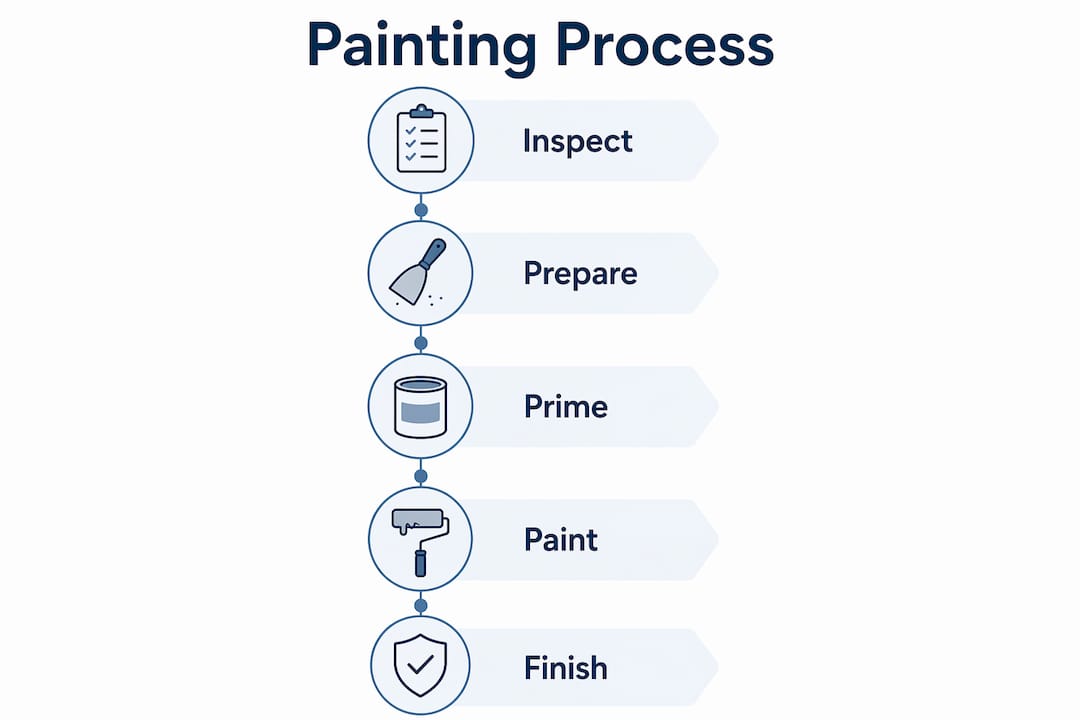
Preparation is the majority of total project time on a professional repaint. Rushing it is the single most common reason paint fails within two to three years.
- Condition survey. Walk the elevation and note blown render (hollow tap), algae, damp stains, cracked pointing, and rotten timber. If you find structural damp or large areas of failed render, stop and call a professional.
- Clean the surface. Pressure wash or soft wash to remove dirt, algae, and loose material. Apply a fungicidal wash to any green or black growth and allow it to dry fully (24–48 hours minimum).
- Scrape and rub down. Remove all loose and flaking paint. Sand timber back to a smooth key; feather edges on masonry.
- Repair. Repoint open joints, patch render, replace rotten timber sections, and fill cracks (see the repair section below).
- Prime. Apply stabilising primer to friable patches only. New render needs a thinned mist coat (1 part paint to 5 parts water) rather than a standard primer. Allow new render to cure for at least four weeks before painting.
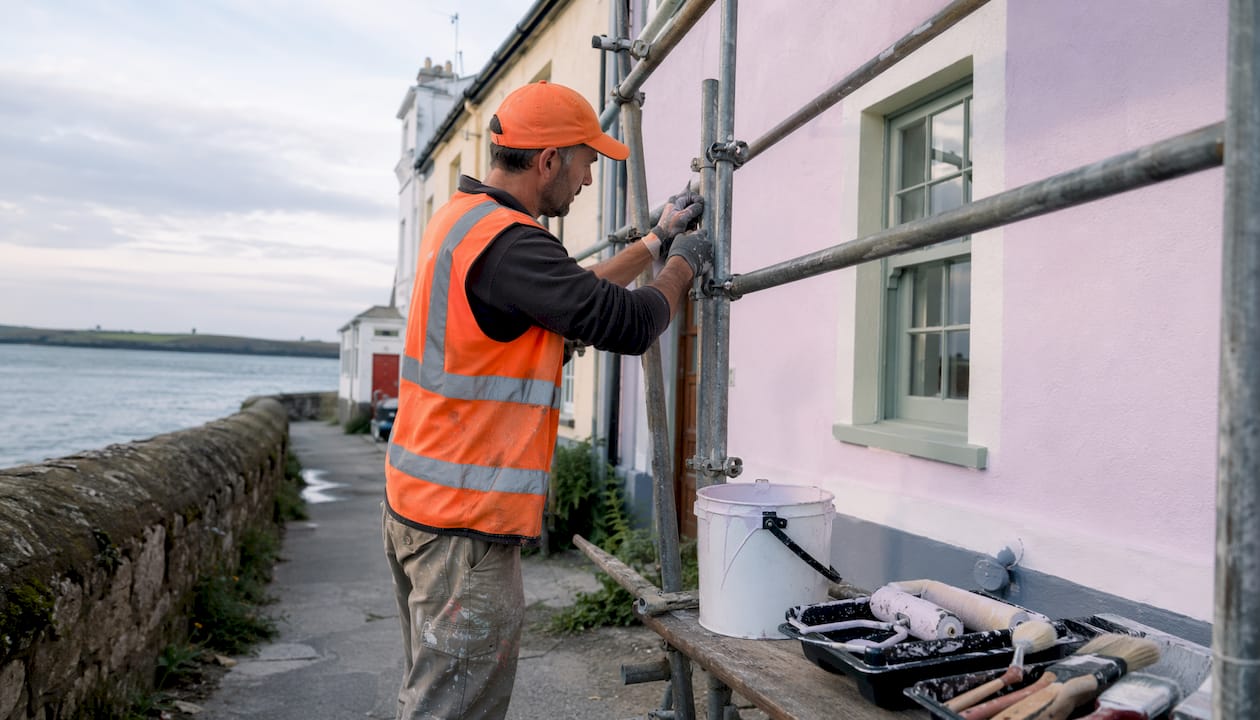
- Paint. Work top to bottom, maintaining a wet edge to avoid lap marks. Apply two full coats, allowing the manufacturer's stated drying time between coats (typically 4–6 hours for masonry paints in dry conditions).
- Finish and inspect. Check for missed areas, holidays (thin spots), and any runs on joinery. Touch up before removing masking.
Typical time budgets: a single front elevation takes a two-person crew a short number of days including prep; a full four-elevation house usually takes multiple days.
Pro Tip: Paint timber joinery before the masonry walls. Any splashes onto unpainted masonry are easy to brush in; splashes onto a finished wall are not.
How do you choose the right paint system for your substrate?
Breathability is the defining property for older masonry and lime render. An impermeable film locks moisture into the wall, which then pushes the paint off from behind.
| Substrate | Recommended system | Lifespan | Coverage (per coat) |
|---|---|---|---|
| New render (cement) | Masonry primer + acrylic or silicone masonry paint | 5–10 years | 8–10 m²/l (smooth) |
| Old render / pre-1919 solid wall | Silicone or mineral silicate masonry paint | 10–25 years | 6–8 m²/l |
| Lime render | Limewash or mineral silicate only | 5–10 years (limewash) | 4–6 m²/l |
| Brick | Breathable masonry paint or leave unpainted | 10–15 years | 8–10 m²/l |
| Timber (siding, fascias) | Microporous primer + microporous topcoat | 5–8 years | — |
| uPVC | Specialist uPVC paint (no primer needed) | 5–7 years | — |
Elastomeric or flexible coatings suit render that shows hairline movement cracks; they bridge small gaps without cracking. Stabilising primer is for isolated friable patches only — applying it across a sound surface reduces breathability.
Pro Tip: Ask your paint supplier for the BS EN 1062 classification on any masonry product. Class W3 (low water absorption) combined with Class V3 (high vapour permeability) is the target for older Dublin masonry.
What are the weather rules and safety requirements for exterior painting?
Weather rules (non-negotiable):
- Air and surface temperature must be above 5°C and rising; never paint in falling temperatures
- No rain for at least four hours after application
- Avoid frost within 24 hours of painting
- Avoid direct hot sun on south-facing walls; paint in shade where possible to prevent rapid drying and brush drag
- Best months in Dublin: May through September; north-facing elevations dry more slowly, so allow extra drying time
Safety checklist for property managers:
- Ladders are acceptable for ground-floor work only (up to approximately 2m)
- Any work above the first-floor eaves requires scaffold or a mobile elevated work platform
- Confirm your contractor holds public liability insurance and employers' liability insurance
- Request a method statement for all work at height before approving the programme
Regulatory note: Exterior painting is permitted development for most properties and does not need planning permission. Listed buildings and properties in conservation areas may require Listed Building Consent or Conservation Area Consent for colour or paint-type changes. Check with your local council before specifying a colour on a protected property.
Pro Tip: North-facing elevations in Dublin stay damp longer after rain. Give them an extra day of drying time after washing before you start painting.
When should you hire a professional painter?
Hire a professional if any of the following apply:
- Work is above the first-floor eaves
- Render is blown, cracked, or failing
- There is evidence of structural damp or rising damp
- Scaffold or access equipment is required
- The property is listed or in a conservation area
Professionals diagnose substrate problems that DIY painters routinely miss, preventing the early repaints that follow inadequate preparation. A good contractor provides:
- Full site inspection and condition survey
- Written scope of work and itemised quote
- Method statement covering access and safety
- Proof of public liability and employers' liability insurance
- Written workmanship guarantee (ask for the term and exclusions)
Questions to ask at quote stage: Which paint system do you recommend and why? Can you provide the product datasheet? Is render repair and repointing included? What is the scaffold plan? How long is the workmanship warranty?
Pro Tip: A contractor who cannot name the paint system or provide a datasheet is a red flag. A professional exterior painting specification should reference the product, its BS EN 1062 class, and the number of coats.
How do you spot and fix common exterior paint failures?
| Symptom | Probable cause | Corrective action |
|---|---|---|
| Peeling in sheets | Moisture ingress behind film | Investigate gutters and pointing; remove loose paint; repair; repaint with breathable system |
| Blistering | Trapped moisture or painting in direct sun | Strip affected area; allow to dry fully; reprime and repaint |
| Chalking / powdering | Paint degradation or wrong product | Stabilise with primer; apply compatible topcoat |
| Salt efflorescence (white staining) | Soluble salts migrating through masonry | Brush off dry; do not wash; allow to stabilise; use breathable paint |
| Algae / green growth | Persistent damp or shaded elevation | Fungicidal wash; treat root cause (gutters, pointing); repaint |
Maintenance schedule:
- Annually: clean gutters and check flashings; inspect pointing and render for cracks
- Every 2–3 years: soft wash elevations to remove algae and dirt
- Repaint cycle: standard acrylic 5–8 years; silicone-based 10–15 years; mineral silicate 15–25 years
Pro Tip: Bundle cleaning, repointing, and painting into one programme. You pay for scaffold once instead of three times, which can cut the combined cost by 20–30%.
What are the low-VOC and environmentally friendly paint options?
Low-VOC masonry paints have improved considerably. Silicone-based and mineral silicate paints tend to carry lower VOC levels than solvent-based alternatives, and many manufacturers now offer water-based microporous timber paints that meet the EU Decorative Paints Directive limits. For timber joinery, water-based satinwood and gloss products have largely replaced oil-based equivalents on professional jobs.
Limewash is the most environmentally benign option for lime render and older stone: it is mineral-based, fully breathable, and biodegradable. The trade-off is a shorter recoat cycle (typically every 5–10 years) and a more limited colour range. For masonry, look for products labelled "water-based" with VOC content below 30 g/l (Category A, EU Directive 2004/42/EC).
How does application technique change by exterior material?
Timber siding and fascias: sand with the grain, prime all bare wood (including end grain), and apply two coats of microporous topcoat. A brush gives better penetration into grain than a roller. Never apply a non-breathable gloss over bare or previously microporous-coated timber.
Smooth render and brick: a medium-pile roller is fastest; cut in with a masonry brush at edges and reveals. Maintain a wet edge by working in manageable sections (roughly 1.5m wide) from top to bottom.
Textured or pebbledash render: a long-pile roller (22mm or more) is needed to push paint into the texture. Two coats are the minimum; three may be needed on heavily textured surfaces. Coverage drops to 4–5 m²/l, so order more than you think you need.
Stucco (smooth cement render): treat as smooth masonry. An airless sprayer is efficient on large flat areas, but mask everything within 3m and use a tip suited to masonry viscosity.
How do you repair exterior surface damage before painting?
Cracks in render: rake out loose material to a depth of at least 10mm, dampen the recess, and fill with a flexible exterior filler or render repair mortar. For hairline cracks, an elastomeric masonry paint may bridge them without filling. For cracks wider than 3mm, investigate the cause before filling.
Rotten timber: cut back to sound wood, treat the exposed timber with a preservative, and build up with a two-part epoxy wood filler. Prime immediately after filling; bare timber left exposed absorbs moisture within hours.
Mould and algae removal: apply a proprietary fungicidal wash, leave for the manufacturer's stated dwell time (usually 30–60 minutes), then rinse. Do not paint over active mould. If mould returns within weeks of treatment, the root cause is likely a moisture source (leaking gutter, failed pointing) that needs fixing first.
Blown render: if pressure washing reveals hollow or detached render, remove and repair it before painting. Paint applied over blown render will not bond and will fail quickly.
Key takeaways
Breathable paint on older masonry, thorough preparation, and professional help for anything above ground-floor level are the three factors that determine whether an exterior paint job lasts 5 years or 15.
| Point | Details |
|---|---|
| Inspect before you buy paint | Tap render for hollow spots and check gutters before specifying any paint system. |
| Match paint to substrate | Use breathable silicone or mineral silicate on pre-1919 solid walls; microporous on all timber. |
| Prep is the majority of the work | Preparation takes 50–70% of total project time; skipping it leads to failure within 2–3 years. |
| Get three written quotes | Insist on a site inspection, itemised scope, and a written workmanship guarantee from every contractor. |
| Sherrypropertycare for prep and cleaning | Sherrypropertycare handles exterior cleaning, power washing, and vegetation clearance in Dublin to ready your property for painting. |
Why substrate checks matter more than paint brand
The most common mistake Dublin property managers make is choosing a paint colour before checking what is underneath. A premium silicone paint applied over blown render or active damp will fail just as quickly as a budget product. The substrate diagnosis comes first; the product selection follows from it.
Older Dublin housing stock, much of it solid-wall construction built before 1919, is particularly vulnerable to moisture problems when the wrong paint system is applied. Wind-driven rain on west and north elevations compounds the issue. North-facing walls also stay damp longer after rain, which means algae growth is faster and drying windows are shorter. These are not problems that a tin of masonry paint solves on its own.
Coordinating painting with garden clearance and exterior cleaning in one programme is worth considering. A single scaffold hire covers cleaning, repointing, and painting in sequence, which cuts both cost and disruption for tenants or occupants.
Sherrypropertycare: exterior preparation and cleaning in Dublin
Getting a property ready for painting is often the part that takes longest and costs most. Sherrypropertycare handles the preparation work that makes a repaint last: exterior power washing, vegetation clearance, patio and path cleaning, and coordination with painters and scaffolders across Dublin.

Combining cleaning and painting prep under one contractor means the scaffold goes up once, the surface is clean and treated before the painters arrive, and the programme runs without delays. Sherrypropertycare provides tailored quotes based on your property's size, condition, and access requirements. Specialist render replacement and structural repairs sit outside the direct service offer, but the team will coordinate with the relevant trades on your behalf.
To get a quote for exterior cleaning and painting preparation in Dublin, contact Sherrypropertycare at sherrypropertycare.ie.
Useful sources
- BS EN 1062 classification guidance: water absorption (W) and vapour permeability (V) classes for masonry coatings
- Breathable masonry paint guidance: substrate compatibility for pre-1919 and lime render
- Weather and application rules: temperature, humidity, and frost guidance for exterior masonry
- Planning permission for exterior painting: permitted development rules, listed buildings, and conservation areas
- DIY vs professional painting: when to hire and what professionals add beyond labour
- Exterior painting costs: scaffolding costs, coverage rates, and lifespan benchmarks
This guide is general information for planning purposes. Confirm current planning rules with your local council and consult a qualified professional for structural or listed-building matters specific to your property.
FAQ
What paint should you use on older Dublin masonry?
Use a breathable silicone or mineral silicate masonry paint on pre-1919 solid walls and lime render. Impermeable acrylics trap moisture and cause internal damp.
How long does exterior paint last in Dublin?
Standard acrylic masonry paint lasts 5–8 years; silicone-based systems last 10–15 years; mineral silicate lasts 15–25 years, depending on exposure and preparation quality.
Do you need planning permission to paint the outside of a house in Dublin?
Most exterior painting is permitted development and needs no planning permission. Listed buildings and properties in conservation areas may require consent for colour or paint-type changes.
When is the best time of year to paint exteriors in Dublin?
May through September offers the most reliable weather windows. Air and surface temperature must be above 5°C, with no rain forecast for at least four hours after application.
What does Sherrypropertycare offer for exterior painting projects?
Sherrypropertycare provides exterior cleaning, power washing, and vegetation clearance in Dublin to prepare properties for painting, and coordinates with painters and scaffolders on your behalf.