
TL;DR:
- A well-organized maintenance checklist helps Dublin landlords ensure legal compliance and preserve property value.
- Regular inspections, documented with photos and logs, are crucial for managing both residential and commercial properties.
- Seasonal preventative maintenance minimizes costly damages caused by Irish weather, supporting long-term property upkeep.
Imagine this: a Dublin landlord gets a call from a frustrated tenant about a burst pipe. The repair costs €1,800, the tenant threatens to contact the RTB, and the property sits partially unusable for a week. A structured checklist, reviewed regularly, would have flagged the ageing pipework months earlier. For Dublin landlords and property managers, a well-organised property maintenance checklist is not optional. It protects you legally, keeps tenants happy, and preserves the value of your investment. This guide walks you through exactly what to include, from RTB compliance to seasonal upkeep, for both residential and commercial properties.
Table of Contents
- Understanding Dublin landlord obligations and the role of checklists
- Essential items for your residential property checklist
- The commercial property checklist: What's different and why it matters
- Seasonal maintenance: Preventative strategies for Irish weather
- Why most landlord property checklists miss the mark (and how to get it right)
- Take the next step towards hassle-free property management
- Frequently asked questions
Key Takeaways
| Point | Details |
|---|---|
| Legal compliance essentials | Checklists help ensure you meet all RTB and safety standards, reducing risk. |
| Proactive maintenance saves money | Addressing issues early with regular checks prevents costly repairs and boosts value. |
| Residential versus commercial focus | Tailor your checklist as commercial and residential properties have different needs and legal obligations. |
| Record-keeping protects landlords | Detailed documentation, including photos, can resolve tenant and RTB disputes more effectively. |
Understanding Dublin landlord obligations and the role of checklists
Knowing your legal obligations is the starting point for any effective checklist. Dublin landlords managing residential properties must comply with RTB minimum standards that cover structural soundness, no damp, hot and cold water, controllable heating, ventilation, natural and artificial lighting, fire safety including alarms and a fire blanket, safe gas and electricity, window restrictors, bin storage, safe appliances, and cooking facilities for short leases. These are not suggestions. Failing to meet them puts you at risk of RTB enforcement and potential fines.
Commercial landlords operate under a different framework. There is no direct RTB equivalent for commercial properties, but you are still accountable for fire safety compliance, structural integrity, accessibility, and regular electrical inspections. The obligations are significant, even if the regulatory body differs.
Here is where checklists earn their value. They serve as both a management tool and a legal record. If a tenant raises a dispute, your completed inspection log with dates, photos, and contractor invoices is your best defence.
Core obligations for both property types:
- Structural soundness and weatherproofing
- Fire detection, alarms, and evacuation plans
- Safe and certified electrical and gas systems
- Adequate ventilation and heating controls
- Clean, safe common areas and bin storage
- Regular inspection and documentation
| Item | Residential | Commercial |
|---|---|---|
| RTB minimum standards | Required | Not applicable |
| Fire safety compliance | Required | Required |
| Electrical certification | Required | Required |
| HVAC and lift servicing | Occasional | Regular |
| Damp and structural checks | Mandatory | Recommended |
| Vendor and contractor logs | Good practice | Essential |
For a broader view of what the law expects from you, the Dublin landlord responsibilities guide is worth reviewing before you build your checklist.
Essential items for your residential property checklist
Once you understand the foundation, here is what to include in your residential property checklist to stay compliant and protect your investment.
A room-by-room approach is the clearest way to structure this. It removes ambiguity and ensures nothing gets missed during an inspection visit.
- Kitchen: Check appliances, ventilation, tap pressure, under-sink plumbing, and cooker extraction.
- Bathrooms: Inspect for damp, mould, grout condition, toilet seals, extractor fans, and hot water.
- Living areas and bedrooms: Test smoke alarms, check windows open and close securely, inspect skirting for damp or pest activity.
- Hallways and stairs: Verify adequate lighting, handrail stability, and fire door condition.
- Exterior: Check gutters, downpipes, roof visible from ground level, paths, fencing, and bin storage areas.
- Heating system: Test boiler controls, bleed radiators, confirm thermostat works, and check carbon monoxide detectors.
- Electrical: Check sockets, switches, and consumer unit for any signs of overloading or damage.
For inspection timing, quarterly or six-monthly checks are the standard recommended range. Quarterly suits properties with older systems or higher tenant turnover. Every six months works well for well-maintained modern properties. Always document what you check and what condition you found it in.
Safety note: Never delay on fire safety items. If a smoke alarm fails a test or a carbon monoxide detector shows a fault, replace it the same day. This is both a legal requirement and a basic duty of care.
Pro Tip: Before each inspection, send your tenant a short written notice and bring a camera or phone with you. Photographing each room at every visit builds a timestamped visual record that is invaluable if an RTB dispute ever arises. Also check out these indoor maintenance tips to keep interiors in top condition between visits.
The commercial property checklist: What's different and why it matters
Commercial landlords face a different set of challenges. Your checklist and approach need to adapt accordingly.
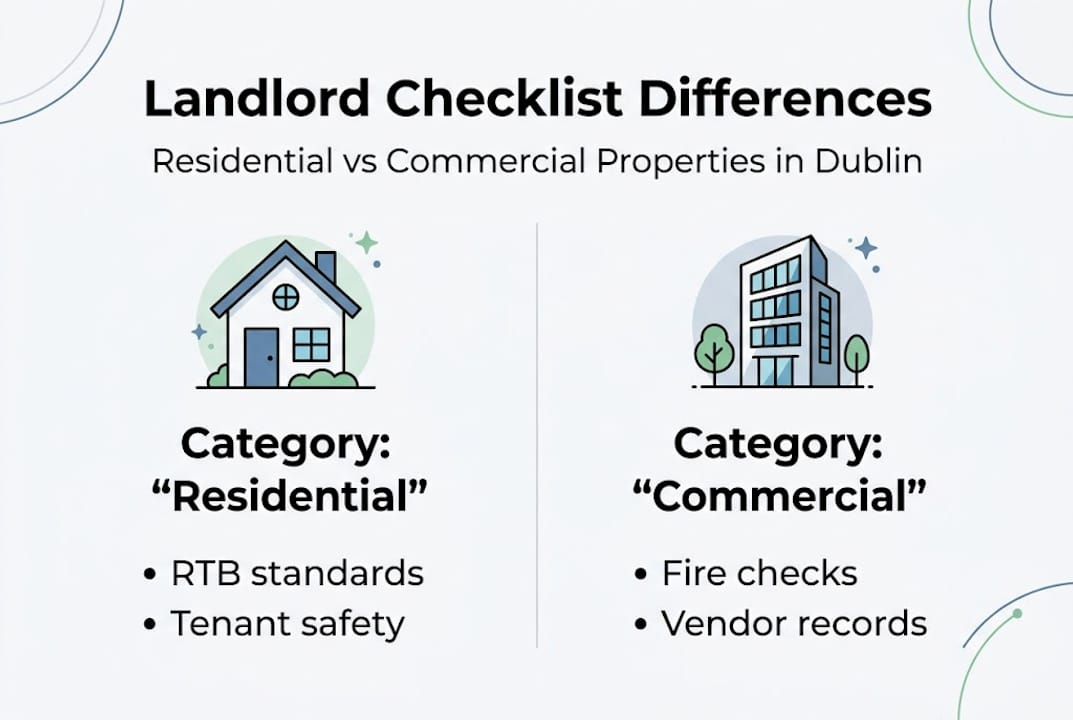
Commercial property compliance centres on fire safety, electrical systems, structural integrity, and vendor management rather than the habitability rules that govern residential tenancies. There is no single governing body like the RTB, but the legal exposure can be just as significant if something goes wrong.
Your commercial checklist should include the following system and compliance checks:
- Fire safety: Sprinkler systems, extinguisher servicing dates, emergency lighting, and evacuation route signage
- Electrical: Periodic inspection condition reports and any remedial work from previous reports
- HVAC: Filter replacements, duct inspections, air handling unit servicing
- Lifts and access: Annual lift inspections, accessibility compliance with building regulations
- Egress routes: Clear passageways, door release mechanisms tested, signage visible
- Structural: Roof, facades, drainage, and car park surfaces
| System | Residential check cycle | Commercial check cycle |
|---|---|---|
| Fire alarms | Annually | Every 6 months |
| Electrical inspection | Every 5 years | Every 3-5 years |
| HVAC servicing | Annually | Bi-annually |
| Roof inspection | As needed | Annually |
| Lift certification | N/A | Annually |
Vendor management is the piece most landlords underestimate. Keep a log of every contractor, their certification, and the work completed. This is your paper trail for insurance, compliance audits, and resale. For a full breakdown, see this commercial maintenance checklist built for Dublin property managers.
Pro Tip: Consider adding ESG benchmarking to your commercial checklist. Tracking energy consumption annually can improve your building's BER rating, attract better tenants, and increase resale value. It is an easy addition with a meaningful long-term return.
Seasonal maintenance: Preventative strategies for Irish weather
Beyond checklists, timing is everything. Here is how to structure your maintenance for maximum efficiency and cost control.
Irish weather is tough on buildings. Wet autumns, cold and damp winters, and unpredictable springs all take a toll. A reactive approach is expensive. Addressing a small roof leak costs roughly €200, but ignoring it until water ingress damages ceilings, insulation, and electrics can run into thousands. Preventative scheduling makes financial sense every time.
Here is a practical seasonal checklist for Dublin properties:
- Autumn: Clear gutters and downpipes of leaves, inspect roof for loose or missing tiles, check external seals around windows and doors, service the boiler before it is needed.
- Winter: Confirm heating is working correctly, insulate exposed pipes in older properties, check for condensation and early-stage damp, test smoke and CO2 alarms.
- Spring: Inspect for damp damage from winter rain, check garden drainage, pressure-wash hard surfaces to remove algae and winter grime, review any cracked render or pointing.
- Summer: Repaint or treat exterior woodwork, trim hedges and trees away from the building, check flat roof surfaces, and address any pest entry points.
For further seasonal guidance specific to Dublin homes, read these seasonal maintenance tips and also consider reviewing the difference between maintenance vs. repairs to understand where your budget is best spent.
Pro Tip: Book your boiler service in late August or early September, before the autumn rush. Dublin plumbers are heavily booked from October onwards, and an unserviced boiler in November is both a legal and a practical problem.
Why most landlord property checklists miss the mark (and how to get it right)
Here is something most guides will not tell you. A checklist you downloaded from a template website is not a compliance tool. It is a comfort blanket.
Generic lists tick obvious boxes but miss the things that actually cause problems in Dublin properties: specific damp patterns in Victorian terraces, garden drainage issues in clay-heavy south Dublin soil, or ageing electrical systems in pre-2000 apartment blocks. A checklist that does not reflect your actual property is a checklist that will let you down.
The landlords who have faced costly RTB disputes or struggled to sell at the right price are rarely those who were negligent. They were often the ones who relied on standard templates and annual inspections, never building a real picture of their property's condition over time.
Photo documentation changes this. A timestamped photo at every inspection, archived properly, shows the condition of the property across years. It protects you in disputes, supports insurance claims, and demonstrates to buyers or valuers that the property has been well maintained. You can see real examples of how consistent upkeep connects to boost value and curb appeal in Dublin.
Build a checklist around your specific property. Review it every six months. Update it when systems change or when a contractor flags something new. That is how you stay ahead.
Take the next step towards hassle-free property management
Running through a thorough checklist takes time. Keeping on top of seasonal tasks, compliance requirements, and exterior upkeep across multiple properties takes even more. That is where professional support makes a real difference.

At Sherry Property Care, we work with Dublin landlords and property managers to handle the outdoor and surface maintenance tasks that protect and enhance your investment. From lawn care and hedge trimming to power washing driveways and preparing surfaces, we make sure your property looks its best year-round. Our team provides expert property care tailored to Dublin residential and commercial properties. Get in touch today for a free quote and find out how we can take the exterior maintenance workload off your plate entirely.
Frequently asked questions
What are the minimum legal standards for Dublin landlords?
Rental properties must meet RTB minimum standards covering sound structure, water supply, heating, lighting, fire safety, and safe gas and electrical systems.
How often should I inspect my rental property in Dublin?
Quarterly or six-monthly inspections are the recommended range, with quarterly suits being better for older properties or those with higher tenant turnover.
What seasonal maintenance is most important for Dublin properties?
Autumn gutters and roofing, winter heating checks, spring damp inspections, and summer exterior upkeep are the four key seasonal priorities, as outlined in a preventative maintenance schedule for Irish properties.
How do commercial landlord checklists differ from residential?
Commercial property compliance centres on fire safety, electrical certification, structural inspections, and vendor management rather than RTB habitability standards.
What is the best way to document my checklist for disputes?
Take dated photos at every inspection and retain all contractor invoices, as thorough documentation for RTB disputes is your strongest protection if a tenant challenge arises.