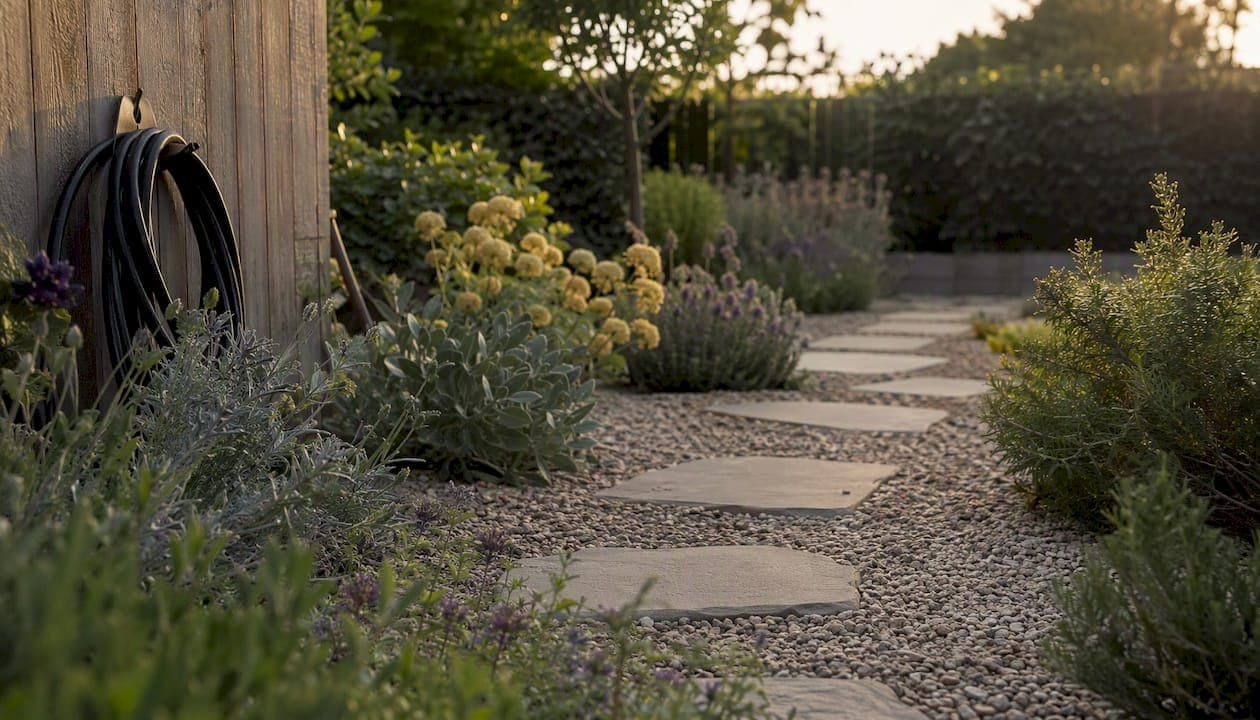
Replace or drastically reduce your lawn, choose hardy perennials and evergreen shrubs, and set up mulched no-dig beds — and you can cut your weekly garden time by more than half. That single combination does more for a low maintenance garden in Ireland than any other set of changes. Here is what to do first:
- Reduce or remove lawn. Even a small formal lawn demands mowing, edging, feeding and treating. Replace it with gravel, permeable paving or decking and the recurring work drops sharply.
- Choose hardy perennials and evergreen shrubs. Plants that come back reliably each year and hold their structure through winter need far less replacement and seasonal fuss.
- Set up no-dig beds with deep mulch. Lay cardboard, top with at least 10cm of well-rotted compost, and you suppress weeds from day one without digging.
- Add permanent edging. A simple steel or stone edge between beds and any remaining lawn saves 20–30 minutes of trimming per session.
- Install a basic drip or timer watering system. Particularly useful for pots and new plantings in the first establishment year.
- Choose gravel or permeable paving for paths. Both drain well in Irish rain and need little upkeep once laid correctly.
- Zone your effort. Keep any higher-input features — pots, a small veg bed, a water feature — close to the house and a water point.
Follow these steps and most Dublin gardens can move from an hour or more of weekly work to a short monthly check. The local case study further below shows exactly how one Dublin garden made that shift.
Key takeaways
A low maintenance garden in Ireland starts with three moves: reduce lawn, build no-dig beds with deep mulch, and choose hardy evergreen plants suited to your specific site conditions.
| Point | Details |
|---|---|
| Reduce lawn first | Replacing lawn with paving, gravel or decking removes the single biggest recurring maintenance task. |
| No-dig beds need depth | Mulch must be well-rotted and at least 10cm deep at setup; top up with around 5cm annually. |
| Match plants to site | Check drainage before choosing gravel or drought-tolerant planting; heavy clay needs a different approach. |
| Front-load the effort | Gravel and mulched beds need more weeding in years 1–3; maintenance drops sharply once plants establish. |
| Sherrypropertycare | Handles full Dublin garden conversions including drainage checks, no-dig beds, hardscaping and irrigation. |
Table of Contents
- What design choices cut the most work in a low maintenance garden?
- Which plants genuinely lower upkeep in Irish gardens?
- How do no-dig beds and mulching cut long-term weeding?
- What are the best low-effort watering options for Irish gardens?
- Which paths and surfaces need the least upkeep?
- What does a low maintenance garden cost and when should you do what?
- How Sherrypropertycare converted a Dublin garden: a real example
- An honest view on low maintenance gardening trade-offs
- Get a personalised quote from Sherrypropertycare in Dublin
- Sources
- FAQ
What design choices cut the most work in a low maintenance garden?
Lawn is usually the biggest hidden maintenance cost in any Irish garden. Mowing alone can account for half your total garden time across the year, and that is before you factor in edging, moss treatment, autumn scarifying and reseeding bare patches. Replacing even a modest formal lawn with a paved, gravelled or decked area removes that entire workload. RHS guidance on disability-friendly gardening confirms that paved and gravel areas are consistently lower-work alternatives to small lawns, and that permanent edging significantly reduces trimming time if you do keep a lawn.
If a lawn still makes sense for your household — children, dogs, or simply the look you want — keep it simple. A rectangular or oval shape with no island beds cuts mowing time dramatically compared with a lawn full of curves and cut-outs. Fit a permanent metal or stone edge between the lawn and any beds, and you eliminate the need for a half-moon edger entirely.
Labour zoning is a principle worth building into any redesign from the start. RHS low-maintenance design guidance recommends placing higher-input features — pots, raised beds, a herb planter — close to the house and near a water point. Moving a tap or adding an outdoor socket for a timer costs little at the design stage and saves considerable carrying time over years.
Practical options at a glance:
- Gravel: Low cost to lay, drains well, suits Mediterranean planting. Needs landscape fabric underneath and front-loaded weeding in years 1–3.
- Permeable paving: Slightly higher upfront cost than gravel, very low upkeep, handles Irish rainfall well and looks clean year-round.
- Decking: Good for sloped sites or where a raised level is useful. Requires annual cleaning and occasional board replacement; composite decking reduces this significantly.
- Retained small lawn: Only worth keeping if it is simple in shape, has permanent edging, and is large enough to justify a rotary mower rather than a strimmer.
Pro Tip: Before committing to any surface, check where water pools after heavy rain. Ireland's rainfall means drainage is a real constraint — a surface that looks good in a catalogue can become a problem on a poorly drained site.
Which plants genuinely lower upkeep in Irish gardens?
The right plant in the right place is the single most reliable rule in low-maintenance gardening. Ireland's mild, wet climate suits a wide range of hardy plants, but it also means slugs, wind and waterlogged soil can punish anything that is not well matched to your site. RHS guidance on hardy shrubs and groundcovers highlights evergreen shrubs, groundcovers and hardy perennials as the core of any low-effort planting scheme.
Low-care perennials
- Geranium 'Rozanne' (AGM): long-flowering, spreads to fill gaps, tolerates most Irish soils.
- Hemerocallis (daylily): tough, drought-tolerant once established, minimal deadheading needed.
- Persicaria amplexicaulis 'Firetail' (AGM): thrives in damp ground, flowers for months, no staking.
- Echinacea purpurea: handles drier spells, attractive seedheads through winter.
Evergreen shrubs
- Viburnum tinus (AGM): flowers in winter, tolerates shade and Irish wet, needs almost no pruning.
- Choisya ternata (AGM): glossy leaves, fragrant flowers, tough in most Dublin gardens.
- Pittosporum tenuifolium: excellent wind tolerance, good for coastal or exposed sites.
- Sarcococca confusa (AGM): deep shade, winter scent, slow-growing so rarely needs cutting.
Ornamental grasses
- Hakonechloa macra: shade-tolerant, no cutting needed until late winter.
- Deschampsia cespitosa: thrives in damp Irish conditions, self-seeds gently.
Groundcovers
- Vinca minor: covers bare ground quickly, suppresses weeds, tolerates dry shade.
- Pachysandra terminalis: reliable under trees where little else grows.
- Ajuga reptans: spreads well in moist soil, colourful foliage.
AGM plants: why they matter
The RHS Award of Garden Merit (AGM) is awarded after independent trials. An AGM label tells you the plant performs reliably in UK and Irish conditions, is widely available and gives good value. When you are buying at B&Q or Woodies, look for the AGM symbol on the label — it is the fastest shortcut to a plant that will not disappoint.
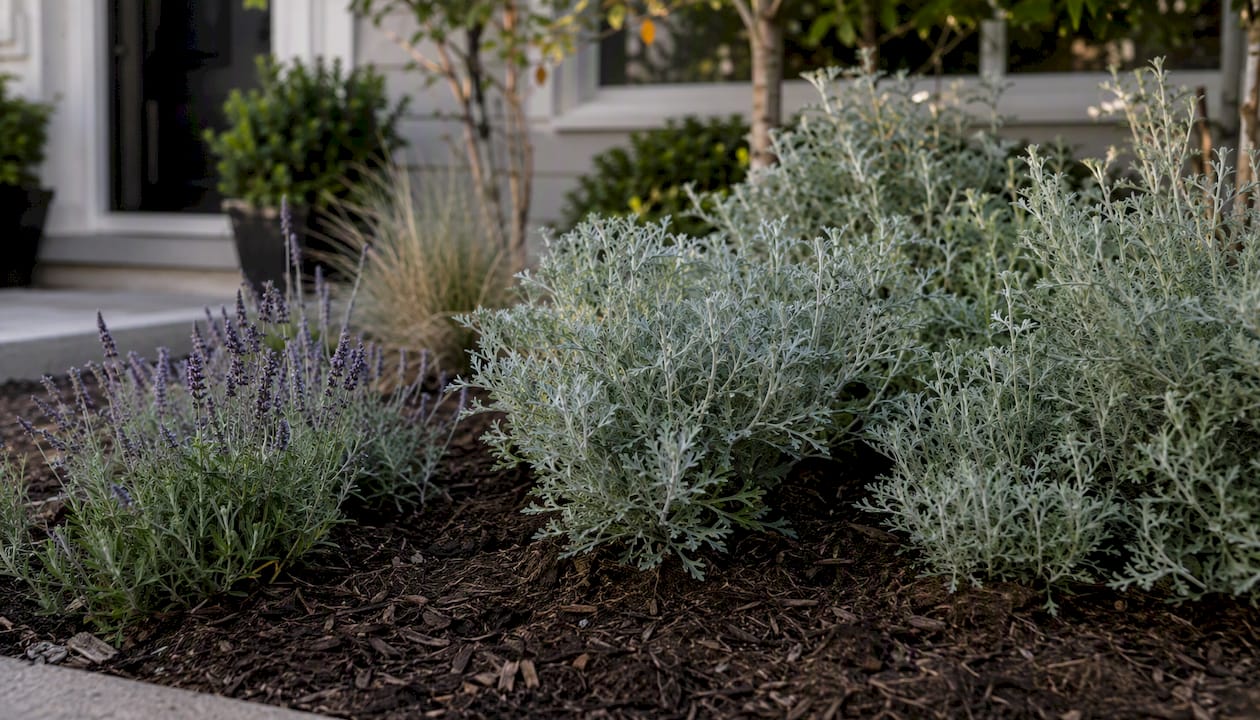
RHS drought-resistant guidance notes that many drought-tolerant plants share visible traits: silver or grey leaves, fine hairs on stems and leaves, or a waxy coating. These adaptations reduce water loss. With correct soil preparation and planting in autumn or early spring, these plants establish well in Ireland and handle dry spells without intervention.
Pro Tip: Buy plants in 9cm or 2-litre pots rather than large specimens. Smaller plants establish faster, cost less, and within two seasons often outperform expensive large specimens planted at the same time.
How do no-dig beds and mulching cut long-term weeding?
No-dig gardening is the single most effective technique for reducing weeding over the long term, and it suits Irish conditions well. The principle is straightforward: instead of digging and disturbing the soil (which brings dormant weed seeds to the surface), you smother existing vegetation and build fertility on top.
Setting up a no-dig bed: step by step
- Mow or cut down existing vegetation as short as possible.
- Lay cardboard (remove all tape and staples) directly over the area, overlapping edges by at least 15cm to prevent gaps.
- Wet the cardboard thoroughly — this helps it break down and stops it blowing.
- Add well-rotted compost or topsoil to a depth of at least 10cm. This is the critical step: thin or poorly rotted material allows weeds and grass to push through within weeks.
- Plant immediately if the compost is well-rotted and deep enough, or wait 4–6 weeks if using fresher material.
- Maintain a clean edge using a spade or permanent edging strip to prevent grass creeping back in from the sides.
RHS no-dig guidance confirms a no-dig bed can be planted straight away when mulch is well-rotted and at least 10cm deep, with annual top-ups of around 5cm to maintain suppression and soil health.
Mulch choices for Irish gardens
- Bark chippings: Long-lasting, widely available at B&Q and Woodies, good for shrub beds.
- Well-rotted compost: Best for vegetable and perennial beds; improves soil as it breaks down.
- Gravel: Suits drought-tolerant and Mediterranean planting; does not improve soil but drains well.
- Leaf mould: Free if you collect autumn leaves; excellent conditioner for woodland-style planting.
Apply mulch generously at establishment and refresh with around 5cm each spring. On new-build sites — common across Dublin's newer estates — soil is often compacted with buried rubble close to the surface. RHS guidance for new-build gardens recommends clearing rubble and completing hard landscaping before any planting, then conditioning the soil before mulching.
Realistic time expectations: Weed control is front-loaded. In years 1–3, expect to spend more time hand-weeding between plants as they fill in. After that, a well-mulched bed with good plant coverage needs only occasional attention.
What are the best low-effort watering options for Irish gardens?
Ireland's rainfall is generally reliable, but dry spells in May and June catch many gardeners off guard, particularly for pots and newly planted beds. A basic watering system removes the daily decision-making and keeps plants alive during the critical establishment period.
- Drip irrigation with a timer: The most effective option for pots and grouped plantings. Drip irrigation guidance from DripWorks notes that timed, drip-fed watering encourages stronger root development and reduces the need for frequent manual watering. A basic timer and drip kit for a patio of 10–15 pots typically costs €40–€80 at B&Q or a garden centre.
- Soaker hose on a timer: Cheaper than a full drip system, works well for border beds. Lay it under mulch and connect to a tap timer.
- Rainwater harvesting: A standard 200-litre water butt connected to a downpipe costs €30–€60 and provides free water for hand-watering. Two butts linked in series extend capacity significantly for a small outlay.
- Watering by hand (deep and infrequent): For established beds, hand-watering once a week deeply is more effective than light daily watering. It trains roots downward and reduces overall water use.
Pros and cons at a glance:
- Drip with timer: reliable, hands-off, suits pots and new plantings; requires annual check for blocked emitters.
- Soaker hose: affordable, easy to install; less precise than drip, needs replacing every 3–5 years.
- Water butt: free water, low cost; limited capacity, needs manual use.
- Hand watering: no setup cost; time-intensive, easy to miss during busy periods.
Pro Tip: Before winter, drain all hoses and disconnect drip emitters. Irish winters rarely cause hard freezes in Dublin, but standing water in pipes can crack fittings in a cold snap. A 10-minute winterisation saves a frustrating spring repair.
Which paths and surfaces need the least upkeep?
Surface choice has a bigger long-term impact on maintenance than most homeowners expect. The wrong material in an Irish garden — one that holds water, grows algae or lets weeds push through joints — creates recurring work that outweighs any initial saving.
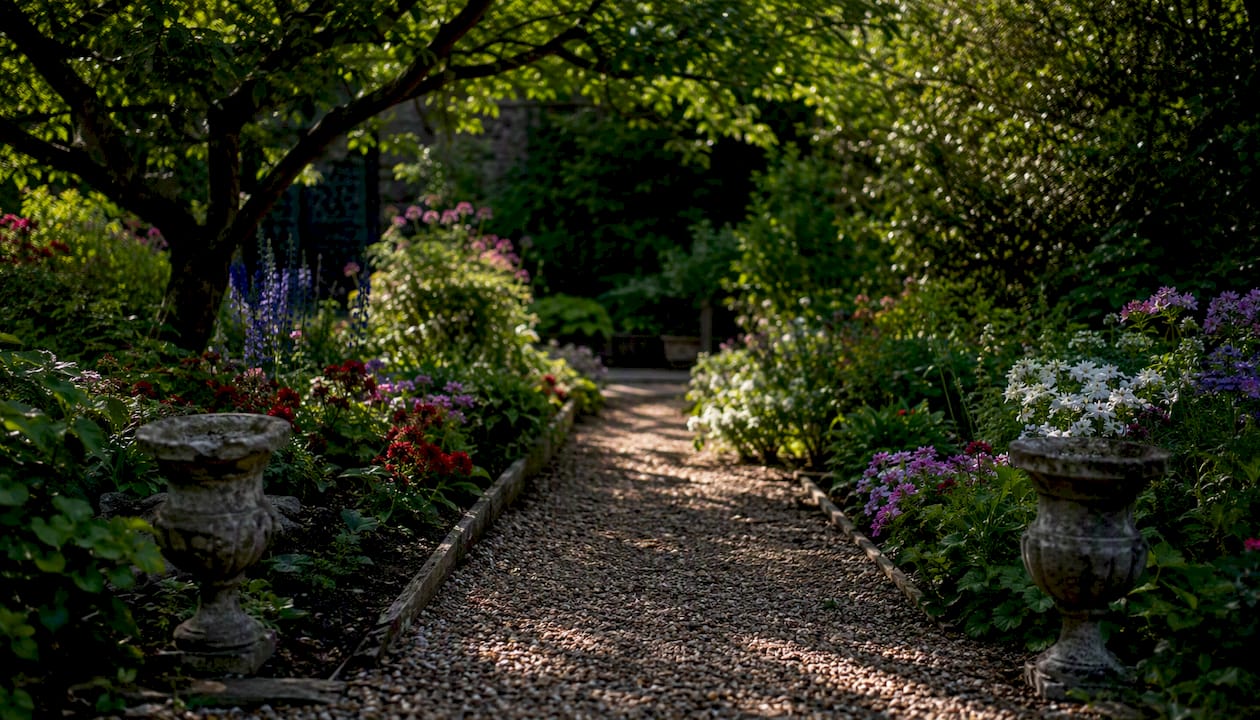
- Gravel (angular, 20mm): Drains well, relatively low cost, suits informal and cottage-style gardens. Needs landscape fabric underneath to limit weeds. RHS gravel garden guidance notes that gravel gardens are low maintenance once established but require more weeding in the first few years. Gravel migrates on slopes and can be tracked indoors — worth considering for front paths.
- Permeable block paving: Higher upfront cost than gravel but very low ongoing work. Joints can be filled with stabilised jointing sand to limit weed growth. Handles Irish rainfall without puddling.
- Compacted limestone or hoggin: Natural, permeable, relatively affordable. Needs occasional re-levelling and a top-up every few years. Good for informal paths and rear garden areas.
- Composite decking: Far lower maintenance than timber; needs an annual wash rather than annual oiling. Non-slip surface finishes are worth specifying for Irish conditions.
- Large-format porcelain paving: Minimal joints mean minimal weed ingress. Slip-resistant finishes are available and recommended for wet climates. Higher material cost, but very low upkeep over 10–15 years.
For safety in wet weather — which is most of the year in Ireland — always specify a non-slip finish for any paved area. A smooth porcelain or polished stone surface becomes genuinely hazardous when wet. Check the slip-resistance rating (R-value) when ordering; R11 or above is recommended for outdoor use.
Permanent edging between any surface and a planted bed is worth the small extra cost. Steel, aluminium or concrete edging strips prevent gravel migrating into beds and stop grass creeping onto paths, cutting the need for regular tidying.
What does a low maintenance garden cost and when should you do what?
Setting up a genuinely low-maintenance garden requires upfront investment — in time, materials or contractor fees. The payoff is a sharp reduction in recurring work from year two onwards. A realistic garden maintenance workflow for Dublin properties shows that most of the labour saving comes in the first 12 months after conversion.
Seasonal checklist
Spring (February–April)
- Top up mulch on all beds (around 5cm).
- Cut back ornamental grasses and any perennials left for winter interest.
- Check drip irrigation fittings and reconnect timers.
- Weed gravel and mulched beds before growth accelerates.
- Plant new perennials and shrubs — autumn is better, but spring works.
- Inspect edging and reset any lifted sections.
Summer (May–August)
- Run drip timers; check pots are not drying out in dry spells.
- Deadhead only where needed (many AGM perennials need none).
- Spot-weed gravel areas before weeds set seed.
- Trim any evergreen shrubs that need shaping (once, after flowering).
Autumn (September–November)
- Plant new shrubs and perennials — best establishment window.
- Empty and store water butts or insulate them.
- Leave seedheads and stems for wildlife and winter structure.
- Apply a fresh layer of bark mulch to exposed beds.
Winter (December–January)
- Drain and store drip irrigation lines.
- Check hard surfaces for frost damage or lifted edging.
- Order plants and materials for spring.
Cost and time estimates
Setup costs vary by garden size and what is already in place, with smaller gardens costing less and larger ones more depending on materials, drainage and soil conditions.
Ongoing time commitment after conversion: most well-designed low-maintenance gardens in Dublin need 1–2 hours per month in summer and under an hour per month in winter, compared with 2–4 hours per week for a traditional lawn-based garden.
Common pests and diseases in Ireland
Slugs are the most persistent problem in Irish gardens, particularly in wet years. Rather than routine spraying, the most effective low-labour approach is to choose slug-resistant plants (Geranium, Digitalis, Persicaria), apply a wildlife-safe slug pellet only at planting time, and use gritty mulch around vulnerable plants. Vine weevil affects pots; repot every two years and use a biological nematode treatment in September. Box blight has made Buxus high-maintenance — replace it with Ilex crenata or Pittosporum for a similar effect without the spraying regime.
How Sherrypropertycare converted a Dublin garden: a real example
A semi-detached property in south Dublin came to Sherrypropertycare with a typical set of problems: a worn, mossy lawn that took 45 minutes to mow and edge each week, two large raised beds that had become weed-dominated, and a concrete path that had cracked and was holding water.
What was changed:
- Lawn removed entirely and replaced with permeable block paving across two-thirds of the rear garden, with a gravel planting strip along the rear boundary.
- Two no-dig beds created along the side boundary: cardboard base, 12cm of well-rotted compost, planted with Viburnum tinus, Geranium 'Rozanne' and Hakonechloa macra.
- Cracked concrete path replaced with compacted limestone, edged with steel strip.
- A basic drip timer system installed for three large pots on the patio.
- Soil in the planting strip tested for drainage before gravel was laid — a simple percolation check confirmed the site drained adequately for Mediterranean-style planting.
The project took two working days. Maintenance in the first year required monthly weeding of the gravel strip as plants established. By year two, the plants had filled in sufficiently to reduce that to a 20-minute quarterly tidy.
Questions to ask any contractor before work begins:
- Will you check drainage before recommending gravel or a Mediterranean palette?
- What depth of mulch or compost are you using for the no-dig beds?
- Are materials permeable and suitable for Irish rainfall?
- What is the expected maintenance requirement in years 1, 2 and 3?
- Do you provide a follow-up visit to check establishment?
Pro Tip: Send photos from both ground level and from an upstairs window before requesting a quote. A bird's-eye view shows the full layout, slopes and problem areas far more clearly than a ground-level shot alone, and it speeds up an accurate estimate considerably.
An honest view on low maintenance gardening trade-offs
The phrase "low maintenance" does a lot of heavy lifting in garden design, and it is worth being direct about what it actually means in practice.
No garden is zero maintenance. What you are really doing is front-loading the effort — spending more time and money at the design and setup stage so that the recurring weekly and monthly work drops to a manageable level. The clients who are happiest with the results are those who understood that clearly from the start.
The two things most people underestimate are soil and drainage. A gravel garden planted on heavy clay, or a no-dig bed built with thin, poorly rotted compost, will create more work than the lawn it replaced within 18 months. Getting those fundamentals right at the start is not glamorous, but it is where the real labour saving comes from. Skipping a drainage check to save a small amount upfront is the most common and most costly mistake in Dublin garden conversions.
The other honest trade-off is appearance versus effort. A garden of hardy evergreen shrubs and groundcovers will look clean and structured year-round, but it will not have the seasonal drama of a garden full of annuals and tender perennials. That is a fair exchange for most busy homeowners, but it is worth deciding consciously rather than discovering it two years in.
One practical rule: design to match your realistic weekly time budget, not your aspirational one. If you can genuinely commit 30 minutes a week, design for that. If it is closer to 30 minutes a month, design for that instead. The garden that suits your actual life will always outperform the one that suits the life you planned to have.
Get a personalised quote from Sherrypropertycare in Dublin
Sherrypropertycare handles the full process of converting a Dublin garden to low maintenance — from the initial site visit and drainage assessment through to no-dig bed construction, hardscaping, and irrigation installation. You get a single, reliable team rather than coordinating separate contractors for groundworks, planting and paving.

Getting an accurate quote is straightforward. Send photos of your garden — one from ground level and one from an upstairs window if possible — along with approximate dimensions and a note of any specific problem areas (waterlogging, overgrown beds, cracked paving). Sherrypropertycare covers residential and commercial properties across Dublin. For grounds maintenance services in Dublin, get in touch directly to request your personalised quote.
Sources
- DIY drip irrigation: Simple irrigation for home gardens | DripWorks blog
FAQ
What are the best low maintenance garden ideas for Irish homes?
Reduce or remove lawn, replace it with permeable paving or gravel, and plant hardy evergreen shrubs and perennials in mulched no-dig beds. These three changes deliver the largest reduction in recurring work for most Irish gardens.
What is the easiest type of garden to maintain?
A garden with minimal or no lawn, permanent edging, mulched shrub beds and a simple drip watering system for pots requires the least ongoing effort. Hardy evergreens and groundcovers reduce seasonal replacement work significantly.
What are good low maintenance shrubs for Irish gardens?
Viburnum tinus, Choisya ternata, Pittosporum tenuifolium and Sarcococca confusa all perform reliably in Irish conditions. All four carry the RHS Award of Garden Merit and need little pruning or seasonal attention.
What is the best low maintenance path material for an Irish garden?
Permeable block paving or large-format porcelain with a non-slip finish (R11 or above) are the most practical choices. Both handle Irish rainfall well, need minimal upkeep and resist weed ingress when jointed correctly.