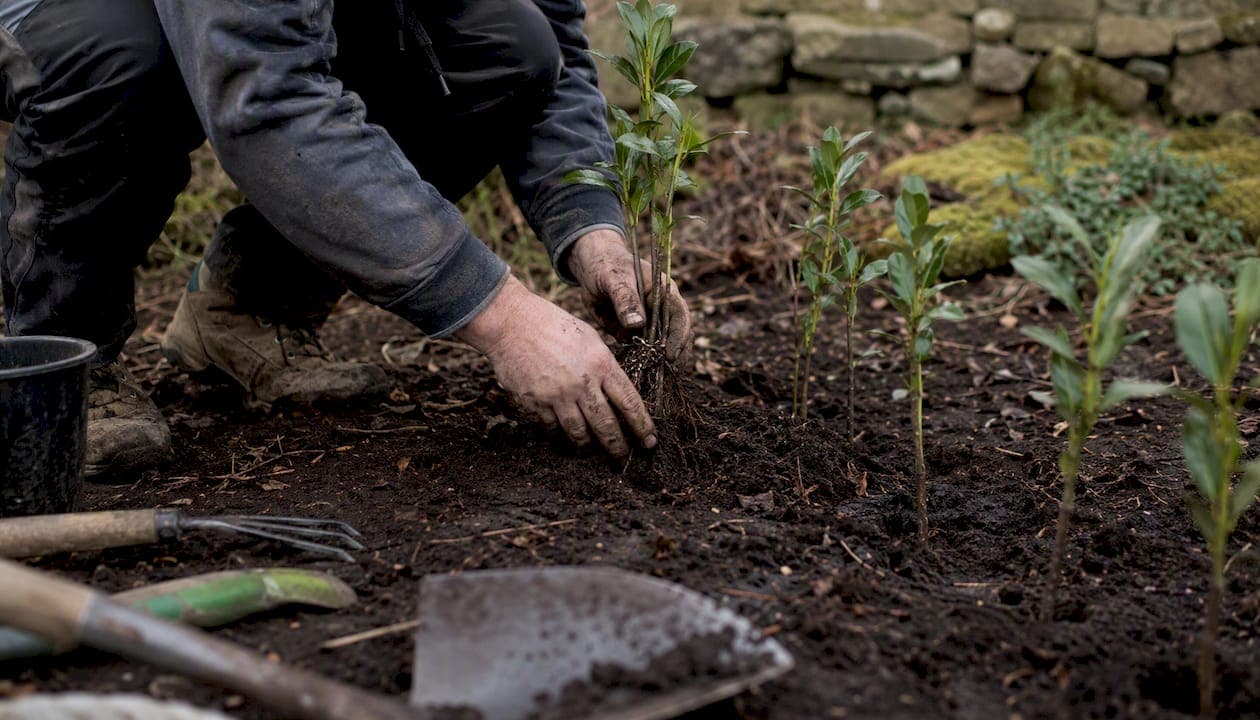
For most Irish gardens, Cherry laurel, Green privet, or a mixed native hedgerow gives the quickest, most reliable route to year-round privacy. Here is a practical shortlist to get you started:
- Cherry laurel (Prunus laurocerasus) — fast, dense, evergreen; ideal for sheltered suburban plots
- Green privet (Ligustrum ovalifolium) — semi-evergreen, tolerates poor soil and coastal exposure
- Leylandii (Cupressocyparis leylandii) — fastest growth but demands regular trimming to stay manageable
- Elaeagnus — the go-to choice for exposed or coastal Irish sites
- Hawthorn/blackthorn mix — traditional native hedgerow; solid privacy within about four years
- Beech or yew — slower but long-lived, formal screens suited to patient gardeners
Next steps: Check your site's exposure first. Order bare-root whips between November and March for the best value and establishment. If you need instant screening or a large planting, contact a local Dublin professional for a quote.
Pro Tip: Bare-root stock planted in the dormant season costs a fraction of potted plants and often establishes faster because roots are not disturbed by pot-bound growth.
Key takeaways
Cherry laurel and mixed native hedgerows offer Irish homeowners a good balance of reasonable establishment time, manageable maintenance, and reliable long-term screening.
| Point | Details |
|---|---|
| Best fast evergreen choices | Cherry laurel and Green privet grow 30–60 cm per year and are far easier to manage than Leylandii. |
| Native mixes for privacy | Hawthorn, blackthorn, holly, and beech planted at close spacing can screen effectively within four to five years. |
| Planting season | Order bare-root stock for November–March planting; it establishes faster and costs less than potted plants. |
| Maintenance rule | Trim to a triangular profile (wider at base) once or twice a year; never cut between 1 March and 31 August. |
| Sherrypropertycare | Offers full hedge installation and trimming services in Dublin; contact for a personalised written quote. |
Table of Contents
- Which privacy hedge plants in Ireland grow fastest?
- Why native hedgerows are often the best long-term privacy screen
- What grows best on exposed or coastal Irish sites?
- When and how to plant for the fastest route to privacy
- How to keep your hedge dense, healthy, and under control
- Where to buy hedging plants in Ireland
- When does hiring a professional hedging service make sense?
- Pest and disease management for privacy hedges in Ireland
- What does a privacy hedge cost in Ireland?
- Environmental considerations: wildlife, sustainability, and hedge law
- An honest view on hedging choices for Dublin gardens
- Get a professional hedge quote in Dublin from Sherrypropertycare
- Sources
- FAQ
Which privacy hedge plants in Ireland grow fastest?
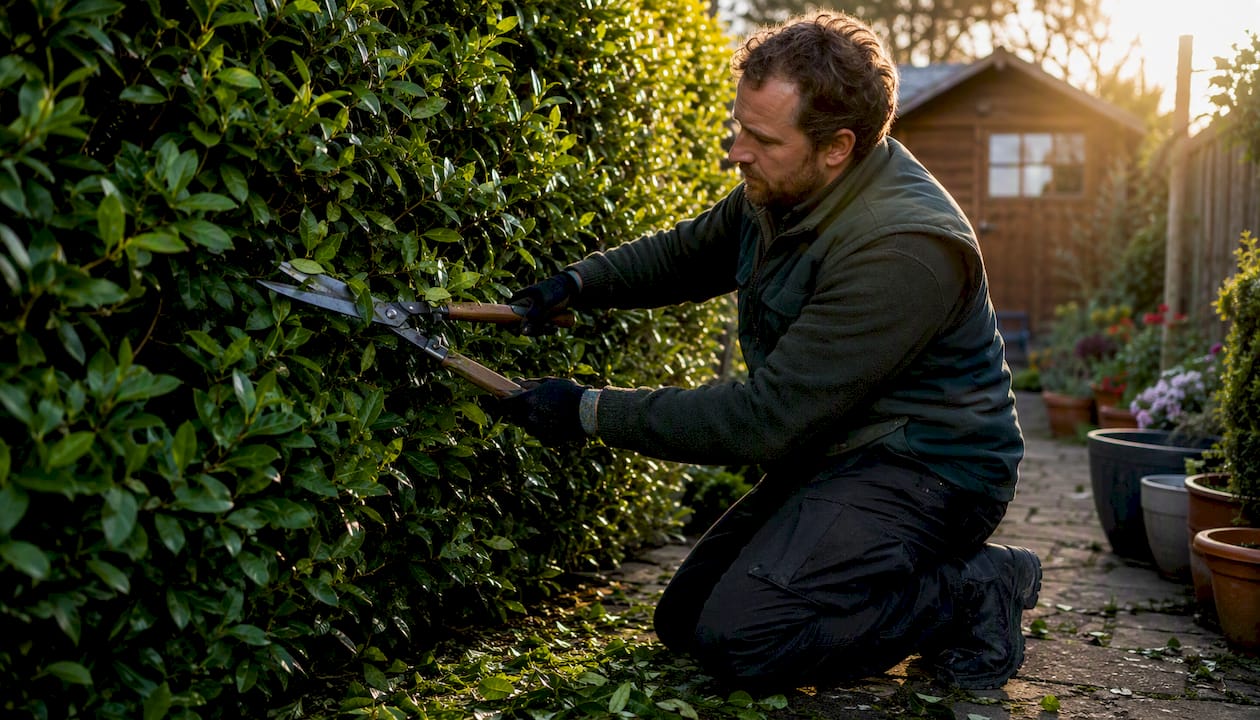
Fast growth and low maintenance rarely come together. Leylandii is known as the fastest-growing option on this list, but exact growth rates vary and it requires regular trimming to stay manageable. It needs trimming at least twice a year to prevent it becoming unmanageable. Cherry laurel grows at a moderate pace and is far easier to keep tidy and dense — slower, but far easier to keep tidy and dense.
| Plant | Annual growth | Mature height | Maintenance | Best sites |
|---|---|---|---|---|
| Leylandii | 75–90 cm | 15–20 m unchecked | High (2+ cuts/year) | Sheltered; poor for coastal |
| Cherry laurel | steady growth | 4–6 m | Medium (1–2 cuts/year) | Most soils; sheltered to semi-exposed |
| Green privet | steady growth | Up to 4 m | Medium (1–2 cuts/year) | Coastal, shade, poor soils |
| Portuguese laurel | moderate growth | 4–6 m | Low–medium (1 cut/year) | Most soils; good for dry sites |
| Elaeagnus | modest growth | 2–4 m | Low (1 cut/year) | Exposed, coastal, windy |
| Beech | modest growth | 4–6 m | Low (1 cut/year) | Most soils; not waterlogged |
| Yew | slower growth | 3–5 m | Low (1 cut/year) | Well-drained; shade tolerant |
Cherry laurel and privet pros and cons:
- Cherry laurel: large glossy leaves give dense screening quickly; tolerates shade; can look coarse in small gardens
- Green privet: adaptable to poor soils, coastal exposure and shade; semi-evergreen so may thin slightly in hard winters
- Portuguese laurel: neater leaf than cherry laurel; slower but more elegant; handles dry spells well
Leylandii note: Despite its speed, Leylandii is increasingly replaced by homeowners who underestimated the maintenance commitment. Once it outgrows its space, cutting back into old wood kills the branch. Many Dublin gardens that planted Leylandii in the 1990s have since replaced it with cherry laurel or privet.
Pro Tip: If you want fast screening without the Leylandii headache, plant Cherry laurel at 60 cm spacing and you will have a solid screen within three to four years with one annual trim.
Why native hedgerows are often the best long-term privacy screen
A mixed native hedgerow can match or exceed the screening performance of a single-species evergreen while delivering far greater seasonal interest and benefits to birds and pollinators. Native species are also well adapted to Irish soils and rainfall, meaning fewer failures after planting.
Recommended native species and their roles:
- Hawthorn (Crataegus monogyna) — the backbone of traditional Irish hedgerows; dense, thorny, and excellent for security as well as privacy
- Blackthorn (Prunus spinosa) — extremely dense and thorny; flowers early, providing food for pollinators before most other plants
- Hazel (Corylus avellana) — fast-growing filler that adds bulk quickly; produces catkins and nuts for wildlife
- Holly (Ilex aquifolium) — one of only two native evergreen options; provides year-round screening and winter berries for birds
- Beech (Fagus sylvatica) — technically deciduous but holds its copper leaves through winter, giving near-evergreen screening
- Yew (Taxus baccata) — the other native evergreen; slow but very long-lived and dense; all parts toxic so avoid near children or livestock
As garden experts note, native evergreen choices are limited to holly and yew, so a mixed hedgerow typically combines these with deciduous species for a screen that is dense enough for privacy even in winter.
Planting patterns:
For a single-row hedge, plant whips at 30–45 cm apart in a staggered zigzag. For a thicker, more wildlife-friendly screen, use a double row with 45 cm between rows and plants offset so each fills the gap left by the other. Hawthorn planted at close spacing can form a good hedge in a few years, and a mixed species planting adds resilience — if one species struggles, others fill the gap.
Teagasc documents approximately 100 plant species associated with Irish hedgerows, and notes that hedgerows provide shelter, flood mitigation, and habitat corridors. A native hedge is not just a privacy screen; it is a functioning piece of local ecology.
What grows best on exposed or coastal Irish sites?
Elaeagnus is the standout choice for salt-laden, windy sites. It is highly tolerant of salt-laden winds and recommended for exposed or coastal Irish gardens, and it establishes where many other species fail. Green privet is a close second: Future Forests lists it as hardy to RHS H6 with strong tolerance of coastal exposure and poor soils.
Tolerant species for exposed sites:
- Elaeagnus — salt-tolerant, wind-firm, semi-evergreen; ideal as a first-line shelterbelt
- Green privet — handles coastal spray, poor soil and shade; grows to around 4 m
- Hawthorn — tough and wind-resistant; the traditional choice for Irish field boundaries
- Blackthorn — even more wind-firm than hawthorn; forms an impenetrable barrier
- Griselinia — popular in coastal Irish gardens; fast-growing and salt-tolerant, though not fully hardy in severe inland frosts
Shelterbelt layout for very exposed sites:
In extreme exposure, a single hedge row often fails or grows lopsided. A layered shelterbelt works better: plant an outer row of wind-tolerant trees such as alder or sycamore, then an inner row of tough shrubs like Elaeagnus or spindle. This staged approach reduces wind speed progressively rather than creating a solid barrier that can generate turbulence on the lee side.
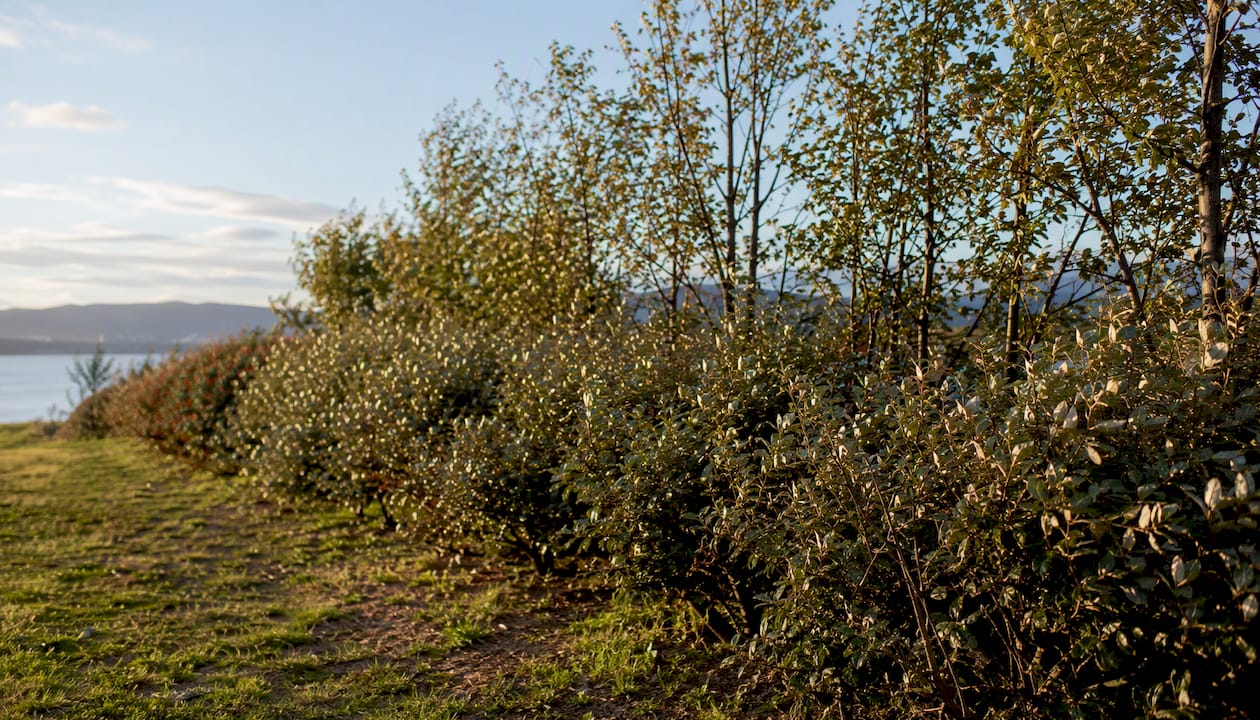
Pro Tip: On coastal sites, lean the outer row of plants slightly into the prevailing wind at planting. This helps them develop a stronger root anchor before they reach full height.
When and how to plant for the fastest route to privacy
The fastest and most cost-effective route to a privacy screen is bare-root stock planted during the dormant season from November to March. Bare-root whips are inexpensive, establish quickly, and are available from most Irish nurseries through the winter months. For immediate screening, root-balled or instant hedging units are available year-round but cost significantly more.
Planting checklist:
- Mark the hedge line and clear a strip 60–90 cm wide of weeds and grass.
- Improve heavy clay or compacted soil with grit and organic matter before planting.
- For bare-root whips, use the T-slash method: push a spade in vertically, lever forward, drop the root into the slot, remove the spade, and firm the soil with your heel.
- For root-balled instant hedging, dig a hole twice the width of the root ball. Do not remove the biodegradable hessian wrapping; it protects the root ball and breaks down in the soil.
- Water thoroughly after planting and apply a mulch layer 5–8 cm deep to retain moisture and suppress weeds.
- In the first growing season, water weekly during dry spells.
Estimated years to substantial privacy:
Spacing guide: Cherry laurel and privet: a few plants per metre. Hawthorn/blackthorn mix: somewhat denser planting rate in a single row, or 3 per metre per row in a double row. Leylandii: 2 plants per metre maximum, or it will close in too fast to manage.
How to keep your hedge dense, healthy, and under control
Routine trimming and a triangular profile are the two things that keep a hedge dense at the base and long-lived. Teagasc recommends a triangular profile — wider at the base than the top — so that light reaches the lower foliage and prevents the bare, leggy base that plagues neglected hedges.
Pruning schedule by species:
Hedge cutting in Ireland is regulated by bird-nesting protections: avoid cutting between 1 March and 31 August. Even after the season reopens, defer cutting hedges heavy with berries to support wildlife through the autumn and winter.
Pro Tip: When trimming, always cut the sides at a slight inward angle so the base is 10–15 cm wider than the top. A hedge trimmed with vertical sides will eventually lose its lower leaves as the top shades them out.
Signs you should hire professional maintenance:
- The hedge has grown beyond comfortable reach with a domestic trimmer
- The base has become bare or woody and needs remedial cutting
- You are unsure whether cutting is permitted under nesting-season rules
- The hedge borders a public road or a neighbour's boundary
- You want a formal, clean finish that requires precision equipment
Where to buy hedging plants in Ireland
Source from reputable Irish nurseries and check native provenance where you are planting a wildlife-friendly mix. Several well-regarded suppliers deliver nationwide.
Supplier types and what they offer:
- Cullen Nurseries — stocks Cherry laurel, privet, and instant root-balled laurel hedging; offers bare-root and potted stock with nationwide delivery
- Future Forests — specialist in native Irish hedging; stocks Green privet, hawthorn, blackthorn, hazel, holly, and other native species; strong on provenance
- Caragh Nurseries — broad range of hedging plants including privet and Elaeagnus; useful for coastal and exposed-site species
- Hillier Nurseries — large UK nursery with a wide hedging range; ships to Ireland; good for less common species
- Thompson & Morgan — online supplier with hedging ranges; useful for smaller quantities and potted stock
- Crocus — well-regarded online nursery; good for potted hedging and unusual varieties
- Primrose Plants — stocks a range of hedging plants with delivery to Ireland
Ordering checklist:
- Confirm plant height at delivery (bare-root whips typically 40–80 cm; instant hedging 1.5–2.5 m)
- Choose bare-root for November–March planting; potted stock for year-round planting
- Calculate quantity: 2–3 plants per metre for laurel and privet; 3–5 per metre for native mixes
- Check delivery lead times, especially for bare-root stock in peak season (December–February)
- For native mixes, ask about Irish provenance to support local biodiversity
When does hiring a professional hedging service make sense?
Hire a professional for large plantings, instant hedging installation, exposed or difficult sites, or when you simply want a turnkey job done correctly from the start. Getting the planting depth, spacing, and soil preparation right at the outset makes a significant difference to how quickly the hedge establishes.
Typical professional services include:
- Site survey and species recommendation based on soil, exposure, and privacy goals
- Soil preparation: breaking up compaction, adding organic matter or grit where needed
- Planting bare-root or root-balled stock to correct depth and spacing
- Handling and installing instant hedging units without disturbing the root ball
- Follow-up maintenance visits: trimming, feeding, and watering checks in the first season
Quote process — what to expect:
- Contact the service and share photos of the site (boundary length, soil type, existing planting).
- Receive a written estimate covering plant supply, labour, and any soil improvement work.
- Agree a planting date within the appropriate season.
- Planting is carried out, with aftercare instructions provided.
- Optional: schedule a follow-up maintenance visit for the first trim.
What to check on a quote: Confirm whether plant supply is included or separate, what soil preparation is covered, and whether a follow-up trim is part of the package. For Dublin hedge care and legal boundary considerations, it is also worth checking that the installer is familiar with local nesting-season rules and boundary regulations.
Pest and disease management for privacy hedges in Ireland
Most privacy hedges in Ireland are reasonably trouble-free, but a few issues recur often enough to watch for.
Cherry laurel can suffer from shot hole disease (Stigmina carpophila), which causes brown spots and holes in leaves. It looks alarming but rarely kills the plant; improve air circulation by thinning dense growth and avoid overhead watering. Vine weevil can damage roots of container-grown plants before they establish; check root balls at planting for the characteristic C-shaped white grubs.
Leylandii is susceptible to Seiridium canker, which causes die-back of individual branches. Remove affected branches promptly and disinfect tools between cuts. There is no chemical cure, so good hygiene is the main defence.
Privet occasionally suffers from honey fungus (Armillaria) in older gardens where tree stumps are present. If sections of the hedge die back suddenly, check the base of stems for white mycelium and the characteristic bootlace-like rhizomorphs in the soil. Remove and dispose of infected material; do not compost it.
Yew is generally very healthy but can suffer from Phytophthora root rot in waterlogged soils. Plant only in well-drained positions and avoid overwatering in the establishment period.
For all species, the best general defence is correct planting depth, good drainage, and avoiding the stress of drought in the first two summers. A stressed hedge is far more vulnerable to disease than a well-established one.
What does a privacy hedge cost in Ireland?
Costs vary considerably depending on species, plant size, and whether you plant yourself or hire a professional.
Plant purchase: Bare-root whips for native species (hawthorn, blackthorn, hazel) typically cost €0.50–€2.00 per plant when bought in bulk from a specialist nursery. Bare-root Cherry laurel and privet run higher, often €3–€8 per plant depending on size. Instant root-balled laurel hedging units at 1.5–2 m height can cost €40–€120 per unit or more, depending on the supplier and size.
Planting costs: DIY planting of bare-root whips is straightforward and costs only your time plus any soil improvement materials. Professional planting, including soil preparation and labour, typically adds €10–€25 per metre for bare-root hedging, with instant hedging installation costing more due to the weight and handling involved.
Ongoing maintenance: A single annual trim by a professional service for a standard garden hedge of 20–30 metres runs roughly €80–€200 depending on height, access, and location. Twice-yearly trimming for faster-growing species such as privet or Leylandii doubles that figure. Reviewing local hedge trimming services before committing to a supplier helps you compare what is included in the price.
The most cost-effective approach for most homeowners is bare-root native or semi-native species planted in winter, maintained with one annual cut. The initial outlay is low, establishment is reliable, and annual maintenance costs stay manageable.
Environmental considerations: wildlife, sustainability, and hedge law
Hedges are among the most wildlife-rich features in any Irish garden. Teagasc notes that hedgerows provide shelter, flood mitigation, habitat corridors, and are associated with approximately 100 plant species. A well-planted mixed hedge supports nesting birds, pollinators, small mammals, and invertebrates in ways that a fence or wall simply cannot.
Choosing native or near-native species maximises this value. Holly and hawthorn berries feed birds through winter. Blackthorn blossom is one of the earliest nectar sources for bees in spring. Hazel provides nuts for squirrels and dormice. Even a predominantly evergreen screen benefits from including at least one or two native species in the mix.
Hedge-cutting law in Ireland is clear: cutting is prohibited between 1 March and 31 August under wildlife legislation, protecting nesting birds during the breeding season. This applies to all hedges, not just rural ones. Cutting outside this window is permitted, but Teagasc advises deferring cuts on berry-heavy hedges even after September to support autumn and winter wildlife.
On sustainability, bare-root native stock from Irish-provenance nurseries has a very low carbon footprint compared to large container-grown imports. Choosing locally sourced whips also reduces the risk of introducing pests or diseases from overseas nurseries.
An honest view on hedging choices for Dublin gardens
The most common mistake Dublin homeowners make is choosing the fastest-growing species without thinking about what that means five years later. Leylandii planted at close spacing will give you a screen in two to three years, but it will also give you a maintenance obligation that grows with the hedge. Many of the gardens we see in Dublin have Leylandii that has been left too long and is now too wide to cut back safely without leaving dead brown sections.
The better approach, in most cases, is to accept a slightly longer wait and plant Cherry laurel or a mixed native hedge. Cherry laurel at 30–60 cm annual growth gives you a solid screen within three to four years, responds well to trimming, and stays manageable for decades. A native mix takes a little longer but delivers something a single-species evergreen never will: a hedge that changes through the seasons, feeds wildlife, and genuinely belongs in the Irish garden.
For exposed Dublin coastal gardens, Elaeagnus planted as a first line with privet or hawthorn behind it is a combination that works reliably. It is not glamorous, but it does the job without the drama of replacing failed plants.
Get a professional hedge quote in Dublin from Sherrypropertycare
Sherrypropertycare offers a practical alternative to sourcing plants, hiring equipment, and managing the installation yourself. Based in Dublin, the team handles the full process: site survey, soil preparation, planting, and follow-up trimming, so you get a finished hedge without the guesswork.
Services relevant to privacy hedging:
- Site survey and species recommendation for your specific soil and exposure
- Supply and planting of bare-root or root-balled hedging stock
- Instant hedging installation, including correct root-ball handling
- Annual or twice-yearly trimming to maintain a dense, well-shaped screen
- Patio, garden, and grounds maintenance packages for ongoing care
Send a photo of your site and boundary to get a personalised quote. Sherrypropertycare works with residential and commercial properties across Dublin. Request your quote here and get a clear written estimate before any work begins.
Sources
- Planting Hedges for a Sustainable Future
- Peter Dowdall: How screening adds a new dimension to the garden
- Buy Fast Growing Hedging Plants online | Award Winning Nursery | Nationwide Delivery | 086 3205310
- Ligustrum ovalifolium - Green Privet – Future Forests
- Ligustrum ovalifolium / Privet – Caragh Nurseries
- Give me shelter: how to grow a native Irish hedge – The Irish Times
FAQ
What is the fastest-growing hedge for privacy in Ireland?
Leylandii grows at 75–90 cm per year, making it the fastest option, but Cherry laurel at 30–60 cm per year is the more practical choice for most gardens because it stays manageable with one or two trims a year.
What is the best hedge for exposed or coastal Irish sites?
Elaeagnus is the most reliable choice for salt-laden, windy sites, with Green privet and Hawthorn also performing well. For very exposed positions, a layered shelterbelt with an outer row of wind-tolerant trees and an inner row of tough shrubs gives the best results.
How long does a native Irish hedge take to give privacy?
Hawthorn planted as bare-root whips at close spacing typically forms a good hedge within about four years. A mixed native planting with blackthorn, hazel, and holly will reach a useful screening height within four to five years.
What type of hedge is best for privacy year-round?
Cherry laurel is the most popular year-round evergreen screen in Irish gardens, combining fast growth, dense foliage, and manageable maintenance. For a native option, including holly and beech in a mixed hedge provides near-evergreen cover through winter.