
TL;DR:
- Consistent, planned property maintenance enhances asset value, reduces emergency costs, and improves tenant retention. Preventive and predictive strategies deliver significant ROI by avoiding failures and extending asset lifespan. A structured maintenance plan with digital tools maximizes property value and operational efficiency in Dublin's competitive market.
Property maintenance is defined as the systematic upkeep of a building and its grounds to preserve structural integrity, functionality, and market value. For property owners and real estate investors in Dublin, the role of property maintenance in ROI is direct: consistent upkeep prevents capital erosion, reduces emergency repair costs, and keeps tenants paying rent on time. Preventive maintenance yields up to 545% ROI, with an average of £2 to £4 saved for every £1 spent. That figure is not a marketing claim. It reflects the compounding effect of avoided failures, extended asset life, and stable occupancy across a well-managed portfolio.
How does property maintenance improve long-term ROI?
The financial case for planned maintenance rests on a simple principle: prevention costs less than cure. Reactive maintenance, where you fix things only after they break, consistently produces higher total spend than a structured preventive programme. Emergency call-outs carry premium labour rates, and secondary damage from a single failure, such as a burst pipe flooding a ground-floor flat, can multiply the original repair cost several times over.
Preventive maintenance, by contrast, schedules inspections and servicing before failures occur. The OxMaint case study across a 2 million square foot commercial portfolio demonstrates this clearly: HVAC maintenance costs fell by 38%, emergency shutdowns dropped by 71%, energy spend reduced by 18%, and the portfolio saved £1.44 million annually across 14 buildings. The payback period was five months. Those numbers show that maintenance ROI is first realised through emergency avoidance, then compounded by broader operating savings.
Predictive maintenance takes the logic further. Using sensor data and condition monitoring, it identifies equipment degradation before a fault develops. This approach extends asset lifespan and reduces the frequency of both planned and unplanned interventions. For Dublin investors managing multiple properties, the cumulative effect on net operating income (NOI) is significant.
- Audit your current maintenance spend by separating planned work from reactive call-outs. If reactive work exceeds 30% of your total maintenance budget, you have a clear efficiency gap.
- Schedule quarterly inspections covering roofing, guttering, heating systems, and external grounds.
- Track mean time between failures for key building systems to identify which assets need more frequent attention.
- Set a maintenance reserve of 1% to 2% of property value annually, adjusted upward for older stock.
- Review contractor performance against agreed response times and first-fix rates every six months.
Pro Tip: Record every maintenance intervention in a single log, even minor ones. This data becomes your strongest negotiating tool when reviewing contractor rates and your clearest evidence of asset condition when refinancing or selling.
What are the main property maintenance strategies and how do they compare?
Three distinct approaches define the field: reactive, preventive, and predictive maintenance. Each carries a different cost profile, risk level, and ROI outcome.
Reactive maintenance means responding to failures as they happen. It requires no upfront planning and appears cheap in the short term. The problem is that deferred maintenance grows costlier over time, undermining ROI through cost escalation and deteriorating building performance. The UK government's 2024 to 2025 State of the Estate report frames this explicitly: short-term cost pressure leads to backlogs that become structurally damaging to asset economics.
Preventive maintenance operates on a fixed schedule. Boilers are serviced annually, gutters cleared twice yearly, and external paintwork inspected every three years. This approach improves budget predictability and reduces emergency work significantly.
Predictive maintenance uses real-time data to trigger interventions only when condition thresholds are crossed. It is the most capital-efficient approach for larger portfolios but requires upfront investment in monitoring technology.
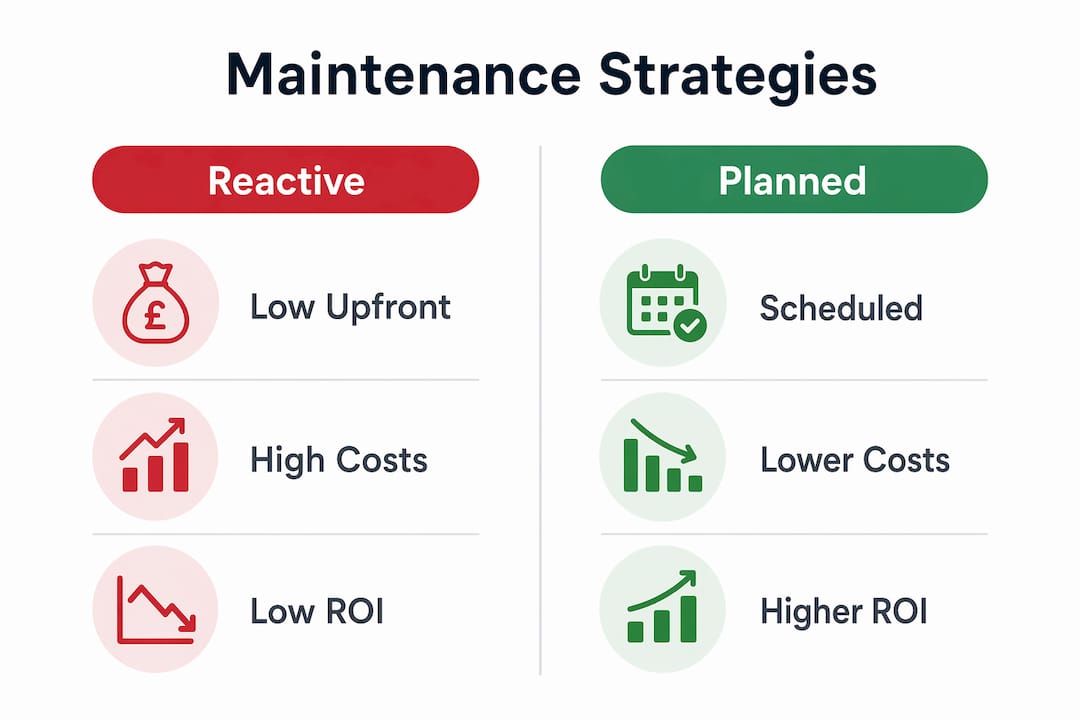
| Strategy | Cost pattern | ROI impact | Tenant satisfaction |
|---|---|---|---|
| Reactive | Low upfront, high long-term | Negative over time | Poor, due to disruption |
| Preventive | Steady and predictable | Positive, 2x to 4x return | Good, fewer disruptions |
| Predictive | Higher upfront, lowest long-term | Highest, up to 545% ROI | Excellent, near-zero downtime |
The shift from reactive to planned maintenance reduces emergency work, increases uptime, and improves budget predictability. These are the three critical levers for ROI optimisation in any property portfolio.
Common pitfalls to avoid when implementing a maintenance strategy:
- Deferring maintenance to protect short-term cash flow, which creates a backlog that costs significantly more to clear later
- Treating all maintenance as equal spend rather than separating value-preserving work from compliance-driven work
- Failing to document completed work, which weakens your position during property valuations and insurance claims
- Selecting contractors on price alone without assessing first-fix rates and response time guarantees
Pro Tip: Measure your planned-to-reactive maintenance ratio monthly. A ratio of 80% planned to 20% reactive is a reliable benchmark for a well-run property portfolio. Below that, your maintenance programme needs restructuring.
How does maintenance affect tenant retention and property value in Dublin?
Tenant retention is one of the most underestimated drivers of ROI in residential and commercial property. Every void period costs you rent income, re-letting fees, and often a redecoration budget. In Dublin's competitive rental market, tenants who experience prompt, professional maintenance responses are far more likely to renew their leases.
Well-maintained properties can increase in value by up to 10% compared with equivalent properties where upkeep has been neglected. That uplift compounds over time. A Dublin property worth €500,000 today, maintained to a high standard, could be worth €550,000 in five years purely on the basis of condition relative to comparable stock. Neglected properties, by contrast, attract lower offers and longer selling periods.
Curb appeal is particularly important in Dublin's residential market. First impressions drive both tenant applications and buyer interest. Routine grounds maintenance including lawn care, hedge trimming, and seasonal planting directly affects how a property is perceived and priced.
Maintenance actions that directly improve tenant satisfaction and retention:
- Responding to reported faults within 24 hours for urgent issues and 72 hours for non-urgent ones
- Carrying out annual property inspections with written feedback shared with tenants
- Maintaining communal areas, bin stores, and external lighting to a consistent standard
- Servicing heating systems before winter, not during it
- Keeping external grounds tidy year-round, which signals to tenants that the landlord takes the property seriously
What digital tools support better maintenance decisions and ROI tracking?
Computerised Maintenance Management Systems (CMMS) are software platforms that schedule, record, and analyse maintenance activity across a property portfolio. JLL highlights that CMMS tools extend asset lifespans, prevent service interruptions, reduce operating costs, and improve safety. For Dublin investors managing more than two or three properties, a CMMS moves maintenance from a reactive burden to a managed programme with measurable outcomes.
AI-driven predictive maintenance platforms go further by analysing sensor data from building systems to forecast failures before they occur. Energy analytics tools identify inefficiencies in heating, lighting, and ventilation that inflate operating costs without adding tenant value.
- Identify your portfolio's highest-cost systems before selecting a platform. HVAC, lifts, and flat roofs typically generate the most emergency spend.
- Choose a CMMS with mobile access so contractors can log completed work on-site in real time.
- Integrate energy monitoring to track consumption patterns and identify anomalies that signal equipment degradation.
- Set automated alerts for inspection due dates, warranty expirations, and contractor review periods.
Pro Tip: Start with a spreadsheet-based maintenance log before investing in CMMS software. Once you have six months of data, you will know exactly which features you need and which platforms are worth the subscription cost.
How can Dublin property owners build a maintenance plan that maximises ROI?
A maintenance plan is a written schedule of all inspections, servicing, and renewal work required across a property, with costs, frequencies, and responsible parties assigned to each task. Without one, maintenance becomes reactive by default. The importance of property upkeep as a scheduled discipline rather than an ad-hoc response is well established in Dublin's property management sector.
The risk of underfunded maintenance is not theoretical. The US General Services Administration currently faces a £50 billion maintenance backlog after funding only 0.375% of asset value annually instead of the recommended 2% to 4%. That shortfall has forced consideration of an 80% reduction in the portfolio to remain financially sustainable. The lesson for private investors is clear: underfunding maintenance does not save money. It defers and multiplies costs.
- Conduct a full condition survey of every property you own, noting the age and condition of all major systems and surfaces.
- Categorise work into statutory compliance (gas safety, electrical certification), planned preventive maintenance, and capital renewal (roof replacement, window upgrades).
- Set an annual maintenance budget based on 1% to 2% of property value, with a separate emergency reserve of 0.5%.
- Select contractors based on references, insurance certificates, and demonstrated response times rather than lowest quote alone.
- Review the plan annually and update condition data after each inspection cycle.
Common mistakes Dublin investors make when building maintenance plans include underestimating the cost of grounds maintenance, ignoring external drainage until it causes internal damage, and failing to account for the cost of deferred repairs when setting budgets. External maintenance, including landscaping and grounds care, is often the first item cut and the first thing prospective tenants and buyers notice.
Pro Tip: Ask your maintenance contractor to provide a written condition report after every visit, not just an invoice. Over two years, those reports build a condition history that protects you during disputes and strengthens your asset's valuation.
Key takeaways
Consistent, planned property maintenance is the single most reliable method for protecting and growing real estate ROI over time.
| Point | Details |
|---|---|
| Preventive maintenance delivers strong returns | Every £1 spent on planned maintenance saves £2 to £4 in avoided repairs and replacements. |
| Reactive maintenance erodes ROI | Deferred maintenance backlogs grow costlier over time and directly reduce asset value and income. |
| Tenant retention depends on maintenance quality | Prompt, professional maintenance responses reduce void periods and protect net operating income. |
| Digital tools improve maintenance efficiency | CMMS platforms and predictive maintenance systems extend asset life and improve budget predictability. |
| A written maintenance plan is non-negotiable | Scheduled inspections, defined budgets, and contractor accountability are the foundation of ROI-focused property management. |
Why maintenance is the investment discipline most Dublin investors overlook
From my experience working with property owners across Dublin, the pattern is consistent. Investors spend considerable time analysing purchase prices, rental yields, and financing costs. They spend very little time modelling maintenance. That gap is where returns are quietly lost.
The UK government's framing of maintenance as capital stewardship rather than operational cost is the right mental model. When you defer a roof repair to protect this year's cash flow, you are not saving money. You are borrowing against next year's return at a high interest rate, because water ingress compounds damage rapidly.
Dublin's property market rewards well-presented, well-maintained stock. Tenants here have more choice than they did five years ago, and they notice the difference between a landlord who responds in 24 hours and one who takes three weeks. That difference shows up directly in lease renewal rates and in the premium you can command at rent review.
My honest view is that maximising ROI through maintenance is not about spending more. It is about spending deliberately. A written plan, a reliable contractor, and a consistent inspection schedule will outperform any amount of reactive spending. If you are not tracking your planned-to-reactive maintenance ratio, start this month.
— gerard
How Sherrypropertycare helps Dublin property owners protect their ROI
If you own residential or commercial property in Dublin and want a grounds maintenance programme that protects your investment, Sherrypropertycare delivers exactly that.

Sherrypropertycare specialises in high-quality gardening and grounds maintenance services for properties across Dublin, covering lawn care, hedge trimming, seasonal planting, and full grounds upkeep. Every programme is tailored to your property's specific needs, with consistent scheduling that keeps your asset looking its best year-round. A well-maintained exterior signals quality to tenants and buyers alike, and that signal translates directly into stronger valuations and lower void periods. Contact Sherrypropertycare today for a customised quote. Send a photo of your grounds and get a clear, no-obligation proposal built around your property.
FAQ
What is the role of property maintenance in ROI?
Property maintenance preserves asset value, reduces emergency repair costs, and supports tenant retention, all of which directly protect and grow return on investment. Preventive maintenance alone can deliver up to 545% ROI by avoiding major failures and keeping properties occupied.
Does maintenance increase property value?
Yes. Well-maintained properties can achieve up to 10% higher market values compared with neglected equivalents. Consistent upkeep also reduces time on market and supports stronger offers from buyers and tenants.
How much should I budget for property maintenance annually?
Industry guidance recommends budgeting 1% to 2% of a property's value annually for planned maintenance, with an additional 0.5% held as an emergency reserve. Properties with older building systems or extensive grounds may require the upper end of that range.
What happens if I defer property maintenance?
Deferred maintenance creates a backlog that grows costlier over time. Secondary failures, such as structural damage from unresolved water ingress, can multiply the original repair cost significantly and reduce both rental income and sale value.
How does grounds maintenance affect tenant satisfaction in Dublin?
External presentation is one of the first things tenants assess when viewing a property. Tidy, well-kept grounds signal a responsible landlord and contribute to tenant comfort and pride in their home, which directly supports lease renewals and reduces void periods.