TL;DR:
- By 2026, the property maintenance industry has shifted to preventive and predictive practices driven by integrated technology platforms. This approach reduces costs, protects asset value, and improves tenant retention by fixing issues before failures occur and responding quickly to requests. Technology such as IoT sensors and AI-driven work orders only deliver benefits when combined with operational discipline and vendor accountability.
The property maintenance industry in 2026 is defined by a decisive shift from reactive repairs to preventive and predictive maintenance, powered by integrated technology platforms. Property managers, landlords, and real estate investors who adopt this shift protect asset value, reduce costs, and retain tenants more effectively. The National Apartment Association and facility management bodies consistently point to preventive scheduling and data-driven maintenance as the foundation of sound property management practices 2026. Sherrypropertycare, working with residential and commercial properties across Dublin, sees this shift playing out in real time with clients who plan ahead and those who do not.
What are the key property maintenance industry trends 2026?
The property maintenance industry trends 2026 are built on one core principle: address problems before they become failures. Preventive maintenance is no longer a best practice reserved for large portfolios. It is the standard operating model for any property manager serious about protecting cash flow and long-term asset value.
Properties without preventive maintenance schedules incur an average of $650 in emergency call-out costs per incident. That figure compounds quickly across a multi-unit portfolio. HVAC filter delivery programmes alone cut related work orders by 38%–50%, which means fewer emergency calls, lower repair bills, and less disruption for tenants.
Predictive maintenance has moved from experimental to standard practice. Predictive systems reduce overall maintenance costs by 20%–25% by catching issues before they escalate. A single catastrophic failure can cost $2,500 or more in immediate Net Operating Income loss. Preventing one such failure per quarter pays for an entire preventive programme.
How does preventive maintenance reduce costs and protect property value?
Preventive maintenance is a high-return investment, not a routine expense. The financial case is straightforward: spend a small amount regularly, or spend a large amount unpredictably. Property managers who treat maintenance as a cost centre rather than an investment consistently face higher repair bills and lower tenant satisfaction.
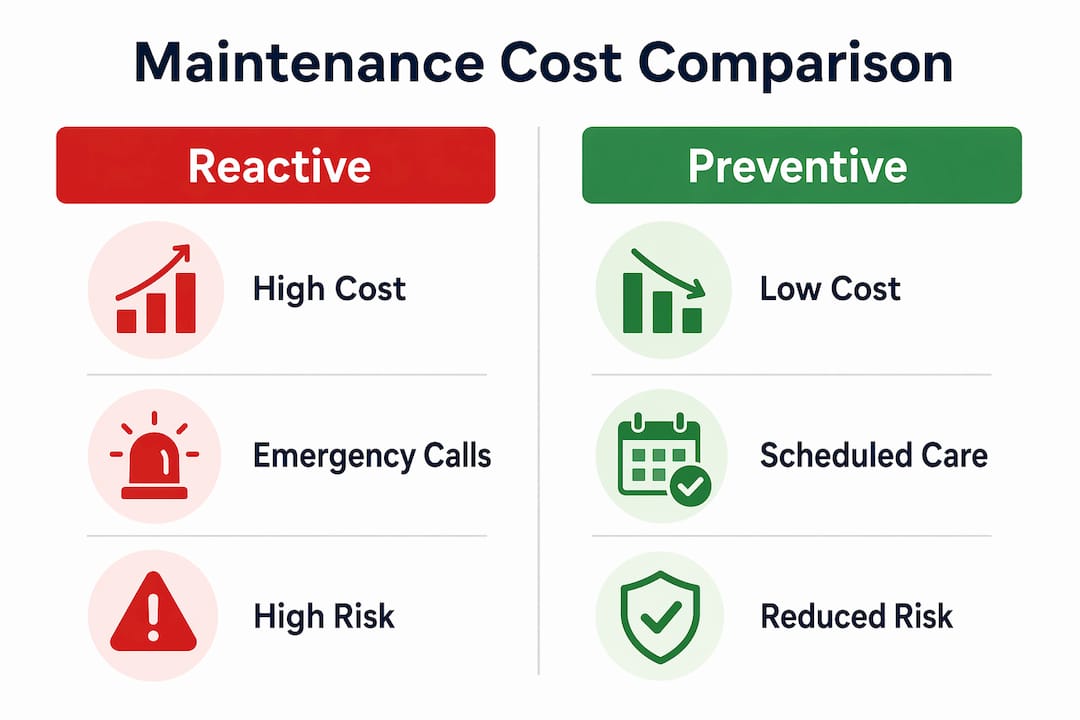
| Maintenance approach | Typical cost profile | Risk level |
|---|---|---|
| Reactive (repairs only) | High per-incident cost, unpredictable | High |
| Preventive (scheduled) | Lower per-unit cost, predictable | Low |
| Predictive (sensor-driven) | Higher setup cost, lowest long-term spend | Very low |
Scheduling HVAC filter replacements at least 30 days before peak season reduces emergency calls by around 35% and lowers average repair cost by £180 per unit. That timing window matters because contractors are available, parts are in stock, and tenants are not yet in peak-demand mode.
Preventive maintenance also protects property valuation directly. A well-maintained property commands higher rents and sells at a premium. Maintenance's role in real estate value is well documented: deferred maintenance reduces asset value faster than almost any other single factor.
Pro Tip: Schedule all seasonal maintenance tasks at least 30 days before peak periods. Book contractors in advance, order parts early, and confirm completion before the season begins. This one habit eliminates the majority of reactive emergency calls.
How is technology reshaping property maintenance management?
The biggest operational shift in 2026 facility management trends is the move away from disconnected tool stacks. Property managers previously juggled separate systems for work orders, tenant communication, vendor management, and financial reporting. Integrated platforms centred on the resident lifecycle now replace that fragmentation, improving both workflow and tenant experience.

AI-driven maintenance triage is now practical and affordable for mid-size portfolios. These systems categorise incoming maintenance requests, assign priority levels, and generate automated work orders without manual input. The result is faster response times and fewer requests that fall through the cracks.
IoT sensors add another layer of protection. Sensors monitoring water pressure, temperature, and energy consumption flag anomalies before they become failures. The critical detail is integration: IoT data must connect directly to automated work order systems. Without that connection, alerts pile up and overwhelm maintenance staff rather than helping them act.
Key benefits of integrated technology platforms include:
- Automated work order creation from sensor alerts or tenant requests
- Centralised vendor management with performance tracking
- Real-time visibility into open, in-progress, and completed tasks
- Reduced administrative overhead for on-site and remote teams
- Consistent audit trails for compliance and insurance purposes
Pro Tip: Standardise vendor Service Level Agreements with firm turn caps. Unstructured vendor management causes a 10% maintenance markup creep over time. A written SLA with a five-day completion cap prevents that cost inflation and keeps tenant satisfaction consistent.
How does maintenance response time affect tenant retention?
Tenant retention is the most direct financial measure of maintenance quality. Responding to maintenance tickets within 24 hours produces 12% higher tenant retention. That figure alone justifies investment in faster response systems.
The downside is equally clear. Failing to resolve a maintenance issue within 72 hours increases the probability of a move-out notice by 18%. Properties responding within 48 hours show a 23% higher lease renewal rate, according to tenant survey data. The window between 24 and 72 hours is where most landlords either win or lose their tenants.
Unit turnover is expensive. Vacancy, cleaning, repainting, and re-letting costs average around £3,500 per unit. Retaining one tenant through better maintenance response pays for a significant portion of a preventive maintenance programme.
Practical steps to improve response times and tenant communication:
- Set a 24-hour acknowledgement standard. Tenants who receive a confirmation that their request is logged are far less likely to escalate or disengage, even if the repair takes longer.
- Use automated status updates. Notify tenants when a work order is assigned, when a contractor is scheduled, and when the job is complete.
- Prioritise by impact. Water leaks, heating failures, and security issues go to the top of the queue. Cosmetic issues are scheduled in the next available slot.
- Track response times by property and by vendor. Data reveals which properties or contractors are consistently slow, so you can address the root cause.
- Close the loop. A brief follow-up message after a repair is complete costs nothing and significantly improves tenant satisfaction scores.
The home maintenance guide for Dublin landlords covers response time frameworks specific to the Irish rental market, where tenant expectations are rising alongside legislative requirements.
Why are sustainability and energy efficiency shaping property care in 2026?
Sustainability is no longer a marketing angle. It is a practical factor in property valuation, tenant attraction, and operating cost control. Energy-efficient maintenance, climate resilience, and outdoor space upkeep are now key priorities for property managers who want to attract quality tenants and protect long-term asset value.
For Irish properties, climate resilience carries specific weight. Dublin's weather patterns mean that drainage, roof integrity, and grounds maintenance are not optional extras. A poorly maintained garden or blocked drain becomes a liability claim or a tenant complaint within one wet season.
Emerging trends in property care around sustainability include:
- Energy monitoring systems that flag inefficient heating or lighting in real time
- Leak detection sensors that prevent water damage before it spreads
- Scheduled grounds maintenance that maintains kerb appeal and prevents drainage issues
- Insulation and draught-proofing checks as part of annual maintenance cycles
- LED lighting upgrades managed as part of planned maintenance rather than reactive replacement
Kerb appeal directly influences rental yield and sale price. A well-kept exterior signals to prospective tenants and buyers that the property is managed with care. Sherrypropertycare's grounds maintenance work across Dublin consistently demonstrates that professional outdoor upkeep increases perceived property value before a prospective tenant even steps inside.
Key takeaways
The most effective property maintenance strategy in 2026 combines preventive scheduling, integrated technology, rapid tenant response, and sustainability planning to protect asset value and reduce costs.
| Point | Details |
|---|---|
| Preventive maintenance saves money | HVAC filter programmes cut related work orders by 38%–50% and reduce emergency call costs significantly. |
| Response time drives retention | Responding within 24 hours produces 12% higher tenant retention and avoids costly unit turnover. |
| Technology must be integrated | IoT sensors and AI work orders only deliver value when connected to a single management platform. |
| Vendor SLAs prevent cost creep | Unstructured vendor management causes a 10% markup creep; written SLAs with turn caps stop it. |
| Sustainability protects value | Energy efficiency and grounds upkeep directly influence tenant appeal and long-term property valuation. |
Gerard's view: what actually works in 2026
The conversation around property maintenance in 2026 has shifted dramatically, and not always in the direction people expect. Everyone talks about AI and sensors, but the landlords and property managers I speak with in Dublin are still losing money on the basics: no preventive schedule, no vendor accountability, and no system for tracking whether repairs actually get done.
The technology is genuinely useful, but only when it sits on top of solid operational discipline. I have seen portfolios where IoT sensors were installed and then ignored because nobody connected the alerts to a work order system. The data was there. The action was not. That is the real gap in 2026 facility management, and it is a human problem, not a technology problem.
My honest advice: start with a property maintenance checklist and a vendor SLA before you invest in any platform. Get the fundamentals right first. Then layer in technology to make those fundamentals faster and more consistent.
The sustainability piece is also underestimated. Dublin landlords who invest in grounds maintenance and energy efficiency are not just being environmentally responsible. They are protecting their rental yield and reducing void periods. Tenants notice a well-kept exterior. They also notice a neglected one, and they act accordingly.
The future of property maintenance is proactive, integrated, and data-informed. But the starting point is simpler than most people think. Plan ahead, hold vendors accountable, and respond to tenants quickly. Everything else builds on those three habits.
— gerard
Sherrypropertycare: professional grounds maintenance for Dublin properties
Property managers and landlords across Dublin are putting the emerging trends in property care into practice right now. Scheduled grounds maintenance is one of the most visible and cost-effective ways to protect property value and attract quality tenants.
Sherrypropertycare provides high-quality gardening and grounds maintenance for residential and commercial properties throughout Dublin. From lawn care and hedge trimming to full grounds upkeep, every service is tailored to your property's specific needs. Preventive and scheduled maintenance is the foundation of what Sherrypropertycare does, helping landlords and property managers stay ahead of problems rather than react to them. Contact Sherrypropertycare today and send a photo of your property for a customised quote.
FAQ
What is the biggest property maintenance trend for 2026?
The shift from reactive to preventive and predictive maintenance is the defining trend. Integrated technology platforms and IoT sensors now make proactive maintenance practical for portfolios of all sizes.
How much does poor maintenance response cost landlords?
Unit turnover from poor maintenance response averages around £3,500 per unit in vacancy and re-letting costs. Responding within 24 hours reduces this risk by producing 12% higher tenant retention.
What is predictive maintenance in property management?
Predictive maintenance uses IoT sensors to monitor property systems continuously and flag issues before they fail. Predictive systems reduce maintenance costs by 20%–25% compared to reactive repair models.
How does grounds maintenance affect property value in Dublin?
Well-maintained outdoor spaces directly improve kerb appeal, which influences rental yield and sale price. For Dublin properties, regular grounds upkeep also prevents drainage and weather-related damage common in the Irish climate.
What is a vendor SLA and why does it matter?
A vendor Service Level Agreement sets firm deadlines for repair completion. Without one, maintenance markup creep of around 10% is common, and inconsistent completion times damage tenant satisfaction.