
TL;DR:
- Proper maintenance records document property upkeep and protect asset value in Dublin's competitive market. They improve resale prospects, speed repairs, and ensure legal compliance, reducing risks and costs. Digital systems enhance record accuracy and accessibility, transforming property management from reactive to proactive.
Maintenance records are the detailed, chronological documentation of every repair, inspection, and upkeep activity carried out on a property. They are the single most reliable tool a property owner or manager has for protecting asset value and meeting compliance obligations. Without them, you are managing blind. The role of maintenance records extends far beyond simple paperwork. Thorough documentation directly influences resale value, repair speed, insurance claims, and regulatory standing. For property owners in Dublin and across Ireland, where the property market is competitive and buyer scrutiny is high, accurate records are a practical necessity rather than an administrative nicety.
How do maintenance records affect property value and resale potential?
Complete maintenance documentation reduces perceived risk for buyers and lenders. A property with a clear, traceable history of upkeep signals responsible ownership. One without it raises immediate questions about hidden defects and deferred repairs.
Failing to maintain complete records can reduce an asset's resale value by 10–30%. That is a significant financial penalty for what is essentially an administrative oversight. In a Dublin property transaction, a 10% reduction on a mid-range home represents tens of thousands of euros lost.
The benefits of maintenance documentation for resale are concrete:
- Buyer confidence: Buyers can verify that boilers, roofing, drainage, and grounds have been serviced regularly.
- Faster sales: Properties with documented histories move through due diligence more quickly, reducing the risk of deals falling through.
- Stronger negotiating position: Sellers with full records can justify their asking price with evidence rather than assurances.
- Kerb appeal validation: Records of grounds maintenance and landscaping confirm that visible improvements are sustained, not cosmetic.
- Commercial property compliance: For commercial landlords, documented maintenance histories satisfy tenant and lender due diligence requirements.
The crucial role of maintenance in real estate is well established in the Irish property market. Buyers and their solicitors increasingly request maintenance logs as part of pre-purchase checks. Properties that cannot produce them face price reductions or conditional offers.
Pro Tip: Start a dedicated maintenance folder for each property, whether physical or digital, and file every receipt, inspection report, and contractor invoice immediately after the work is completed.
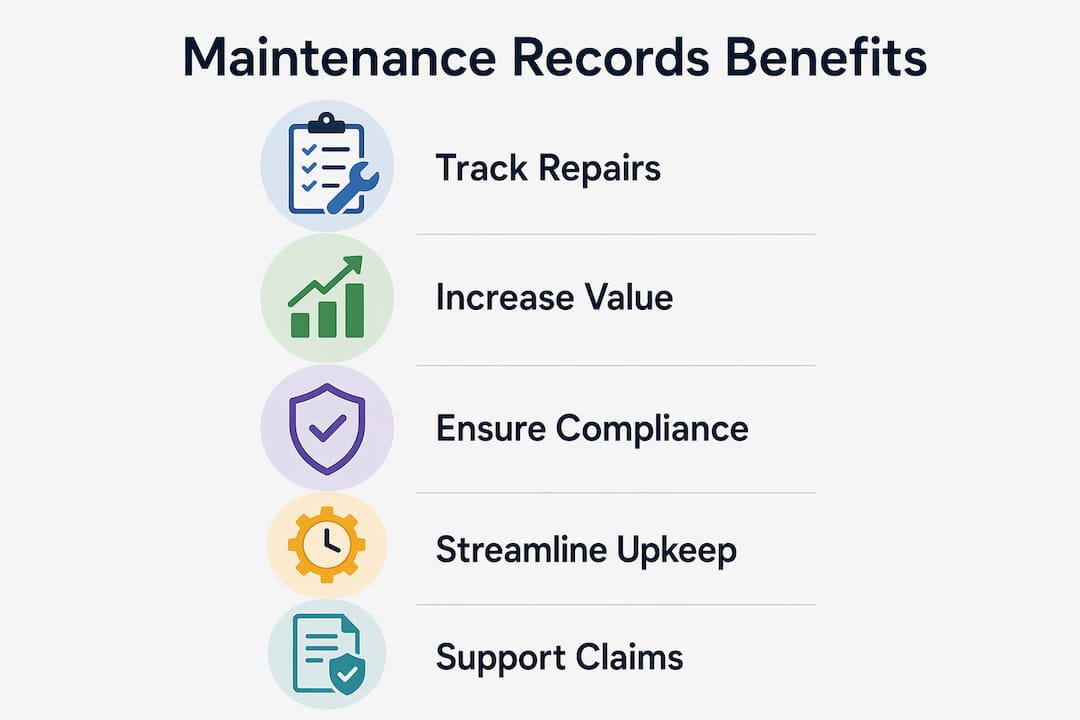
What operational benefits do maintenance records offer for day-to-day upkeep?
Maintenance logs function as a property's medical chart. They record what has been done, what was found, and what was recommended. Without that history, every new fault starts from zero.

Equipment failures with no prior maintenance history take 40% longer to diagnose and repair than those with documented logs. That delay costs money in contractor time, temporary fixes, and tenant disruption. For a property manager overseeing multiple units in Dublin, that inefficiency compounds quickly.
The operational advantages of consistent record-keeping follow a clear sequence:
- Faster fault diagnosis: A technician who can see the boiler's full service history identifies the fault faster and arrives with the right parts.
- Preventive scheduling: Records reveal patterns. If a drain blocks every autumn, you schedule a pre-emptive clean rather than an emergency call-out.
- Reduced unplanned downtime: Facilities using automated logging report up to 30% reduction in unplanned downtime and 25% faster repair times.
- Cost control: Knowing when a component was last replaced tells you when to budget for the next replacement, rather than being caught off guard.
- Contractor accountability: A written record of every visit makes it straightforward to challenge a contractor who claims work was done when it was not.
The medical chart analogy holds up in practice. A property with a ten-year maintenance log gives any new manager or contractor an immediate, reliable picture of the asset's condition. That picture is worth more than any verbal handover.
Pro Tip: Log every maintenance event within 24 hours of completion. Include the date, the contractor's name, the work carried out, any parts replaced, and the next recommended service date. Brief entries made promptly are far more useful than detailed ones written from memory weeks later.
How can digital maintenance tracking systems transform record-keeping?
Paper logs have a fundamental weakness: they are only as useful as your ability to find them. A filing cabinet full of handwritten notes offers no search function, no audit trail, and no protection against fire or flood.
Switching from paper to digital systems recovers 2–3 hours of administrative time per technician each week and reduces record search times from over 30 minutes to under 10 seconds. That efficiency gain alone justifies the transition for any property manager handling more than two or three properties.
Computerised Maintenance Management Systems, known as CMMS, go further than simple digital filing. They offer automated workflows, mandatory data fields, digital signatures, and audit-ready reporting. The table below shows how paper and digital approaches compare across the criteria that matter most to property owners.
| Criteria | Paper logs | Digital CMMS |
|---|---|---|
| Search speed | 30+ minutes | Under 10 seconds |
| Audit readiness | Manual compilation | Automated reports |
| Access from site | Not possible | Available on any device |
| Data completeness | Relies on discipline | Mandatory fields enforced |
| Risk of loss | High (fire, flood, misplacement) | Backed up automatically |
Viewing maintenance records as living documents enables property managers to project 3 to 5 year asset lifecycle costs. That forward view is what separates reactive property management from planned, budget-conscious upkeep.
One common and costly error is mixing short-term maintenance entries with permanent status records. Temporary notes about minor repairs should be kept separately from major structural or system records. Confusing the two causes crucial permanent data to be lost during audits or property transfers.
Pro Tip: When setting up a digital system, create two distinct record categories from the start: one for routine maintenance entries and one for permanent asset records such as structural repairs, system installations, and regulatory inspections.
What are the legal and compliance implications of accurate maintenance records?
Maintenance records are legal documents. They prove that a property has been maintained to the required standard and that safety obligations have been met. Without them, you cannot defend against a claim, validate a warranty, or satisfy a regulatory inspection.
Civil penalties for failing to keep complete and traceable records can exceed $17,000 per violation in regulated industries. While property-specific penalties vary by jurisdiction, the principle applies directly: incomplete records create legal exposure. In Ireland, health and safety legislation and building regulations both require evidence of compliance, not just verbal assurances.
The legal value of accurate records covers several distinct areas:
- Insurance claims: Insurers require documented proof that a property was properly maintained before settling claims related to structural failure, water damage, or fire.
- Warranty validation: Most manufacturer warranties on boilers, roofing systems, and electrical installations require proof of regular servicing. Without records, the warranty is void.
- Regulatory inspections: Gas safety, electrical certification, and fire safety checks all generate documentation that must be retained and produced on request.
- Dispute resolution: Maintenance records support insurance and warranty claims and provide the evidence base needed to resolve contractor disputes or tenant complaints.
Records should be retained for the full period of ownership and ideally transferred to the new owner on sale. Losing records mid-ownership, through poor filing or a system change, creates gaps that are very difficult to reconstruct and can affect both compliance standing and resale value.
How can property owners apply maintenance record best practices?
The most effective maintenance record systems are built on consistency, not complexity. You do not need expensive software to start. You need a clear process and the discipline to follow it.
- Log immediately after every activity. Do not rely on memory. Record the date, the work done, who did it, and what was found, within 24 hours.
- Link records to asset profiles. Each major system, such as the boiler, roof, drainage, and grounds, should have its own record file. This makes longitudinal tracking straightforward.
- Separate record types. Keep routine maintenance entries apart from permanent records such as structural repairs and system installations. This prevents accidental loss of critical data.
- Review logs quarterly. Regular reviews reveal patterns. Recurring faults point to underlying issues. Gaps in the schedule point to missed servicing.
- Use planned maintenance frameworks. Structured plans tied to your maintenance logs shift you from reacting to problems to preventing them.
- Engage professional services. For grounds and exterior maintenance in Dublin, working with a specialist like Sherrypropertycare means your outdoor upkeep is documented, consistent, and carried out to a high standard.
Effective maintenance logging transforms property management from reactive firefighting to a predictive, condition-based approach. That shift reduces costs, extends asset life, and gives you the data to justify every pound spent on upkeep. Regular tree and grounds maintenance is a good example of where documented, scheduled care prevents costly emergency work and protects the property's exterior presentation.
Key takeaways
Accurate maintenance records are the most cost-effective tool a property owner has for protecting value, meeting legal obligations, and reducing repair costs.
| Point | Details |
|---|---|
| Records protect resale value | Missing documentation can reduce a property's resale value by 10–30%. |
| Digital systems save time | Switching to digital logging cuts record search times from 30 minutes to under 10 seconds. |
| Legal compliance depends on records | Insurers, warranty providers, and regulators all require documented proof of maintenance. |
| Logs speed up repairs | Undocumented faults take 40% longer to diagnose and fix than those with a full history. |
| Separate record types | Keep routine entries and permanent asset records in distinct files to prevent data loss. |
What I have learned from watching property owners manage records badly
Most property owners I have spoken with in Dublin treat maintenance records as an afterthought. They keep receipts in a drawer, rely on memory for service dates, and assume the next buyer will take their word for it. That approach costs them money every single time.
The pattern I see most often is this: a property owner invests genuinely in upkeep, spends years maintaining their home or rental to a high standard, and then loses thousands on the sale price because they cannot prove it. The buyer's solicitor asks for records, none are produced, and the buyer either walks away or renegotiates downward. The maintenance was real. The documentation was not.
What has changed in recent years is the availability of simple digital tools. You no longer need a CMMS licence or an IT department. A well-structured spreadsheet, consistently updated, does the job for most residential property owners. The discipline matters more than the tool.
The shift I find most encouraging is the growing awareness among Dublin property managers that effective maintenance scheduling and documentation are connected. You cannot schedule well without records, and records without a schedule are just history. Together, they are a management system. That is the mindset shift that separates good property managers from reactive ones.
My honest view is that any property owner who is not keeping structured maintenance records is leaving money on the table and creating legal risk they are not aware of. The fix is straightforward and the cost of not doing it is high.
— gerard
Sherrypropertycare: professional grounds maintenance for Dublin properties
Property owners in Dublin trust Sherrypropertycare for meticulous grounds maintenance that is carried out consistently and to a high standard.

Sherrypropertycare specialises in lawn care, hedge trimming, landscaping, and general grounds upkeep for residential and commercial properties across Dublin. Every visit contributes to a documented maintenance history that supports your property's value and kerb appeal. Whether you manage a single home or a portfolio of rental properties, consistent exterior maintenance is one of the most visible signals of quality upkeep. Get in touch with Sherrypropertycare for a customised quote tailored to your property's specific needs.
FAQ
What are maintenance records in property management?
Maintenance records are chronological logs of every repair, inspection, and servicing activity carried out on a property. They document who did the work, what was done, when it was completed, and what was found.
Why do maintenance records affect property resale value?
Buyers and their solicitors use maintenance records to assess the condition and risk of a property. Missing or incomplete records can reduce resale value by 10–30%, as buyers factor in the unknown cost of deferred or undocumented repairs.
How long should property maintenance records be kept?
Records should be retained for the full period of ownership and transferred to the new owner on sale. Regulatory documents such as gas safety certificates and electrical reports typically carry their own minimum retention requirements under Irish legislation.
What is a CMMS and do property owners need one?
A CMMS, or Computerised Maintenance Management System, is a digital platform for logging, scheduling, and retrieving maintenance records. Most residential property owners do not need a full CMMS. A well-structured digital spreadsheet or cloud-based folder system provides most of the same benefits.
How do maintenance records support insurance claims?
Insurers require documented proof that a property was properly maintained before settling claims. Without records, claims related to structural failure, water ingress, or fire damage can be reduced or rejected entirely.