
Regulations set the floor, not the ceiling, for property maintenance. They define what "safe" and "habitable" mean in legal terms, how often you must check certain systems, and what proof you need to keep on file. In practice, that means a rented property in Ireland must have working gas and electrical systems, sound structure, effective heating, and clear records showing all of it was checked by someone qualified.
The rules that matter most focus on safety and evidence. GOV.UK guidance for landlords is explicit that gas equipment must be installed and maintained by a qualified engineer, with a safety check record given to tenants annually. Electrical checks work on a similar cycle, and periodic testing under standards like the Electrical Safety Standards in the Private Rented Sector (England) Regulations 2020 sets a benchmark most Irish landlords now follow as good practice even where the exact statute differs locally. At Sherrypropertycare, we see this play out from the ground up: a property that looks well kept on the surface can still be storing up a compliance problem if nobody has scheduled the underlying checks.
Here's what to do this week:
- Check which safety certificates you currently hold and when each expires.
- Book any overdue gas, electrical, or fire safety inspections.
- Set up one central file, physical or digital, for every certificate and invoice.
Pro Tip: Keep certificates and inspection dates in a single spreadsheet with automatic renewal reminders. Missing a certificate is one of the most common reasons landlords fail an inspection, even when the actual maintenance work was done properly.
Key Takeaways
Regulations define the minimum standard for property upkeep, and consistent records are what actually prove you met it when questioned.
| Point | Details |
|---|---|
| Audit certificates first | Confirm gas, electrical, and fire safety records are current before anything else. |
| Schedule regular inspections | Aim for three inspections yearly for standard tenancies, more for HMOs. |
| Prioritise safety-critical work | Fix gas, electrical, and fire detection issues before cosmetic repairs. |
| Centralise every record | Keep certificates, invoices, and inspection notes in one accessible file. |
| Use scheduled grounds care | Sherrypropertycare's dated visit records support your compliance file while keeping the property presentable. |
Table of Contents
- Which laws, standards and regulators affect property upkeep?
- What compliance obligations fall on owners and landlords?
- How does enforcement actually work, and what does it cost?
- What does a practical compliance plan look like?
- When should you hire a professional, and what should you demand from them?
- What we see on the ground: a grounds-maintenance provider's view
- How Sherrypropertycare keeps compliance simple
- Where to check the definitive rules
- Sources
- FAQ
Which laws, standards and regulators affect property upkeep?
Property upkeep sits at the crossroads of several regulatory regimes, and most disputes happen because an owner only thought about one of them. Housing and health standards cover general habitability. Building regulations govern structural work and alterations. Fire safety rules apply to shared and single-occupancy properties alike. Gas and electrical safety sit in their own categories with specific certification cycles, and environmental or waste rules cover things like bin storage, drainage, and pest control.
The regulators and reference points vary by issue:
- Local authority housing departments handle habitability complaints and can carry out inspections.
- National guidance, such as GOV.UK's landlord pages, sets out baseline safety duties.
- Tenant-rights organisations like Shelter publish plain-language explainers that are useful for cross-checking your obligations.
- HMO-specific rules add extra layers, including higher inspection frequency, where a property houses multiple unrelated tenants.
Damp is the clearest example of overlap. A patch of black mould can trigger a housing standards complaint, a structural investigation under building regulations, and a ventilation review, all from one tenant call. Treating it as a single-category problem is how landlords end up back-tracking on remedial work.
If you want the legal detail rather than a summary, go to the primary source. Section 11 of the Landlord and Tenant Act 1985 sets the implied repair responsibilities that underpin most disrepair cases, covering water, gas, electricity, and the structure and exterior. Our own guide to landlord maintenance responsibilities walks through how these categories apply in a Dublin context.
What compliance obligations fall on owners and landlords?
Most obligations cluster around six areas: structure and exterior, heating and hot water, gas and electrical safety, fire detection, damp and mould control, and the condition of common areas and grounds. None of these are optional extras. GOV.UK guidance confirms landlords are responsible for keeping installations for water, heating, and wiring in working order, and Shelter's guidance backs this up, adding that tenants are expected to report problems and allow reasonable access for repairs.
A typical case moves through a predictable sequence. A tenant reports a damp patch on a bedroom wall. You or your managing agent arranges an inspection within days. A contractor assesses the cause, quotes for extractor fan repair or render work, and completes the job. You file the invoice and inspection notes. That last step is the one landlords skip most often, and it's the one that matters if a dispute or inspection follows months later.
| Obligation category | Usually responsible | Governing standard |
|---|---|---|
| Structural and exterior repairs | Landlord | Landlord and Tenant Act 1985, s.11 |
| Gas appliances and flues | Landlord (Gas Safe engineer) | Gas safety check requirements |
| Electrical systems | Landlord (qualified electrician) | Electrical Safety Standards |
| Fire detection and alarms | Landlord | Local fire safety guidance |
| Garden and grounds safety | Landlord or managing agent | General health and safety duties |
Pro Tip: When budgets are tight, triage safety-critical items first: gas, electrics, and fire detection. A cracked path can wait a fortnight. A missing carbon monoxide alarm cannot.
How does enforcement actually work, and what does it cost?
Enforcement usually starts with a complaint, not a raid. Councils respond to tenant reports, but they also carry out routine inspections and can escalate quickly if a property fails a Housing Health and Safety Rating System (HHSRS) assessment. GOV.UK notes that where serious hazards are found, local authorities are obliged to take action, which can mean anything from an informal request to a formal improvement notice with a fixed deadline.
The typical sequence looks like this:
- Initial contact or complaint — often resolved within days if the landlord responds promptly.
- Inspection and HHSRS assessment — councils assess hazard category and urgency.
- Improvement notice issued — sets a compliance deadline, commonly measured in weeks rather than days for non-emergency hazards.
- Follow-up inspection — failure to comply can lead to fines or prosecution.
Newham Council's landlord guidance recommends routine inspections three times a year for family homes, with more frequent checks for HMOs, precisely because early detection avoids this whole enforcement chain.
Cost is driven by more than the repair itself. Scope of works, access difficulty, how urgently a certified contractor is needed, and, in the worst cases, temporary rehousing costs where a property becomes unsafe to occupy, all push the bill up. A blocked drain caught early might cost a callout fee. Left unaddressed until it floods a ground-floor flat, it becomes a structural repair plus a potential disrepair claim.
What does a practical compliance plan look like?
Turning regulation into routine starts with an audit, not a to-do list. Work through it in order:
- Audit current certificates — gas, electrical, fire alarm testing, and any HMO licensing documents.
- Build an inspection schedule — align with the three-times-a-year benchmark for standard tenancies.
- Assign responsibilities — decide what you handle directly and what goes to a managing agent or contractor.
- Plan seasonal checks — gutters and drainage before winter, grounds and hedges before growth season.
- Budget for replacement cycles — boilers, alarms, and appliances all have a working life; plan the spend before they fail.
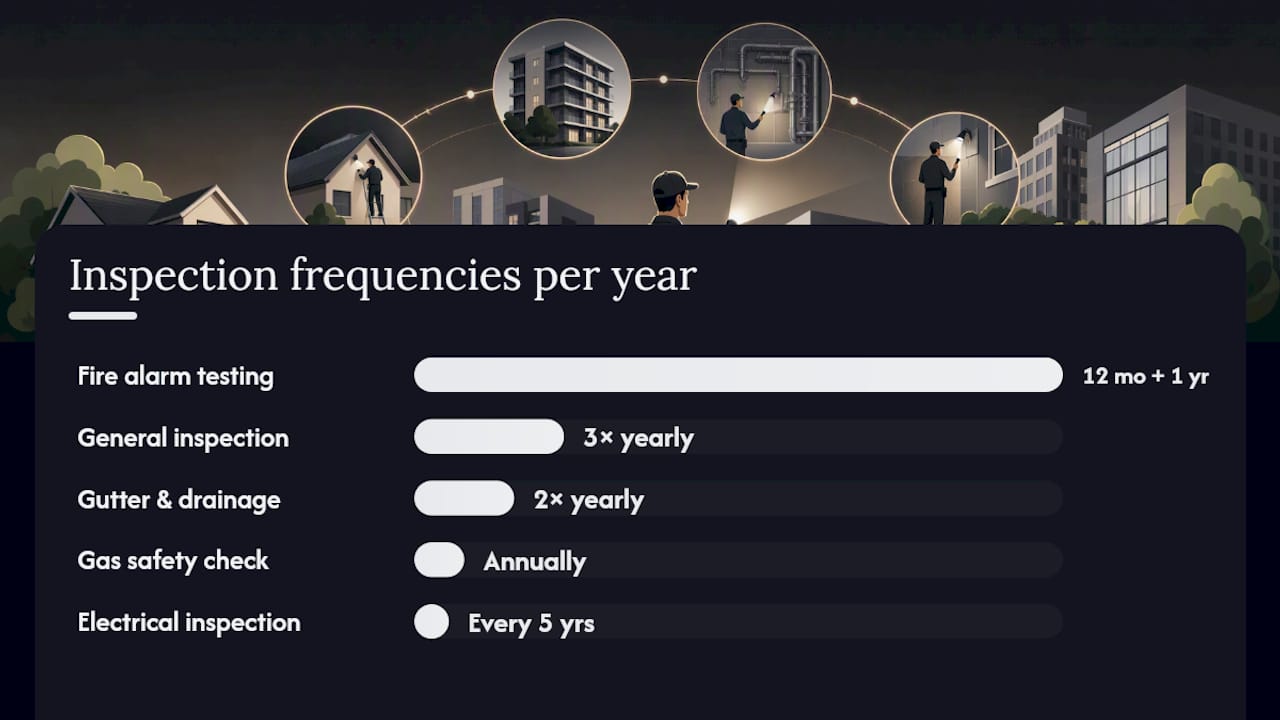
A simple maintenance schedule keeps this manageable:
| Task | Frequency | Who to call |
|---|---|---|
| Gas safety check | Annually | Gas Safe registered engineer |
| Electrical inspection | Every five years | Qualified electrician |
| Fire alarm testing | Monthly self-check, annual professional test | Landlord or fire safety contractor |
| Gutter and drainage clearance | Twice yearly | Grounds maintenance provider |
| General property inspection | Three times yearly | Landlord or managing agent |
Keep every safety certificate, contractor invoice, inspection report, and tenant repair request in one place, and retain them for at least the length of the tenancy plus a reasonable buffer, several years is sensible practice. Shelter's guidance notes that written records are what actually carry weight if a dispute or council investigation arises.
Quick wins that cost little but close obvious gaps:
- Fit any missing smoke or carbon monoxide alarms.
- Repair trip hazards on paths and steps.
- Clear gutters and drains before the next heavy rain.
Our property maintenance checklist gives a longer version of this you can adapt property by property.
When should you hire a professional, and what should you demand from them?
Some jobs are simply not DIY territory. Gas work, major electrical rewiring, and structural repairs must go to certified professionals, both for safety and because uncertified work can invalidate insurance or fail an inspection outright. Grounds maintenance sits in a different category. It's routine work, but neglecting it is exactly how minor issues turn into regulatory ones, a blocked drain becomes a flooding claim, an overgrown hedge becomes a blocked fire escape route.
Before hiring anyone, check for:
- Relevant qualifications (Gas Safe registration, NICEIC for electricians).
- Public liability insurance.
- Registration with any applicable trade body.
- References from recent, comparable jobs.
- A written quote and a detailed, dated invoice on completion.
Ask these questions before you sign anything:
- What certification do you hold for this specific type of work?
- Can you provide proof of current insurance?
- What's included in the written quote, and what would trigger extra charges?
- Will I get a dated, signed certificate or invoice once the job is done?
Pro Tip: A dated, signed invoice isn't paperwork for its own sake; it's your evidence if a council inspector or a tenant dispute ever asks when work was completed and by whom. Guidance on vetting qualified home service providers covers the same checks in more detail if you want a second reference point.
What we see on the ground: a grounds-maintenance provider's view
Working on properties across Dublin week after week, the same failure points come up repeatedly, and they rarely start as regulatory issues. A gutter left uncleared for two seasons overflows and starts feeding damp into a wall. An overgrown path becomes a trip hazard nobody notices until someone falls. A hedge grows across a fire exit because nobody scheduled a trim.

None of these start as legal problems. They become legal problems when they're ignored long enough that a tenant complaint or a council inspection turns them into one. We've seen properties avoid a formal notice entirely simply because routine grounds visits caught a drainage issue before it caused internal damp, the kind of damp that triggers exactly the housing-standards overlap described earlier in this piece.
The operational fix is straightforward: build grounds maintenance into your compliance calendar the same way you schedule gas checks. Seasonal tasks, gutter clearance before autumn, hedge cutting before growth season peaks, path repairs before winter ice, should sit on the same calendar as your certificate renewals, not treated as a separate, lower-priority task. Coordinating a grounds contractor alongside your safety inspections means fewer surprise callouts and a property that reads as well cared for the moment anyone, tenant or inspector, walks up to the front door.
How Sherrypropertycare keeps compliance simple
Sherrypropertycare gives Dublin landlords something a one-off contractor call-out can't: a standing grounds maintenance schedule that doubles as part of your compliance record. Every visit comes with a dated invoice, so you're not scrambling to prove when a path was last cleared or a hedge last trimmed when a council inspector or tenant asks.

Beyond the aesthetic value, well-kept grounds reduce the chance of the exact issues that escalate into enforcement, blocked drains, overgrown access routes, hazardous paths. Sherrypropertycare covers landscaping, lawn care, hedge trimming, patio cleaning, and power washing for residential and commercial properties across Dublin, with quotes built around your property's actual condition rather than a generic rate card. If you're managing several properties, having one provider handle the seasonal side of compliance frees you up to focus on the certificates and paperwork that need your direct attention.
Send a few photos of your property and request a tailored quote through the Sherrypropertycare website, and get your grounds maintenance scheduled before the next inspection catches you off guard.
Where to check the definitive rules
For anything beyond general guidance, go straight to the source rather than relying on secondhand summaries.
- Gov for gas, electrical, and general safety duties.
- Gov for structural and installation repair obligations.
- Shelter's landlord and tenant responsibilities for plain-language explanations of repair duties.
- Local authority guidance, such as Newham Council's landlord standards page, for inspection frequency and notice periods.
Use GOV.UK for statutory certificate requirements, Shelter for understanding your position in a dispute, and your local authority for area-specific inspection expectations.
This article is general information, not a substitute for advice from a qualified lawyer. Consult a qualified legal professional about your own circumstances before acting on anything here.
Sources
- Gov
- Gov
- Landlord responsibilities for repairs - Shelter England
- Rights and responsibilities – Maintaining good standards in your rented property for landlords – Newham Council
FAQ
What is the main role of regulations in property upkeep?
Regulations set the minimum legal standard for safety and habitability, defining what must be maintained, how often it must be checked, and what records prove it was done.
How often should a rented property be inspected?
Local guidance commonly recommends around three inspections per year for standard family homes, with more frequent checks for HMOs.
What happens if a landlord ignores a council improvement notice?
Failure to comply within the given timescale can lead to fines, follow-up inspections, and further enforcement action from the local authority.
What records should landlords keep for compliance?
Keep gas and electrical safety certificates, contractor invoices, inspection reports, and tenant repair requests, ideally for the length of the tenancy plus several years.
Does grounds maintenance count towards compliance?
Yes. Overgrown paths, blocked drains, and hazardous grounds can trigger the same housing standards issues as internal disrepair, and scheduled care from a provider like Sherrypropertycare gives you dated records to show ongoing upkeep.