
TL;DR:
- Tenant maintenance includes routine tasks tenants must handle to keep a property in good condition, while landlords are responsible for structural and repair duties. Clear agreements, regular inspections, and effective communication help prevent disputes and ensure proper upkeep throughout the tenancy.
Tenant maintenance is defined as the routine upkeep duties a tenant must carry out to keep a rental property in reasonable condition throughout the tenancy. These duties are distinct from the structural and installation repairs that fall to the landlord under Section 11 of the Landlord and Tenant Act 1985. Getting this distinction right matters enormously. Misunderstanding it is the most frequent cause of tenancy disputes, and the consequences range from damaged properties to costly legal proceedings. For landlords in Dublin and across Ireland, a clear grasp of tenant maintenance responsibilities is the first line of defence for protecting your rental asset.
What is tenant maintenance and what does it cover?
Tenant maintenance refers to the day-to-day care tasks a tenant performs to keep the property clean, safe, and functional. The industry term used in tenancy law is "tenant-like manner," a standard established in English case law that describes the level of care a reasonable tenant would apply. Both terms are used in practice, and understanding both helps landlords draft tighter agreements.
Tenant responsibilities typically include the following tasks:
- Keeping the interior clean and free from rubbish
- Disposing of waste correctly and on collection days
- Replacing light bulbs and batteries in smoke alarms
- Testing smoke and carbon monoxide alarms regularly
- Ventilating rooms to prevent condensation and mould build-up
- Maintaining any garden or outdoor space unless the tenancy agreement states otherwise
- Reporting damage or defects to the landlord promptly
The garden point catches many landlords off guard. Tenants are generally expected to mow lawns and keep outdoor areas tidy unless the agreement explicitly assigns that duty elsewhere. For landlords with larger grounds, this is worth spelling out clearly in writing.
Pro Tip: List every tenant maintenance task in the tenancy agreement by name. Vague phrases like "keep the property in good order" create room for disagreement. Specific lists do not.

How do landlord repair obligations differ from tenant maintenance?
The legal boundary between tenant maintenance and landlord repairs is set primarily by Section 11 of the Landlord and Tenant Act 1985. That legislation requires landlords to keep the structure and exterior of the property in repair, along with installations for water, gas, electricity, heating, and sanitation. Tenants carry none of those obligations.
The table below summarises the split clearly.
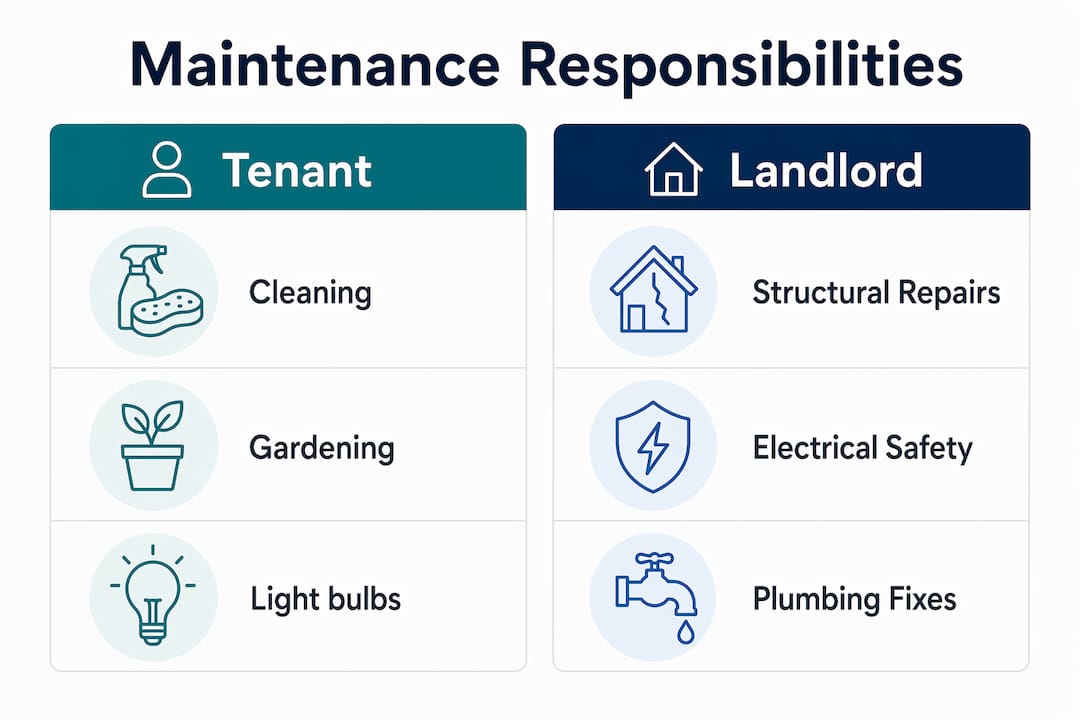
| Responsibility | Tenant | Landlord |
|---|---|---|
| Cleaning and rubbish disposal | Yes | No |
| Replacing light bulbs | Yes | No |
| Smoke alarm testing | Yes | No |
| Garden upkeep (where agreed) | Yes | No |
| Structural repairs (roof, walls) | No | Yes |
| Heating and hot water systems | No | Yes |
| Gas and electrical installations | No | Yes |
| Appliances supplied by landlord | No | Yes |
| Tenant's own appliances | Yes | No |
One critical nuance: landlord repair duty is triggered only after the tenant gives notice of a defect. Verbal notice is legally sufficient, though written notice is strongly recommended for evidence purposes. A landlord who has not been told about a problem carries no legal obligation to fix it.
Landlords must also arrange Electrical Installation Condition Reports every five years and remediate any issues within 30 days. That is a landlord duty, not a tenant one, and failing to comply carries real consequences.
Local authorities can impose civil penalties up to £30,000 for non-compliance with fitness and repair laws. That figure concentrates the mind. Awaab's Law, introduced following the Rochdale mould tragedy, adds further urgency by requiring landlords to investigate and fix damp and mould hazards within fixed timeframes.
The concept of fair wear and tear also sits in this section of the law. Fair wear and tear is the expected deterioration of a property through normal use and is not chargeable against a tenant. A landlord must consider the age of an item at the start of the tenancy before making any deposit deduction. Scuffed skirting boards after three years are wear and tear. A broken door handle is damage.
What practical steps can landlords take to manage tenant maintenance?
Clear expectations set at the start of a tenancy prevent the vast majority of maintenance problems. The tenancy agreement is the right place to establish those expectations, but it should be backed up by a face-to-face walkthrough on move-in day.
- Write a detailed tenancy agreement. Name every tenant maintenance task explicitly. Reference the "tenant-like manner" standard and give examples. Clear tenancy agreements that outline responsibilities reduce disputes and enforce compliance.
- Provide a welcome pack. Include bin collection days, boiler instructions, ventilation guidance, and a contact number for reporting repairs. Tenants who know what to do are far more likely to do it.
- Conduct regular inspections. Quarterly visits, arranged with proper notice, let you catch problems early. A small damp patch spotted in march is far cheaper to fix than a mould outbreak found in september.
- Create a simple repair reporting process. Give tenants one clear channel, whether that is email, a messaging app, or a written form. Prompt tenant repair requests and landlord responsiveness reduce costly property damage.
- Keep a detailed inventory. An accurate inventory at tenancy start reduces appliance disputes. Appliance repair responsibility depends on ownership: landlords are liable for appliances they supply; tenants are responsible for their own items.
Pro Tip: Use a property maintenance checklist at every inspection. It creates a paper trail and signals to tenants that you take upkeep seriously.
How can tenants and landlords collaborate to prevent maintenance disputes?
Misunderstanding the distinction between tenant maintenance and landlord repairs is the leading cause of tenancy disputes. The fix is not legal action. It is communication, established early and maintained consistently.
Start at the beginning of the tenancy. Walk the tenant through the property and explain what you expect them to maintain. Point out the boiler, the ventilation points, and the garden boundaries. Tenants who understand their obligations from day one are far less likely to neglect them.
Good communication on maintenance roles is essential for a productive relationship. These practices make that communication concrete:
- Send a written summary of tenant duties after the move-in walkthrough
- Acknowledge every repair report in writing within 24 hours, even if the fix takes longer
- Use a simple template for tenants to log issues, including date, description, and photos
- Respond to reports of damp or mould within the timeframes now required under Awaab's Law
- Review the tenancy agreement annually and update responsibilities if the property changes
Landlord responsiveness is a trust-building measure. A tenant who sees repairs handled promptly is far more likely to report problems early, before they become expensive. Viewing repair requests as investment protection rather than inconvenience shifts the entire dynamic of the relationship.
Dispute resolution options exist when communication breaks down. In Ireland, the Residential Tenancies Board (RTB) provides a formal mediation and adjudication service. In the UK, tenancy deposit schemes offer dispute resolution for deposit-related disagreements. Both routes are slower and more expensive than a clear agreement made at the start.
For end-of-tenancy situations, professional end of lease cleaning can help tenants meet their obligations and reduce the risk of deposit disputes over cleanliness.
Key takeaways
Tenant maintenance is defined by law and by the tenancy agreement: tenants handle routine upkeep, landlords handle structural and installation repairs, and clear written agreements prevent the disputes that arise when those lines blur.
| Point | Details |
|---|---|
| Legal definition matters | Section 11 of the Landlord and Tenant Act 1985 sets the boundary between tenant and landlord duties. |
| Written agreements prevent disputes | Name every tenant task explicitly in the tenancy agreement to remove ambiguity. |
| Notice triggers landlord duty | Landlords are only legally obliged to repair after receiving tenant notification. |
| Fair wear and tear is not damage | Normal deterioration over time is not chargeable; age of items must be considered before deductions. |
| Communication reduces costs | Prompt reporting and landlord responsiveness stop small issues from becoming expensive problems. |
What I have learned from years of watching maintenance disputes unfold
The most common mistake I see landlords make is assuming tenants know what is expected of them. They do not. Most tenants have never read Section 11 of the Landlord and Tenant Act 1985, and many have never been told clearly what "tenant-like manner" actually means in practice.
The landlords who avoid disputes are not the ones with the toughest agreements. They are the ones who take 20 minutes on move-in day to walk through the property and explain exactly what they expect. That conversation, backed up by a written list, does more than any legal clause.
Awaab's Law has changed the stakes considerably. Damp and mould are no longer issues a landlord can quietly defer. The law now requires investigation and remediation within fixed timeframes, and Dublin landlords should take note even where Irish legislation differs, because the direction of travel is clear. Tenants are gaining stronger protections, and landlords who stay ahead of that curve protect both their tenants and their assets.
The difference between maintenance and repairs is not just a legal technicality. It is the foundation of a functional landlord-tenant relationship. Get it right from the start, and most problems simply do not arise.
— gerard
How Sherrypropertycare helps Dublin landlords stay on top of grounds maintenance
Keeping a rental property well maintained goes beyond what happens inside the front door. The exterior, garden, and grounds are part of the tenant's first impression and a direct reflection of your property's value.

Sherrypropertycare provides professional grounds maintenance services for residential and commercial properties across Dublin. From lawn care and hedge trimming to full grounds upkeep, the team delivers meticulous, reliable work tailored to each property. Whether you manage one rental or a portfolio, Sherrypropertycare offers customised quotes based on your property's specific needs. Send a photo of your grounds and get a clear, no-obligation quote. It is a straightforward way to keep your outdoor spaces in excellent condition and protect the kerb appeal that supports your rental value.
FAQ
What is tenant maintenance in a rental property?
Tenant maintenance is the routine upkeep a tenant must carry out to keep a rented property in reasonable condition. It includes cleaning, rubbish disposal, smoke alarm testing, and ventilation, but excludes structural repairs, which are the landlord's responsibility.
What are tenant obligations regarding garden maintenance?
Tenants are generally responsible for maintaining gardens unless the tenancy agreement states otherwise. This includes mowing lawns and keeping outdoor areas tidy throughout the tenancy.
When does a landlord's repair duty begin?
A landlord's repair obligation under Section 11 of the Landlord and Tenant Act 1985 begins only after the tenant gives notice of a defect. Verbal notice is legally sufficient, but written notice is recommended for clarity and evidence.
What is the difference between fair wear and tear and tenant damage?
Fair wear and tear is the expected deterioration of a property through normal use and cannot be charged to the tenant. Damage caused by misuse or neglect is chargeable, and landlords must consider the age of items when assessing deposit deductions.
How can landlords in Dublin reduce tenant maintenance disputes?
Clear tenancy agreements that name every maintenance responsibility, combined with regular inspections and a simple repair reporting process, are the most effective way to prevent disputes. The Residential Tenancies Board (RTB) provides formal mediation if disagreements do arise.