
TL;DR:
- Cleaning plays a crucial role in property maintenance by preventing damage, extending system life, and improving inspections. Properly scheduled cleaning, combined with inspections, helps detect defects early and reduces costly repairs. For Dublin properties, moisture control, HVAC upkeep, and scheduled cleaning are vital to long-term value preservation.
Cleaning is often dismissed as a cosmetic task. Something you do before visitors arrive, not something that sits at the heart of property management. That misconception costs property owners in Dublin real money every year. The role of cleaning in maintenance goes well beyond appearances. It prevents structural damage, extends the life of building systems, and makes inspections far more effective. Whether you manage a residential property in Ranelagh or a commercial block in the city centre, understanding how cleaning and maintenance connect will change how you plan and budget for your property.
Table of Contents
- Key takeaways
- The role of cleaning in maintenance and property upkeep
- Cleaning as an inspection tool
- HVAC cleaning and moisture control
- Chemical cleaning for commercial and complex properties
- My perspective on cleaning and property management
- How Sherrypropertycare can help your Dublin property
- FAQ
Key takeaways
| Point | Details |
|---|---|
| Cleaning is preventive maintenance | Regular cleaning stops minor issues becoming costly repairs by exposing defects early. |
| Cleaning levels must match the need | Applying the wrong level of cleaning wastes money or creates safety risks. |
| HVAC cleaning protects performance | Cleaning filters and coils regularly prevents breakdowns and reduces energy costs. |
| Moisture control before mould cleaning | Fix the water source and dry the area first; cleaning alone will not solve mould. |
| Inspection and cleaning go together | Treating each cleaning session as an inspection dramatically improves defect detection. |
The role of cleaning in maintenance and property upkeep
Many people think of cleaning and maintenance as two separate activities. Cleaning is what you schedule weekly or monthly. Maintenance is what you call a contractor for. In practice, the two are deeply connected, and separating them is one of the most common and costly mistakes property managers make.
Maintenance cleaning is defined as baseline cleaning aimed at sustaining daily usability and visual acceptability. It is not about perfection. It is about keeping spaces and systems operational and preventing deterioration from setting in.
There are broadly three levels of cleaning relevant to property upkeep:
- Maintenance cleaning: Day-to-day or regular cleaning that keeps a property functional and presentable. This is what most residential and commercial properties in Dublin need as a baseline.
- Prestige cleaning: A higher standard, typically for premium office environments or public-facing commercial spaces where appearance carries additional business value.
- Clinical cleaning: The most exacting standard, required in healthcare or food production environments where hygiene is a regulatory and safety requirement.
For most property owners in Dublin, maintenance cleaning is the right specification. The importance of cleaning in maintenance at this level is that it prevents the accumulation of dirt, moisture, and debris that leads to structural and systems damage over time. Choosing the wrong level can either waste budget or, worse, leave risk unaddressed. Incorrect application can inflate costs or compromise safety and appearance.
Understanding this distinction gives you a practical foundation for writing cleaning schedules that actually protect your asset rather than just satisfy a checklist.
Cleaning as an inspection tool
There is a concept in industrial maintenance called TPM Initial Cleaning. It is straightforward. When operators clean equipment, they treat it as an inspection event. They look for leaks, cracks, unusual wear, and loose components as they work. The result is that defects get found and logged during the cleaning process rather than discovered later during an emergency breakdown.
The same principle applies directly to property maintenance. When you or your team clean a property, you are also physically close to every surface, pipe, seal, and fitting. That proximity is an opportunity.
Dirt and grease films on equipment hide defects and lead to missed early warnings, which ultimately cause costly emergency breakdowns. In a property context, this means grime on window seals obscures early signs of water ingress. Dust and debris around skirting boards can hide early damp patches. Blocked drains go unnoticed until they overflow and cause ceiling damage.
"Clean equipment is inspectable equipment." This is the principle behind TPM Initial Cleaning, and it applies equally to a commercial property in Dublin's city centre as it does to an industrial plant.
Treating cleaning as an inspection opportunity increases defect detection rates and reduces unplanned downtime. Plants adopting the TPM approach found hundreds of defects during initial cleaning sessions, saving significant costs. Property managers who integrate inspection checklists with their cleaning schedules see fewer emergency call-outs for the same reason.
Pro Tip: Create a simple one-page inspection sheet that cleaning staff or caretakers complete during each visit. Record any visible damage, unusual staining, or signs of moisture. This turns every clean into a documented inspection.
For Dublin property managers looking to protect long-term value, an indoor maintenance guide that combines regular cleaning with structured inspection routines is one of the most cost-effective approaches available.
HVAC cleaning and moisture control
Two areas where cleaning has a direct and measurable impact on property performance are HVAC systems and moisture management. Both are common problem areas for Dublin properties, particularly older residential buildings and commercial premises with flat or low-pitch roofs.
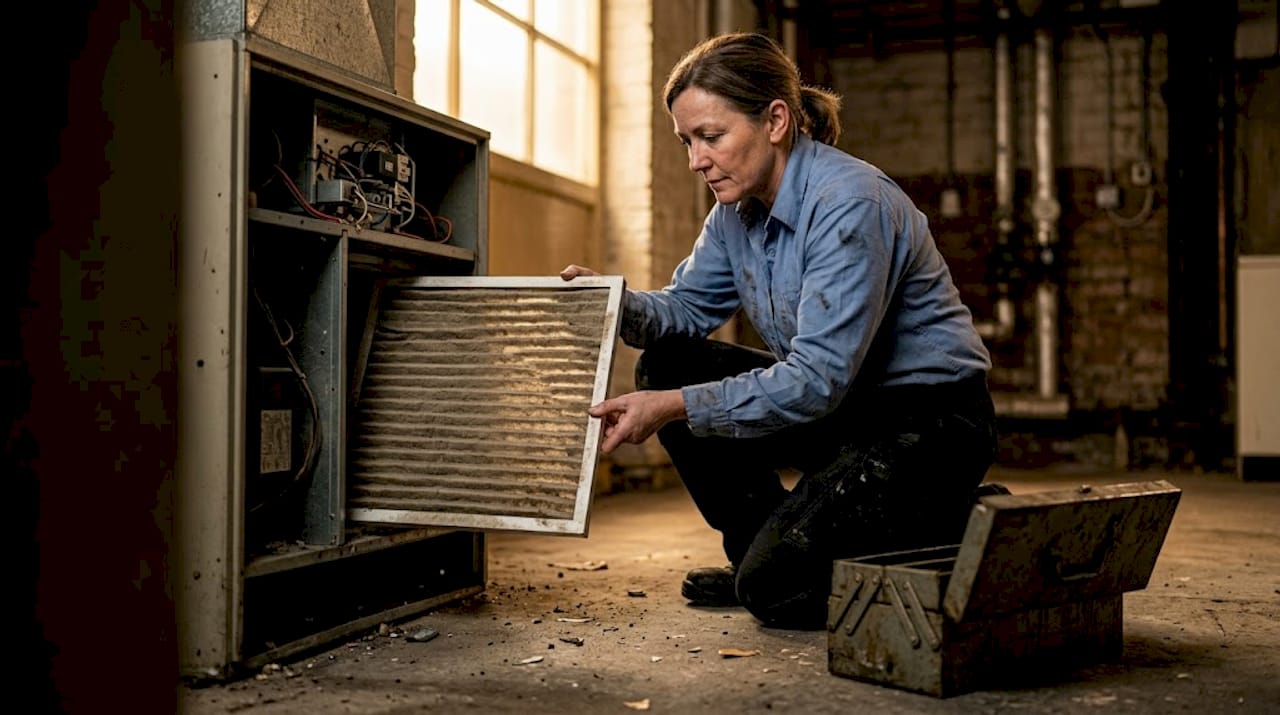
HVAC filter and coil maintenance
HVAC systems are one of the most expensive items in any property to repair or replace. They are also one of the most sensitive to poor cleaning practices.
- Clean or replace filters every one to two months during the cooling season, and more frequently if the property has pets, high dust levels, or significant foot traffic. The Department of Energy recommends this frequency as a baseline for maintaining system efficiency.
- Clean evaporator and condenser coils annually. Dirty coils cannot transfer heat effectively. Regular cleaning of coils, fins, and drains maintains proper airflow and prevents clogs that cause operational shutdowns.
- Clear condensate drain lines each season. Blocked drains cause water to back up into the system, leading to water damage inside walls and ceilings.
- Track HVAC cleaning as a performance indicator, not just a housekeeping task. Cleaning filters and coils should be measured against energy use and breakdown frequency to demonstrate their value over time.
A clogged HVAC filter does not just reduce air quality. Dirty filters reduce airflow and cause dirt to build up on the evaporator coil, impairing cooling efficiency and shortening the equipment's lifespan. For a commercial property in Dublin, a system failure in summer or during a busy letting period is an expensive and avoidable problem.
Moisture control and mould prevention
Mould is a recurring issue in Irish properties, given the climate. Many property managers make the mistake of cleaning mould without fixing the source. The mould returns within weeks.
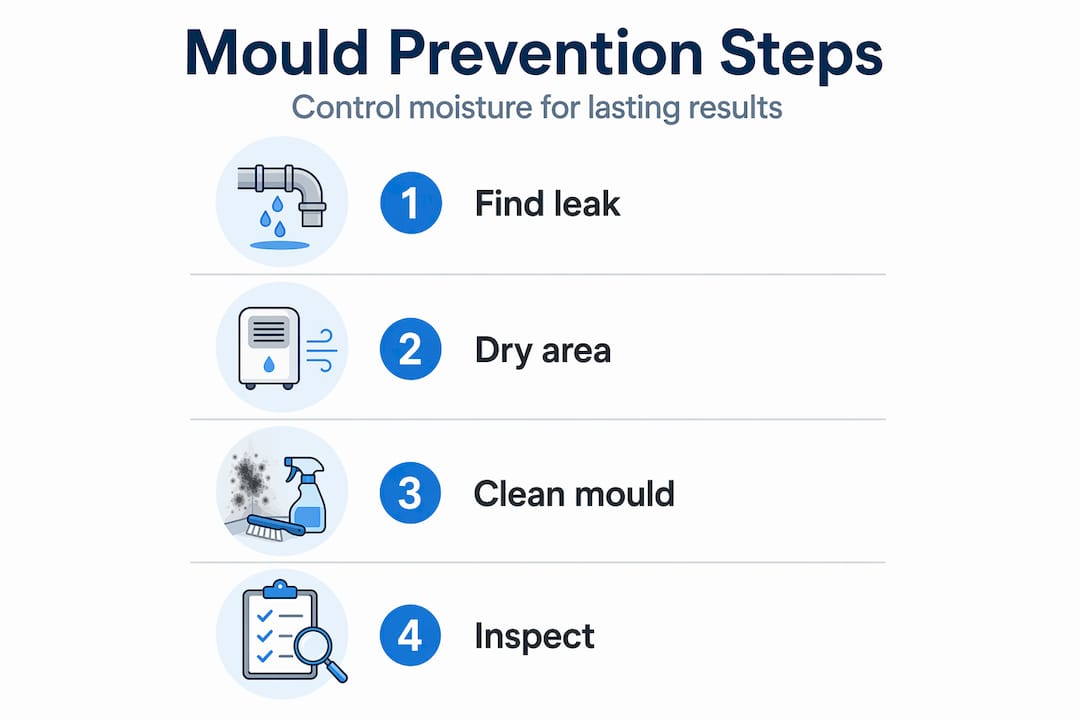
The EPA is clear on the correct sequence. Fixing the water source first, drying the affected area within 24 to 48 hours, and keeping indoor humidity below 60% must happen before any cleaning is effective. Cleaning visible mould with a mild detergent works, but only after the moisture problem is resolved. Porous materials that cannot be dried fully should be removed and replaced.
Managing moisture before cleaning mould is the difference between a one-off fix and a recurring problem. This is a direct link between cleaning practices in facility maintenance and long-term property health.
Chemical cleaning for commercial and complex properties
For commercial properties and more complex building systems, standard surface cleaning is not always sufficient. Chemical cleaning is a higher-level approach that removes internal deposits from pipes, heat exchangers, boilers, and other closed systems.
The table below outlines the practical difference between reactive repairs and scheduled chemical cleaning:
| Approach | Cost profile | Disruption | Outcome |
|---|---|---|---|
| Reactive repair | High, unpredictable | Significant downtime | Problem fixed after failure |
| Mechanical disassembly | Moderate to high | Extended shutdown | Access-dependent, labour-intensive |
| Chemical cleaning | Moderate, predictable | Minimal | Deposits removed, efficiency restored |
Chemical cleaning safely removes internal deposits, restoring thermal efficiency and reliability while reducing downtime. For Dublin commercial property managers dealing with older heating systems or water-fed building services, this approach is often far more cost-effective than waiting for a system to fail and then dealing with emergency contractors.
Cleaning strategies for maintenance success at a commercial level often include scheduled chemical cleaning as part of a planned preventive maintenance programme. This keeps systems running efficiently, extends asset life, and removes the unpredictability of reactive repairs from the annual maintenance budget. You can explore further detail on this in our commercial property maintenance guide for Dublin properties.
My perspective on cleaning and property management
I've worked with property owners across Dublin for years, and one pattern comes up again and again. The properties that cost the most to maintain are almost never the oldest or the most complex. They are the ones where cleaning was treated as a nice-to-have rather than part of the maintenance schedule.
In my experience, the biggest mistake is scheduling cleaning reactively. Owners clean when the property looks dirty, not on a structured cycle that supports inspection and defect detection. By the time something looks bad enough to clean, the underlying damage has often already started.
What I've found actually works is building a simple, documented cleaning schedule that assigns responsibility, sets frequency, and includes a short inspection checklist. It does not need to be sophisticated. A one-page document used consistently outperforms an elaborate system that nobody follows.
For Dublin property owners specifically, the damp climate makes moisture monitoring a non-negotiable part of any cleaning-linked maintenance routine. I've seen mould remediation bills that could have been avoided entirely if someone had checked the bathroom extractor fan during a routine clean three months earlier.
The role of cleaning in property upkeep is not glamorous, but it is one of the highest-return habits a property manager can build. It is also one of the easiest to implement without significant cost.
— gerard
How Sherrypropertycare can help your Dublin property
If you manage a residential or commercial property in Dublin and want cleaning and maintenance working together properly, Sherrypropertycare is here to help.

At Sherrypropertycare, we specialise in high-quality grounds maintenance and property care across Dublin. Our team understands that well-maintained grounds and exterior areas are directly linked to property value and long-term upkeep costs. Clean, tidy, and properly maintained exteriors are also far easier to inspect for damage before it becomes expensive. Whether you need regular grounds maintenance, lawn care, hedge trimming, or a full exterior care programme, we provide customised quotes tailored to your property's specific needs.
Send us a photo of your property and we will provide a detailed quote. Get in touch with the Sherrypropertycare team today and let us help you protect and enhance your Dublin property.
FAQ
What is the role of cleaning in maintenance?
Cleaning in maintenance is the practice of keeping property systems and surfaces free of dirt, debris, and moisture build-up, which prevents damage and allows defects to be spotted early. It is a core part of preventive maintenance, not just a cosmetic task.
How does cleaning affect equipment lifespan?
Dirt and grime on equipment hide defects and reduce performance, leading to premature failure. Keeping equipment clean allows inspections to catch problems early, extending asset life and reducing emergency repair costs.
How often should HVAC filters be cleaned?
The Department of Energy recommends cleaning or replacing HVAC filters every one to two months during the cooling season, with higher frequency in dusty environments or properties with pets.
What is the correct way to deal with mould in a property?
Fix the source of moisture first, then dry the area within 24 to 48 hours, and then clean visible mould with a mild detergent. Cleaning mould without fixing the water source will not prevent it from returning.
What is maintenance cleaning and how does it differ from other cleaning levels?
Maintenance cleaning is baseline cleaning that keeps spaces operational and visually acceptable on a daily basis. It sits below prestige and clinical cleaning in terms of intensity and cost, and is the appropriate standard for most residential and commercial properties in Dublin.