
TL;DR:
- Commercial upkeep involves ongoing maintenance tasks like cleaning, repairs, and grounds care to preserve property value and functionality. Proper scheduling of preventive, predictive, and routine maintenance reduces costs and extends asset lifespan, while reactive repairs increase expenses and risk. Documenting maintenance activities and following a seasonal schedule are essential for compliance and optimal property management in Dublin.
Commercial upkeep is defined as the ongoing management and maintenance of a commercial property to preserve its value, functionality, and appearance. For business owners and property managers in Dublin, it covers everything from daily cleaning and grounds care to planned preventive maintenance and regulatory compliance. Professional property maintenance typically represents 15–20% of total operating expenses for a Class A office. That figure climbs to 30% when reactive management takes hold, directly eroding asset value. Sherrypropertycare works with commercial clients across Dublin to keep that figure under control through meticulous, scheduled grounds and property care.
What does commercial upkeep involve?
Commercial upkeep, known in the industry as facilities management or commercial property maintenance, covers four distinct maintenance types. Understanding each one helps you build a programme that prevents costs from spiralling.

Routine maintenance is the baseline. Daily upkeep tasks include cleaning, waste handling, basic repairs, system checks, and landscaping to keep buildings safe, functional, and visually appealing. These tasks happen on a fixed schedule regardless of whether anything appears to be wrong.
Preventive maintenance is planned capital expenditure. Preventive upkeep is a scheduled, capital expense designed to avoid exponentially higher emergency repair costs. Servicing an HVAC unit twice a year, testing fire suppression systems, and inspecting roofing before winter are all preventive tasks.
Predictive maintenance goes a step further. IoT sensors and real-time monitoring reduce costs by 50% beyond preventive maintenance by scheduling servicing only when data indicates a need. That means fewer redundant tasks and no unnecessary parts replacement.
Corrective maintenance covers repairs after something fails. It is the most expensive category per incident and the one a good upkeep programme works to minimise.
Typical commercial upkeep activities span three areas:
- Interiors: janitorial cleaning, carpet and floor care, internal painting, lighting replacement, pest control
- Exteriors: grounds maintenance, lawn care, hedge trimming, car park sweeping, gutter clearing, facade washing
- Building systems: HVAC servicing, plumbing checks, electrical testing, fire safety inspections, lift maintenance
Compliance-driven maintenance sits across all three areas. Commercial upkeep mitigates risk, prevents costly disasters, and avoids regulatory penalties, while boosting tenant retention by maintaining safety and functionality. In Dublin, this includes adherence to Irish fire safety regulations, building energy rating requirements, and Health and Safety Authority standards.
Pro Tip: Schedule your compliance-driven tasks, such as fire safety and electrical testing, at the start of each financial year. Booking them early avoids the end-of-year rush and gives you documented evidence for insurers well ahead of renewal.
How does commercial upkeep affect property value and costs?
The financial case for structured commercial property maintenance is direct. Poor upkeep raises operating costs and lowers the market value of your asset. Good upkeep does the opposite.
The clearest illustration is the cost of inaction. Replacing a £200 HVAC belt prevents a £15,000 compressor failure. That ratio, roughly 75 to 1, applies across most building systems. A blocked gutter left uncleared causes water ingress. A cracked car park surface left unpatched becomes a liability claim. Small planned costs consistently outperform large reactive ones.
The table below shows how reactive and preventive approaches compare across key cost and outcome measures.
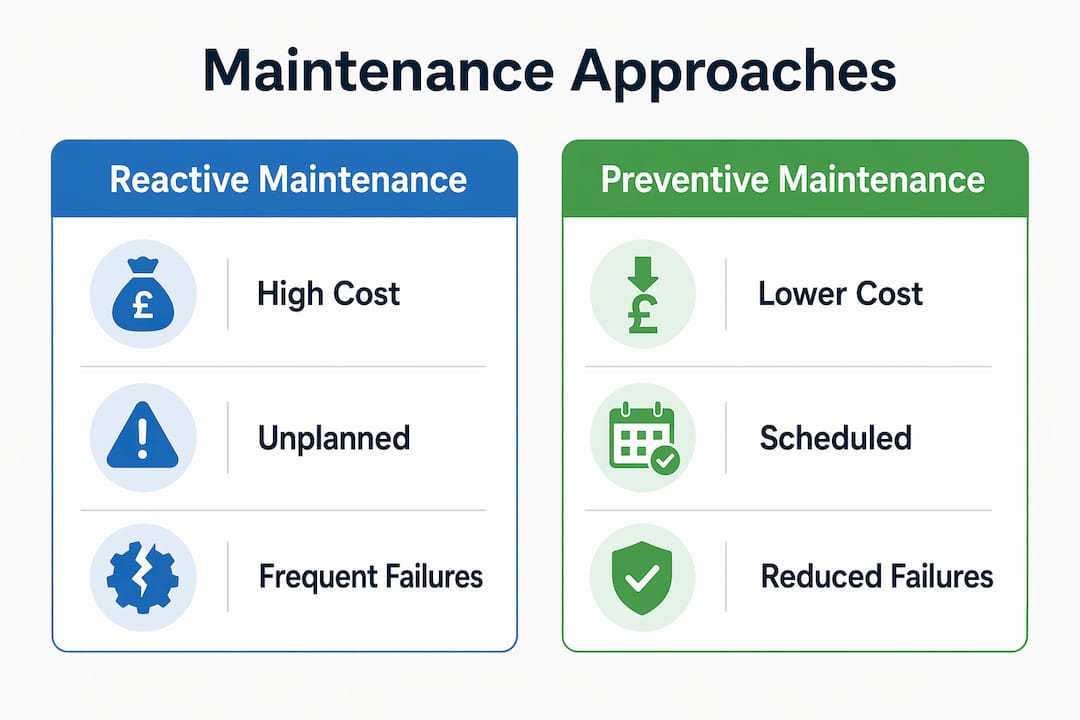
| Factor | Reactive maintenance | Preventive maintenance |
|---|---|---|
| Cost per incident | High, unplanned | Low, budgeted |
| Asset lifespan | Shortened by repeated failures | Extended through regular servicing |
| Regulatory compliance | At risk during failure periods | Maintained consistently |
| Tenant satisfaction | Disrupted by downtime | Stable and predictable |
| Operating expense share | Up to 30% of op-ex | 15–20% of op-ex |
An integrated maintenance framework combining routine, preventive, and corrective approaches protects long-term fiscal investment. This is not a theoretical point. Properties with documented maintenance histories command stronger valuations at sale and attract higher-quality tenants at lease renewal.
Pro Tip: Track your maintenance spend by category each quarter. If corrective repairs account for more than 40% of your total maintenance budget, your preventive schedule needs reviewing.
What does a structured commercial upkeep schedule look like?
A structured schedule organises tasks by frequency so nothing is missed and costs are spread predictably across the year. The standard maintenance schedule comprises daily janitorial tasks, weekly and monthly minor repairs and lighting checks, plus quarterly and annual major inspections of HVAC, fire safety, and roofing.
The table below gives a practical framework for commercial properties in Dublin.
| Frequency | Typical tasks | Responsible party |
|---|---|---|
| Daily | Cleaning, waste removal, entrance and car park checks | In-house or contracted janitorial team |
| Weekly | Lighting checks, minor repairs, grounds inspection | Facilities manager or grounds contractor |
| Monthly | Filter checks, fire exit inspections, exterior wash-down | Specialist contractor or in-house team |
| Quarterly | HVAC servicing, fire safety testing, drainage inspection | Certified specialist contractor |
| Annual | Roof inspection, full electrical test, structural survey | Chartered surveyor or specialist engineer |
For grounds and exterior upkeep, the schedule should also account for seasonal variation. Lawn care and hedge trimming in Dublin follow a growth cycle that peaks from april through september. Gutter clearing is most critical in autumn, when leaf fall blocks drainage. A grounds maintenance contractor familiar with Dublin's climate will build this into your schedule automatically.
Property management software such as Planon or Archibus can track task completion, store contractor records, and flag overdue items. For smaller portfolios, a shared spreadsheet with automated reminders works equally well. The tool matters less than the discipline of recording every task completed.
For a detailed look at how to build this kind of programme, the scheduled maintenance guide from Sherrypropertycare covers HVAC, fire safety, and roofing cycles specific to Dublin commercial buildings.
What are the common challenges in commercial upkeep?
The biggest barrier to effective upkeep is the reactive mindset. Proactive, data-driven maintenance programmes extend asset lifecycles and reduce costs. Yet many property managers default to fixing things only when they break, because reactive repairs feel more urgent than planned ones.
The result is a budget that lurches from one emergency to the next. Reactive management also creates compliance gaps. A fire suppression system that fails its annual test because it was never serviced is not just expensive to fix. It is a regulatory liability.
Common pitfalls to avoid:
- Skipping documentation after each maintenance visit
- Using a single contractor for all tasks rather than specialists for complex systems
- Failing to communicate planned works to tenants in advance
- Letting grounds and exterior upkeep slip during winter months
- Ignoring minor defects until they become structural problems
Detailed documentation of maintenance activities is critical for compliance, insurance, and audit readiness. A rigorous maintenance log including technician reports and parts records protects you during insurance claims and regulatory inspections. It also gives you the data to negotiate better rates with contractors at renewal.
Vendor management is equally important. A contractor who arrives on time, completes the work to standard, and provides a written report is worth more than a cheaper alternative who does not. Build a preferred supplier list and review it annually.
Pro Tip: After every maintenance visit, request a written completion report from the contractor. File it with the date, work carried out, and any follow-up actions noted. This takes two minutes and saves hours during an insurance audit.
For practical guidance on organising tasks across your portfolio, the effective maintenance scheduling guide from Sherrypropertycare is a useful reference for Dublin property managers.
Key takeaways
Commercial upkeep is a planned, continuous investment that protects property value, controls operating costs, and keeps tenants satisfied across every season.
| Point | Details |
|---|---|
| Define upkeep broadly | Commercial upkeep covers routine, preventive, predictive, and corrective maintenance across interiors, exteriors, and systems. |
| Cost control starts with prevention | Preventive maintenance keeps operating costs at 15–20% of op-ex; reactive management pushes that to 30%. |
| Schedule by frequency | Daily, weekly, monthly, quarterly, and annual task cycles keep maintenance predictable and budgets stable. |
| Document everything | Maintenance logs are critical for insurance claims, regulatory compliance, and contractor management. |
| Grounds upkeep is seasonal | Dublin's climate means exterior and grounds maintenance must follow a seasonal schedule to stay effective. |
Commercial upkeep in Dublin: what I have learned from the ground up
Working with commercial properties in Dublin over the years, the pattern I see most often is this: property managers who treat upkeep as a cost to minimise end up spending far more than those who treat it as a programme to manage. The maths is not complicated. A neglected grounds area signals neglect to every tenant and visitor who walks past it. A well-kept exterior signals that the building is managed with care.
Dublin's climate adds a specific layer of complexity. The wet winters and mild but unpredictable springs mean that exterior surfaces, drainage, and soft landscaping need attention across all four seasons, not just in summer. I have seen car parks develop serious drainage problems because autumn gutter clearing was skipped. I have seen hedges become unmanageable because they were left through a wet growing season. These are not dramatic failures. They are the result of small decisions to defer maintenance that compound quietly over time.
The shift from reactive to preventive thinking is the single most impactful change a property manager can make. You do not need expensive software or a large team. You need a written schedule, a reliable contractor, and the discipline to follow through. The commercial property maintenance guide for Dublin from Sherrypropertycare is a good starting point if you are building a programme from scratch.
Upkeep is not glamorous work. But it is the work that keeps a property worth owning.
— gerard
Sherrypropertycare: commercial grounds care in Dublin
Sherrypropertycare specialises in commercial grounds and property maintenance for business owners and property managers across Dublin, Ireland.

Whether you manage a single office building or a multi-site portfolio, Sherrypropertycare provides meticulous lawn care, hedge trimming, landscaping, and exterior upkeep tailored to your property's specific needs. Every service is built around a scheduled programme, so your grounds stay presentable and compliant across every season. Send a photo of your property and get a customised maintenance quote with no obligation. Sherrypropertycare brings the same attention to detail to every Dublin commercial site, regardless of size.
FAQ
What is commercial upkeep in simple terms?
Commercial upkeep is the ongoing maintenance of a business property to keep it safe, functional, and visually appealing. It covers cleaning, repairs, grounds care, and compliance tasks carried out on a regular schedule.
What does upkeep involve for a commercial building?
Commercial building upkeep includes routine cleaning, preventive servicing of HVAC and fire safety systems, exterior grounds maintenance, and corrective repairs when faults arise. Compliance-driven tasks such as electrical testing and fire inspections are also part of the programme.
Why is preventive maintenance better than reactive repairs?
Preventive maintenance costs far less per incident than reactive repairs. Replacing a £200 component on schedule prevents failures that can cost £15,000 or more to fix in an emergency.
How often should commercial property maintenance be carried out?
Maintenance tasks run on daily, weekly, monthly, quarterly, and annual cycles depending on the system or area involved. Grounds and exterior upkeep in Dublin also follow a seasonal schedule aligned with the local climate.
Does commercial upkeep affect property value?
Well-maintained commercial properties hold their market value and attract higher-quality tenants. Poor upkeep raises operating costs and reduces asset value, particularly when reactive management pushes maintenance spend above 30% of total operating expenses.