
TL;DR:
- Lighting maintenance involves scheduled cleaning, inspections, and component replacements to ensure safety, efficiency, and compliance. Proper upkeep prolongs equipment lifespan, maintains uniform illumination, and reduces unexpected repair costs, especially for Dublin properties facing environmental challenges. Implementing routine procedures and formal contracts safeguards property value, minimizes disruption, and ensures regulatory adherence.
Lighting maintenance is the scheduled and unscheduled upkeep of lighting systems to preserve consistent illumination, operational safety, and energy efficiency across residential and commercial properties. It covers everything from cleaning lenses and inspecting electrical connections to testing emergency backup systems and replacing failing components before they cause disruption. For property owners and managers in Dublin, understanding what lighting maintenance involves is the difference between a proactive asset management approach and a costly cycle of reactive repairs.
Preventive lighting maintenance reduces unexpected failures by shifting from reactive fixes to planned interventions, delivering both operational and financial benefits. This matters whether you manage a single residential property in Ranelagh or a commercial building in Dublin's city centre.
What does lighting maintenance involve?
Lighting maintenance, known in the facilities industry as a lighting upkeep programme, covers two distinct categories: preventive tasks carried out on a schedule, and corrective work triggered by faults or failures.
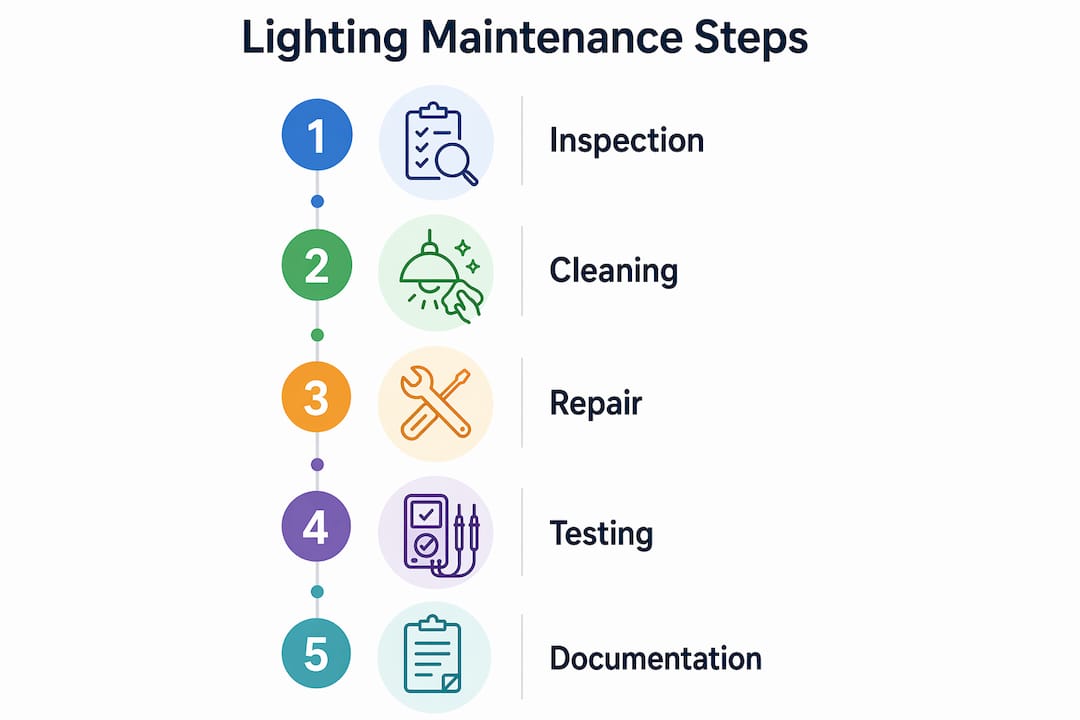
Preventive tasks form the backbone of any well-run programme. According to facility-service scopes, these typically include:
- Cleaning optical components such as lenses, reflectors, and diffusers to restore light output
- Inspecting fixtures for physical damage, corrosion, or moisture ingress
- Checking electrical connections for loose terminals or signs of overheating
- Measuring illumination levels against design standards
- Replacing lamps or drivers approaching end of rated life before they fail
Corrective maintenance addresses faults as they arise: a failed driver, a tripped circuit, or a fixture damaged by weather. Neither category operates in isolation. A well-structured programme uses preventive work to reduce the frequency of corrective call-outs.
Emergency lighting sits in its own category entirely. Regulatory guidance mandates a monthly 30-second functional test and an annual 90-minute full-duration battery discharge test, with records kept for at least three years. This means emergency lighting maintenance is as much about documentation as it is about the physical testing itself.
Pro Tip: Keep a dedicated maintenance log for your emergency lighting separate from your general lighting records. Inspectors look for this distinction, and mixing the two can create compliance gaps even when your fixtures are performing correctly.
How does lighting maintenance benefit safety and energy efficiency?
Well-maintained lighting systems deliver consistent illumination, longer equipment lifespan, lower running costs, and regulatory compliance. Each of these benefits connects directly to the day-to-day concerns of property owners and managers.

Consistent illumination is the most immediate safety benefit. Poorly maintained lighting creates uneven light levels in car parks, stairwells, and building entrances, which increases the risk of accidents and exposes property owners to liability. Replacing lamps on a group relamping schedule rather than waiting for individual failures keeps light levels predictable and uniform.
Energy efficiency improves when systems are maintained properly. Dirty lenses and degraded reflectors can reduce light output by 20 to 30 per cent without any visible sign of failure. Cleaning restores output without replacing hardware, which means you get the same light for less energy. System audits that measure illumination levels and energy consumption identify underperforming fixtures and inform targeted upgrades rather than blanket replacements.
"Lighting maintenance is not just about keeping the lights on. It is about keeping them working at the level they were designed to deliver, safely and efficiently, for as long as possible."
Equipment lifespan extends significantly with planned maintenance. LED systems in particular are subject to lumen depreciation, where light output gradually declines over time. Standards such as LM-80 and TM-21 use metrics like L70 lumen maintenance to guide decisions about when cleaning restores acceptable performance and when replacement becomes necessary. Acting on this data prevents premature replacements and avoids running fixtures well past their useful output life.
How do residential and commercial maintenance needs differ?
The scope and frequency of lighting upkeep varies considerably between a family home in Dublin and a commercial premises. The table below outlines the key differences.
| Factor | Residential properties | Commercial properties |
|---|---|---|
| Primary focus | Exterior safety and kerb appeal | Operational continuity and compliance |
| Cleaning frequency | Every 6 to 12 months in urban areas | Every 3 to 6 months in high-use environments |
| Emergency lighting | Rarely required | Mandatory with documented testing |
| Inspection schedule | Annual electrical inspection | Quarterly visual checks plus annual full inspection |
| Regulatory pressure | Lower | Higher, with health and safety obligations |
For residential properties, exterior lighting upkeep focuses on safety at entrances, driveways, and garden paths, as well as the visual impression the property makes. In Dublin's coastal and urban environments, salt air and pollution accelerate lens degradation and corrosion on outdoor fittings, making cleaning every 6 to 12 months the standard recommendation for urban areas and more frequently for exposed locations.
Commercial properties carry additional obligations. Treating general lighting separately from emergency lighting is not optional. Mixing the two in a single maintenance scope creates compliance gaps that can surface during fire safety audits, even when all fixtures appear to be functioning. Retail units, offices, and hospitality venues in Dublin also face higher cleaning demands because dust, cooking residues, and heavy footfall degrade fixtures faster than in residential settings.
Environmental factors drive maintenance frequency more than property type alone. Outdoor facade lighting on Dublin buildings faces thermal cycling, moisture ingress, and seal degradation that require preventive replacement planning to avoid progressive failures. Waiting for visible faults on facade fittings is a false economy.
What is the role of maintenance contracts in lighting upkeep?
An Annual Maintenance Contract, commonly referred to as an AMC, is a formal agreement between a property owner and a service provider that defines the scope, frequency, and cost of scheduled lighting maintenance over a 12-month period. AMCs formalise professional lighting upkeep, extending equipment lifespan, preserving visual quality, and controlling costs through predictable budgeting.
A typical AMC for a commercial property in Dublin covers:
- Scheduled preventive inspections at agreed intervals
- Optical cleaning of lenses, diffusers, and reflectors
- Electrical connection checks and thermal imaging where specified
- Fault diagnostics and component replacement within defined response times
- Emergency lighting testing and compliance documentation
AMCs come in two broad forms. A full-coverage contract includes all parts and labour for repairs within the scope. A partial contract covers labour only, with parts billed separately. For properties with older or mixed-technology systems, a full-coverage contract provides better cost certainty. For newer LED installations still within manufacturer warranty, a partial contract often makes more financial sense.
The maintenance contracts guide from Sherrypropertycare's blog covers how to evaluate contract types for different property needs in Dublin. Choosing the right structure depends on the age of your system, the complexity of your installation, and your appetite for unplanned expenditure.
Pro Tip: When reviewing an AMC, check whether emergency lighting testing and documentation are explicitly included. Many standard contracts cover general lighting only, leaving you responsible for life-safety compliance separately.
What practical steps can property owners take to maintain lighting effectively?
Effective lighting system care does not require specialist knowledge for every task. A structured approach to scheduled maintenance puts you in control of costs and compliance without waiting for problems to appear.
The following steps form a practical starting point for any property owner or manager in Dublin:
- Set a cleaning schedule. Clean exterior fittings every six months as a minimum. Interior commercial fittings in high-use areas benefit from quarterly cleaning. Use this as a trigger to inspect for physical damage at the same time.
- Test emergency lighting monthly. Carry out the 30-second functional test on all emergency fittings and record the result. This takes minutes and protects you during any compliance inspection.
- Conduct an annual full inspection. This should cover electrical connections, fixture integrity, lumen output where measurable, and a full 90-minute battery discharge test on emergency systems.
- Document everything. Records kept for at least three years satisfy most regulatory requirements. A simple spreadsheet with dates, findings, and actions taken is sufficient for most residential and small commercial properties.
- Know when to call a professional. Any work involving electrical connections, panel-level faults, or emergency lighting certification requires a qualified electrician or specialist lighting contractor. Routine cleaning and visual checks are well within the scope of a competent property manager.
- Schedule work to minimise disruption. For commercial properties, plan inspections outside peak trading hours. For residential properties, coordinate exterior work with seasonal maintenance visits to reduce call-out costs.
The property maintenance checklist for Dublin landlords from Sherrypropertycare includes lighting upkeep as part of a broader annual schedule, which is a useful reference for integrating lighting tasks into your overall property management routine.
Key takeaways
Lighting maintenance is a planned discipline that protects safety, controls costs, and keeps properties compliant. Reactive repairs always cost more than scheduled upkeep.
| Point | Details |
|---|---|
| Core definition | Lighting maintenance covers both preventive and corrective upkeep of all lighting systems. |
| Emergency lighting compliance | Monthly and annual tests with three years of records are mandatory for commercial properties. |
| Residential vs commercial | Commercial properties require more frequent cleaning, stricter compliance, and separate emergency lighting management. |
| AMC value | Annual Maintenance Contracts provide cost predictability and professional servicing for all property types. |
| Practical first step | Set a cleaning and inspection schedule, document every visit, and call a professional for electrical or certification work. |
Why proactive lighting maintenance pays off in Dublin
I have seen the same pattern repeat itself with Dublin property owners more times than I can count. A landlord or commercial manager defers lighting maintenance because nothing appears to be wrong, then faces a significant repair bill when a fixture fails at the worst possible moment, or worse, fails a fire safety audit because emergency lighting records do not exist.
The shift from reactive to proactive maintenance is not complicated. It requires a schedule, a log, and the discipline to follow through. What surprises most property owners is how little time and cost a preventive programme actually demands compared to the disruption of unplanned failures.
The compliance dimension is the part most often underestimated. Emergency lighting documentation is not a bureaucratic formality. It is the evidence that your building is safe for occupants, and it is what protects you legally if an incident occurs. I would always recommend treating emergency lighting as a separate maintenance obligation from general lighting, with its own records and its own service schedule.
For Dublin properties specifically, the combination of urban pollution, coastal air, and variable weather means outdoor fittings degrade faster than manufacturers' standard estimates suggest. Building that reality into your maintenance frequency, rather than relying on generic guidance, is the practical difference between a system that performs and one that disappoints.
— gerard
Professional lighting and property maintenance in Dublin
Sherrypropertycare provides professional property maintenance services across Dublin, covering both residential and commercial properties. Whether you need scheduled exterior lighting upkeep as part of a broader grounds maintenance programme or a customised plan for your commercial premises, the team at Sherrypropertycare can help you put the right schedule in place.

Getting started is straightforward. Send a photo of your property and Sherrypropertycare will provide a tailored quote based on your specific needs. The focus is always on quality work, reliable scheduling, and clear communication so you know exactly what is being done and when. Contact Sherrypropertycare today to discuss a maintenance plan that keeps your property safe, compliant, and looking its best throughout the year.
FAQ
What is lighting maintenance in simple terms?
Lighting maintenance is the regular care and inspection of lighting systems to keep them working safely and efficiently. It includes cleaning fixtures, checking electrical connections, replacing failing components, and testing emergency lighting.
How often should lighting be inspected on a commercial property?
Commercial lighting benefits from quarterly visual checks and a full annual inspection covering electrical connections, lumen output, and emergency system testing. Emergency lighting requires a monthly 30-second functional test and an annual 90-minute battery discharge test.
Is emergency lighting maintenance different from general lighting maintenance?
Yes. Emergency lighting has strict regulatory testing and documentation requirements that are separate from general lighting upkeep. Records must be kept for at least three years, and the two systems should be managed under distinct maintenance schedules.
What does an Annual Maintenance Contract cover for lighting?
An AMC typically includes scheduled inspections, optical cleaning, electrical connection checks, fault diagnostics, component replacement, and emergency repair response. Contracts can be full coverage or labour-only depending on the property's needs.
How does lighting maintenance affect energy bills?
Dirty lenses and degraded reflectors reduce light output significantly without any visible sign of failure. Regular cleaning restores output, meaning your system delivers the same illumination for less energy, which reduces running costs over time.