
Maintenance budgeting is the process of planning how much money you need to keep buildings, equipment or grounds performing at the standard you've promised, and where every pound or euro of that money will go. It covers labour, spare parts, contractor services, consumables, inspections and monitoring tools, as Tractian's glossary puts it. The single most important decision you'll make is how you build that number.
Build the budget from your assets and their risk profile, not from a blanket percentage carried over from last year. A budget built asset by asset, risk by risk, survives scrutiny.
Before you walk into any budget meeting, arm yourself with these:
- The rough sanity check: a commonly referenced benchmark is a small percentage of a portfolio's current replacement value, though it's only a coarse cross-check, never a substitute for bottom-up costing, as Tractian notes.
- The biggest cost lever: shifting effort from reactive to preventive work is commonly cited as producing substantial savings when prioritized effectively, according to Re-Leased.
- The evidence finance actually wants: asset registers, work-order history, parts usage and contractor quotes, not opinions, as Eptura's guidance makes clear.
Key takeaways
A defensible maintenance budget is built bottom-up from asset risk and evidence, not from a blanket percentage carried over from last year.
| Point | Details |
|---|---|
| Start with asset data | Pull the asset register, work-order history and PM schedule before estimating any cost. |
| Separate OpEx from CapEx | Keep routine maintenance and capital replacements in distinct budget lines. |
| Use benchmarks as checks, not answers | Treat the 2 to 4% CRV rule as a sanity check alongside your bottom-up build. |
| Present three funding scenarios | Show statutory, planned service and risk-reduction options with residual risks stated. |
| Review monthly, not annually | Track variance by category and the planned-to-reactive ratio to catch drift early. |
Table of Contents
- What is maintenance budgeting and what does it cover?
- Why a defensible maintenance budget matters beyond the spreadsheet
- What belongs in a maintenance budget: the full line-item list
- Seven evidence lines that build a defensible budget
- How to prepare a maintenance budget: sequence and timing
- Presenting three funding scenarios instead of one number
- Benchmarks, sanity checks and a worked example
- What finance needs to approve the budget
- Monitoring the budget once it's approved
- Common mistakes that sink a maintenance budget
- A copyable template for your budget workbook
- Why this matters for Dublin property owners specifically
- Sources
- FAQ
What is maintenance budgeting and what does it cover?
Maintenance budgeting is the formal exercise of allocating money to keep every asset in your portfolio running at the service level you've committed to, and then tracking planned spend against actual spend throughout the year. It's not a spreadsheet you fill in once a year and forget. It's a working document that should evolve as conditions change, contracts renew and equipment ages.
A properly scoped maintenance budget typically includes:
- Internal labour hours for planned and reactive work
- Spare parts and consumables, priced against current supplier rates
- Contractor and specialist service costs, including statutory inspections
- Licences and monitoring or CMMS software subscriptions
- A documented contingency for unplanned failures
Here's where a lot of planners trip up: they lump capital projects into the same line as day-to-day upkeep. Operating maintenance budgets (OpEx) fund the recurring work that keeps things running. Capital or project budgets (CapEx) fund replacements, upgrades and major overhauls. Vixxo's guidance on facility management budgets is blunt about this: separate them clearly so finance can trace operating costs and capital investment independently, even though both should link back to the same asset plan. Get this wrong and you'll either understate your real running costs or bury a major replacement inside a line meant for filter changes.
Why a defensible maintenance budget matters beyond the spreadsheet
A weak maintenance budget doesn't just risk overspending. It risks safety failures, service interruptions and a slow bleed of asset value that nobody notices until the bill for full replacement lands on someone's desk.
A credible budget delivers five concrete outcomes:
- Safety and compliance: statutory inspections and certifications happen on schedule, not when someone remembers.
- Continuity of service: critical assets get planned attention before they fail, not after.
- Cost predictability: finance can forecast cash flow instead of absorbing surprise invoices.
- Asset life management: preventive work extends useful life and delays expensive capital replacement.
- Decision transparency: finance sees exactly what's funded, what isn't, and what risk that creates.
Reactive maintenance is typically significantly more expensive than planned work carried out on schedule, and tracking your planned-to-reactive ratio is one of the earliest warning signs of a budget under strain, according to Robin Powered's overview of reliability-based budgeting. If your reactive spend is climbing quarter on quarter, your budget conversation next year will be a defensive one rather than a strategic one.
For residential or commercial property owners specifically, the stakes are tangible. Deferred grounds maintenance shows up fast in kerb appeal and tenant satisfaction. Our own guide on how scheduled maintenance boosts property value in Dublin covers this from the property side; the budgeting principle is the same one that applies to plant rooms and lifts.
What belongs in a maintenance budget: the full line-item list
A complete operating maintenance budget should itemise every category of spend, not just the obvious ones. Here's what a properly built one contains:
- Internal labour: hours for planned preventive tasks, corrective repairs and administrative time (inspections, reporting)
- Planned preventive tasks: scheduled servicing, calibration, lubrication, filter changes
- Corrective work: unscheduled repairs arising from breakdowns or inspection findings
- Parts and consumables: stock items, wear parts, and long-lead specialist components
- Contracts and inspections: statutory testing, specialist servicing agreements, and third-party inspection fees
- Licences and monitoring tools: CMMS subscriptions, sensor monitoring, compliance software
- Approved backlog reduction: a funded allocation to work down known deferred maintenance
- Operating contingency: a documented buffer for genuinely unplanned events
Statutory testing and long-lead spare parts deserve special treatment. If a piece of safety-critical equipment needs a part with a twelve-week lead time, that cost needs to sit in the budget as a planned line, priced and timed, not discovered when the part fails. Specialist services, such as a one-off arboriculture survey or a lift examination, should be quoted and locked in early rather than estimated from memory.
Anything that replaces an asset outright, funds a major refurbishment, or adds new capacity belongs in CapEx, not here. Xero's explainer on OpEx versus CapEx makes the point that operational teams need to work with finance to classify large overhauls correctly, because misclassifying a major replacement as routine maintenance distorts both budgets and creates reporting headaches later.
Pro Tip: Keep a running "watch list" of ageing assets that are close to the CapEx threshold. Flagging them a year ahead gives finance time to plan the capital spend instead of being ambushed by a mid-year emergency request.
Seven evidence lines that build a defensible budget
A bottom-up budget is only as strong as the data behind it. Practitioner guidance consistently points to a small set of evidence lines that, taken together, turn a guess into a number finance can trust. Infodeck's planning guide frames this as building the budget from asset risk, planned work, labour, parts, contracts, projects and backlog, then presenting scenarios rather than a single figure.
- Scope and service level: define exactly which assets and areas are in scope, and at what standard. Record this in the asset register alongside a criticality rating.
- Planned maintenance demand: pull the PM schedule for the year and cost each task by hours, parts and any contractor involvement.
- Corrective baseline: use work-order history from the last 12 to 24 months to estimate a realistic corrective spend, rather than assuming it will drop to zero.
- Labour and contractor capacity: map internal hours available against demand, and identify where contracted support fills the gap.
- Parts and consumables: review usage history and current supplier pricing, flagging any long-lead items separately.
- Known projects and lifecycle decisions: list any assets approaching end of life so the CapEx conversation starts early, not late.
- Backlog and contingency: quantify deferred maintenance explicitly and set a documented, evidence-based contingency rather than a round number.
| Evidence line | Primary data source | What to record in the asset register |
|---|---|---|
| Scope & service level | Portfolio survey, tenant agreements | Asset ID, location, criticality rating |
| Planned demand | PM schedule, OEM manuals | Task frequency, estimated hours, parts list |
| Corrective baseline | Work-order history | Fault frequency, average repair cost |
| Labour & contractor capacity | Rosters, contractor SLAs | Hours available, contract expiry dates |
| Parts & consumables | Stock records, supplier quotes | Lead time, unit cost, reorder point |
| Projects & lifecycle | Condition surveys | Expected remaining life, replacement cost estimate |
| Backlog & contingency | Deferred work log | Age of item, risk rating, estimated cost |
Pro Tip: *Document your contingency calculation, not just the total.
How to prepare a maintenance budget: sequence and timing
Preparing a maintenance budget properly is a sequence, not a single sitting. Rushing it into a two-week sprint before the deadline is the single most common reason budgets get rejected or trimmed without explanation.
- Confirm scope with asset owners and property managers: which buildings, systems or grounds are included this cycle.
- Extract data from the asset register, work-order history and current contracts.
- Cost planned work using labour rates, parts pricing and contractor quotes.
- Establish the corrective baseline from historical trends, adjusted for any known changes (new equipment, ageing plant).
- Identify backlog items and rank them by risk, not by age alone.
- Build funding scenarios (covered in the next section) so finance sees choices, not a single fixed ask.
- Draft the one-page summary and supporting attachments.
- Submit and present, leaving time for a follow-up meeting before final sign-off.
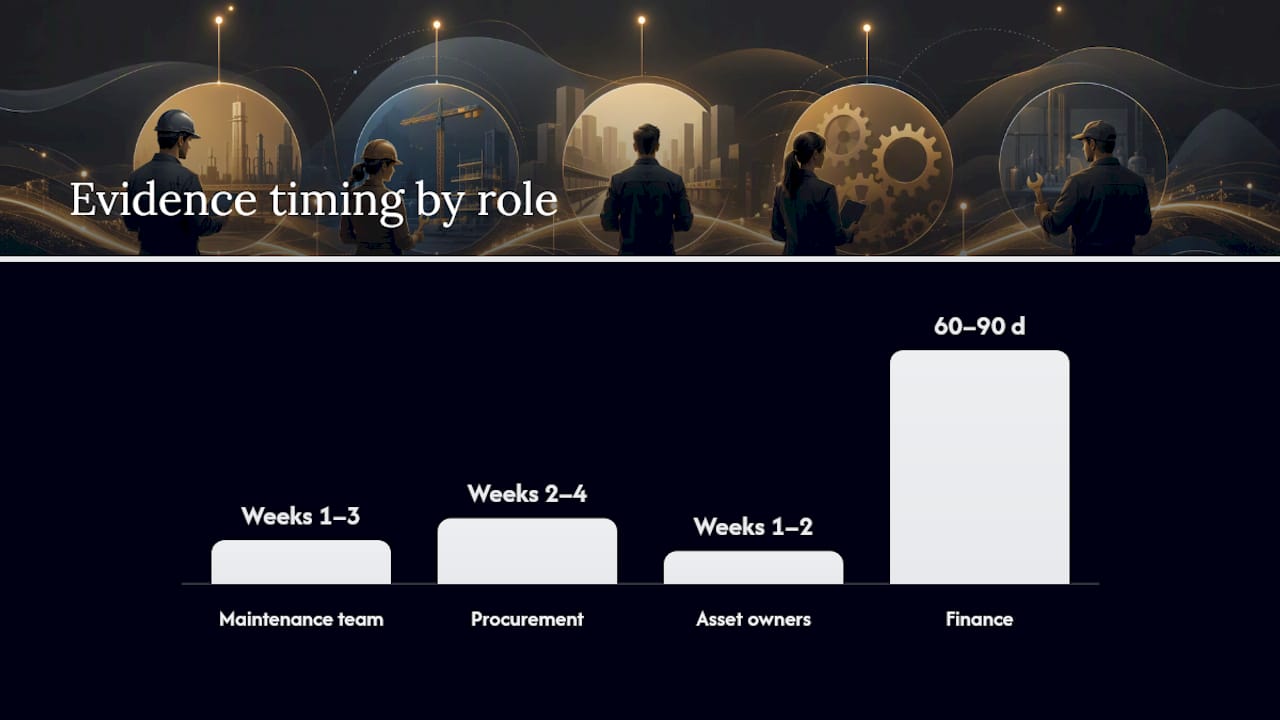
Most organisations work to a 60 to 90 day window ahead of the new fiscal year, though the exact deadline varies by business. Starting the data extraction at day one and leaving scenario building and the summary document for the final two weeks gives you room to negotiate rather than scramble.
| Role | Evidence they supply | Typical timing |
|---|---|---|
| Maintenance team | Work-order history, PM schedule, labour hours | Weeks 1 to 3 |
| Procurement | Contractor quotes, parts pricing, contract renewal dates | Weeks 2 to 4 |
| Asset owners | Scope confirmation, service level expectations | Weeks 1 to 2 |
| Finance | Prior year actuals, budget templates, submission deadline | Ongoing |
Good scheduling discipline also reduces the corrective baseline you're forecasting. Our piece on optimising property upkeep with effective maintenance scheduling covers the operational side of getting planned work to actually happen on time, which directly affects next year's numbers.
Presenting three funding scenarios instead of one number
A single budget figure invites a single response: cut it. Three scenarios, each with clear consequences, turns the conversation into a decision finance can actually own. Infodeck's guidance frames this as presenting the service level and residual risks alongside each option, so the request reads as an operating plan rather than a demand.
| Scenario | What it funds | What stays unfunded | Example outcome |
|---|---|---|---|
| Statutory & critical | Legal compliance, safety-critical assets, must-run systems | Planned preventive work, backlog reduction | Legal exposure reduced; breakdown risk rises on non-critical assets |
| Planned service | Statutory work plus full PM schedule and normal contingency | Backlog reduction, lifecycle upgrades | Service level maintained; deferred items continue ageing |
| Risk reduction | Planned service plus targeted backlog clearance | Nothing significant | Lowest breakdown risk; highest upfront spend |
Presenting scenarios this way does two things. It shows finance exactly what each pound buys, and it keeps deferred work visible rather than quietly disappearing from the conversation. A budget that only ever shows the "planned service" figure, with statutory and risk-reduction options hidden, leaves finance guessing at what a cut actually costs in risk terms.
Benchmarks, sanity checks and a worked example
The 2 to 4% of current replacement value benchmark is the number most facility managers hear first, and it's genuinely useful as a gut check. Tractian's guidance notes it can run up to 5% in some sectors. But it's a check, not a method. A portfolio of newer, well-maintained assets will sit comfortably below that range; an ageing portfolio with deferred backlog can legitimately need more.
UpKeep's guidance recommends pairing the replacement-value check with alternate metrics: cost per square metre for buildings and grounds, or cost per asset group for equipment-heavy portfolios. Use these to spot outliers within your own numbers, not to replace the bottom-up build.
Here's how a worked example moves from task to total for a mid-sized grounds and property portfolio:
What finance needs to approve the budget
Finance rarely rejects a budget because the number is wrong. They reject it because they can't see how the number was built. A one-page summary, backed by attachments, solves that in one meeting.
Your one-page summary should contain:
- Portfolio scope and agreed service level
- Total cost by category (labour, parts, contracts, contingency)
- Top five funded risks and what funding them achieves
- Top five unfunded risks and their consequence if left unfunded
- Side-by-side scenario comparison
- Key assumptions (inflation rate, contract renewals, known lifecycle events)
Attach the evidence that supports it:
- Asset register extract showing criticality ratings
- Work-order history for the corrective baseline
- Signed contractor quotes for major contract lines
- Statutory testing dates and certification requirements
- Parts lead-time schedule for long-lead items
- Backlog register with risk ranking
When finance pushes back, the most common objections are predictable: "why is this higher than last year", "can this wait a year", and "what happens if we just fund the middle scenario". Answer each with the evidence already in your attachments rather than a fresh explanation. If the corrective baseline is climbing, point to the work-order trend. If backlog reduction is being questioned, point to the risk ranking. Readers preparing public-sector or highly audited submissions should also look at GAO's published reports for the standard of evidence auditors expect from budget justifications.
Monitoring the budget once it's approved
A signed-off budget isn't the finish line. It's the start of a monthly discipline that catches problems while they're still small.
Run this monthly review:
- Compare actual spend against forecast, by cost category, not just in total.
- Review any changes in asset condition that might shift next quarter's forecast.
- Check backlog movement: is it growing, shrinking, or static?
- Assess contractor performance against SLA commitments.
Track these KPIs consistently:
- Planned-to-reactive ratio: the earliest signal that something is drifting off track.
- Variance by cost category: not just overall variance, which hides problems in one line by offsetting them against another.
- Backlog ageing: how long deferred items have sat unresolved.
- Spend per asset group: useful for spotting which category is consuming disproportionate budget.
Federal facility operations and maintenance guidance offers useful checklists for building this kind of monitoring discipline into a routine rather than an occasional audit.
Identify whether the variance is a one-off (an emergency repair) or a trend (rising parts costs, contractor scope creep), and adjust the forecast accordingly.
Common mistakes that sink a maintenance budget
Most rejected or mid-year-collapsed budgets fail for the same handful of reasons, and every one of them is avoidable.
- Top-down percentage budgets: taking last year's figure and adding a flat percentage, with no asset-level justification.
- Mixing OpEx and CapEx: burying a major replacement inside routine maintenance lines, distorting both budgets.
- Hiding backlog: leaving deferred work off the budget entirely instead of showing it as an unfunded risk.
- No documented contingency: either skipping it altogether or setting a round number nobody can explain.
- Failing to link spend to risk: presenting costs without showing what breaks, or how badly, if they're not funded.
Pull the work-order history immediately and identify which two or three assets are driving it. Nine times out of ten, it's a small number of repeat offenders, not a portfolio-wide problem.*
Deferring maintenance to protect this year's budget usually costs more next year. Our guide on property maintenance versus repairs walks through exactly how that trade-off plays out financially.
A copyable template for your budget workbook
You don't need bespoke software to start. A well-labelled spreadsheet with the right row structure gets you most of the way there.
Use these row labels as your starting template:
- Planned labour (by trade or team)
- Parts and consumables (by category)
- Contracted services (by supplier)
- Corrective baseline (historical average)
- Statutory inspections and licences
- Backlog items (ranked by risk)
- Operating contingency
| Column | What it captures |
|---|---|
| Cost category | Which line item this belongs to |
| Basis for estimate | Historical average, quote, OEM schedule |
| Annual cost | The budgeted figure for the year |
| Actual to date | Running total, updated monthly |
| Variance | Actual minus forecast, flagged if outside tolerance |
Before signing off the proposed budget, run through this final checklist: every planned task has a cost basis, corrective baseline reflects real history, backlog is visible with a risk rank, contingency is documented not guessed, and all three funding scenarios are attached with residual risks stated. For property owners weighing which grounds and garden items to prioritise within a tight budget, our maintenance contracts guide and this partner guide on budget-friendly property fixes that pay off both offer useful prioritisation angles.
Why this matters for Dublin property owners specifically
Sherrypropertycare builds grounds and garden maintenance contracts for residential and commercial properties across Dublin, and the same asset-driven logic in this guide applies directly to that work. A lawn, hedge line or car park planting scheme is an asset with a condition, a service level and a realistic cost of upkeep, exactly like a boiler or a lift.

When we prepare a quote, we're effectively doing a scaled-down version of the process above: scoping the site, estimating labour and materials against the service level the client wants, and being upfront about what a basic maintenance contract covers versus what a fuller programme would add. That's the same statutory-versus-planned-versus-risk-reduction thinking property managers should bring to their own internal budget submissions.
Sources
- Maintenance Budget: Definition — Tractian glossary
- Maintenance budget planning guide for facility teams — Infodeck
- Preventive maintenance vs. reactive maintenance: costs, ROI & best practices — Re-Leased
- Maintenance Budgets, with definitions, examples and best practices — Eptura
FAQ
How do you prepare a maintenance budget?
Scope the assets in question, extract data from the asset register and work-order history, cost planned and corrective work, rank backlog items by risk, then build multiple funding scenarios before submitting a one-page summary to finance.
What are the three P's of maintenance?
Definitions vary across sources, but the version used most often refers to planned, preventive and predictive maintenance, the three approaches that reduce reliance on reactive repairs.
What are the three types of budgets in maintenance planning?
The common categories are operating budgets (day-to-day upkeep), capital or project budgets (replacements and major works), and contingency allocations for unplanned events, with operating and capital always presented separately.
What does "maintain budget" mean?
It means keeping actual spend in line with the approved forecast throughout the year, tracked monthly against the categories set out in the original budget rather than checked only at year-end.