
TL;DR:
- Scheduled maintenance is a proactive, pre-planned approach that maintains property condition and prevents costly repairs. It involves scheduled tasks, both recurring and one-time, managed through fixed or floating calendars, tailored to each property's needs. Properly implemented, it safeguards investment, enhances kerb appeal, and ensures legal compliance in Dublin properties.
Most property owners assume scheduled maintenance simply means booking a service call once a year and ticking a box. The reality is more purposeful than that. Scheduled maintenance is a structured, proactive approach to keeping your property in good condition before problems develop. Done well, it protects your investment, preserves kerb appeal, and avoids the kind of costly emergency repairs that drain budgets fast. This guide covers the scheduled maintenance definition, how it works in practice, common pitfalls, and how to build a programme that genuinely serves your Dublin property.
Table of Contents
- Key takeaways
- What is scheduled maintenance, explained clearly
- Common scheduled maintenance tasks for properties
- Limitations of calendar-based scheduling
- How to plan an effective maintenance programme
- Benefits of scheduled maintenance for property value
- My perspective on smarter property maintenance
- How Sherrypropertycare supports Dublin property owners
- FAQ
Key takeaways
| Point | Details |
|---|---|
| Clear definition matters | Scheduled maintenance is pre-planned work assigned to a specific person within a set timeframe. |
| Fixed vs floating schedules | Understanding both schedule types helps you avoid overlapping tasks and missed deadlines. |
| Calendar-only approaches fall short | Relying solely on dates without condition monitoring can generate unnecessary work or miss early faults. |
| Small tasks prevent large costs | Neglecting minor maintenance leads to cumulative damage that costs far more to fix later. |
| Professional support adds value | Working with a reliable local provider like Sherrypropertycare helps Dublin property owners stay on track. |
What is scheduled maintenance, explained clearly
According to established practice, scheduled maintenance is any pre-planned maintenance work completed by a specific person or group within a set timeframe, covering both recurring and one-time tasks. That definition sounds straightforward, but property owners often confuse it with related terms.
Scheduled maintenance refers to work that is booked in advance on a calendar or triggered by a set condition. Planned maintenance is a broader concept that includes the strategy and resources behind any organised upkeep activity. In practice, scheduled maintenance is a type of planned maintenance. Reactive maintenance, by contrast, only happens after something goes wrong. A burst pipe fixed the day it fails is reactive. A plumbing inspection completed every six months to catch issues early is scheduled.
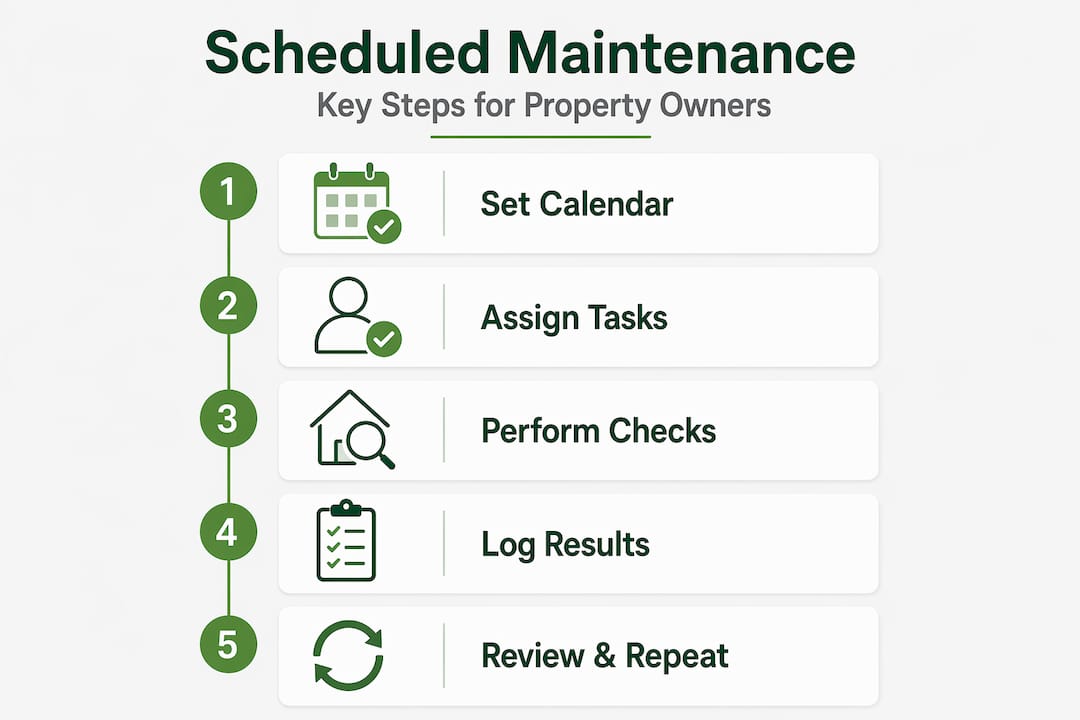
A maintenance schedule translates a maintenance plan into an actionable calendar, specifying tasks, timing, frequency, and the responsible party. Think of it as the operational layer that turns intention into action.
Two scheduling models are worth knowing:
- Fixed schedules are calendar-driven and run from the last target date, regardless of whether the previous task was completed on time. These are easier for regulatory compliance.
- Floating schedules run from the actual completion date of the last task. They prevent overlapping work orders and suit properties where task timing naturally shifts.
For most residential and commercial properties in Dublin, fixed schedules work best for legally required checks. Floating schedules suit recurring grounds care tasks where timing has some flexibility.
Common scheduled maintenance tasks for properties
Knowing what scheduled maintenance involves in practice helps you build a realistic programme. Tasks fall broadly into time-based categories, meaning they happen on a set calendar, and usage-based categories, meaning they are triggered by how heavily a system or surface has been used.
For a typical Dublin property, common scheduled maintenance examples include:
- Grounds and gardens: Lawn mowing, hedge trimming, weed control, seasonal planting, and leaf clearance. These are typically monthly or seasonal tasks. Seasonal property maintenance for Dublin homes also includes preparing lawns and beds ahead of winter.
- Building fabric: Guttering clearance, roof inspections, window and door seal checks, and external paintwork assessments.
- Mechanical and electrical systems: Boiler servicing, HVAC filter replacement, fire alarm testing, and emergency lighting checks. For complex infrastructure, some re-assessment schedules occur every four to six years, while routine checks have shorter recurring intervals.
- Safety and compliance: Portable appliance testing, gas safety certificates, and fire extinguisher inspections. These are typically annual regulatory requirements.
- Drainage and plumbing: Periodic checks for blockages, slow drains, and visible corrosion on exposed pipework.
Recurring tasks happen on a regular cycle. One-time scheduled maintenance includes larger projects like a planned external repaint or a full drainage survey, scheduled based on the property's known condition.
Seasonal scheduling matters in Dublin. Autumn calls for guttering clearance and lawn aeration. Spring is the right time for hedge shaping, post-winter inspections, and fertilisation. Regulatory requirements, such as annual gas safety checks for landlords, add another layer of non-negotiable dates to your calendar.

Pro Tip: Keep a single maintenance log that combines regulatory deadlines with routine grounds care tasks. Having everything in one place makes it far easier to spot gaps and avoid double-booking contractors.
Limitations of calendar-based scheduling
Calendar-based scheduled maintenance creates rhythm and prevents most failures. However, it is worth understanding where it falls short, because relying on it exclusively carries risks that many property owners do not anticipate.
The core issue is that a fixed schedule cannot tell you what is actually happening with a system or structure. Calendar-based maintenance ensures rhythm and prevents most failures, but it is an expensive standard that may generate unnecessary work or miss early failures developing between visits.
A boiler serviced in October may develop an efficiency problem by January. A fixed annual schedule will not catch it. Only someone checking real operating data, or a mid-year condition inspection, will.
This is why maintenance professionals increasingly talk about blending scheduled routines with condition-based monitoring. Condition-based maintenance acts on actual readings, such as temperature, pressure, or visual wear, rather than the calendar. Globally, only 18% of industrial facilities use condition-based maintenance as their primary strategy, which shows how new this shift still is, even in professional settings.
Transitioning fully to condition-based maintenance requires sensors and processes to interpret data, which is not practical for most residential properties. But a blended approach is achievable. You keep the fixed schedule for compliance and routine care, and add condition-based checks for higher-risk or higher-cost systems.
The table below shows how the two approaches compare in a property context.
| Factor | Calendar-based scheduling | Condition-based monitoring |
|---|---|---|
| Trigger for action | Set date or interval | Actual condition or reading |
| Cost | Predictable, sometimes excessive | Variable, often more targeted |
| Risk of missing faults | Higher between scheduled visits | Lower with active monitoring |
| Practicality for homes | High | Lower without specialist tools |
| Best use | Routine care, compliance tasks | High-value or high-risk systems |
A rigid, calendar-only approach also creates risk when inspections are carried out by inexperienced contractors who miss what they do not know to look for. Scheduling a task is only half the work. Who carries it out, and how thoroughly, determines whether the visit actually protects your property.
How to plan an effective maintenance programme
Building a workable scheduled maintenance programme does not require specialist software, though it helps. What it does require is clear thinking about what your property needs, how often, and who is responsible.
Here is a practical process to follow:
- Audit your property. Walk through every system, space, and external area. Note the condition of guttering, grounds, mechanical equipment, and structural elements. This gives you a starting point, not guesswork.
- Identify regulatory requirements. List every legally required check with its frequency. For Dublin landlords, this includes gas safety certificates, fire alarm servicing, and electrical condition reports. These dates are non-negotiable and anchor your calendar.
- Add routine care tasks. Layer in recurring grounds care, seasonal tasks, and building fabric checks based on your property type and exposure. A south-facing garden in Dublin will need different attention than a sheltered courtyard.
- Assign responsibility clearly. Each task needs an owner, whether that is you, a property manager, or a professional contractor. Ambiguity here is how maintenance falls through the cracks.
- Choose a tracking method. A simple spreadsheet works for smaller properties. Property management software suits portfolios. The key is that every task has a date, an assignee, and a status.
- Review and adjust quarterly. Scheduled maintenance procedures should not be set and forgotten. Review completion rates, note any tasks that are repeatedly delayed, and adjust frequencies based on what the property actually needs.
You can find detailed guidance on effective maintenance scheduling to help you build a structure that works for your specific property.
Pro Tip: When creating your programme, assign a realistic time buffer between tasks, particularly for grounds care during busy seasonal periods. Contractors get booked up fast in spring and autumn across Dublin.
Benefits of scheduled maintenance for property value
The case for scheduled maintenance is straightforward once you look at the numbers behind neglect. Neglected minor maintenance tasks cause cumulative operational drain that costs significantly more to address than if they had been handled proactively.
Regular upkeep delivers benefits that compound over time:
- Structural integrity. Catching minor damp, cracked seals, or blocked gutters early prevents structural damage that can run into thousands of euros to repair.
- Aesthetic appeal and kerb value. Well-maintained grounds, trimmed hedges, and tidy exteriors directly affect how a property is perceived and valued on the Dublin market. You can read more about how scheduled maintenance boosts property value in Dublin.
- Reduced emergency repair costs. Proactive maintenance dramatically cuts the frequency of reactive call-outs, which carry premium costs and disruption.
- Tenant retention and satisfaction. For landlords, well-maintained properties attract better tenants and reduce vacancy periods.
- Environmental and safety compliance. Regular servicing of heating systems, drainage, and fire safety equipment keeps you legally compliant and reduces energy waste.
The importance of scheduled maintenance is not just about avoiding problems. It is about actively protecting and growing the value of an asset you have invested in significantly.
My perspective on smarter property maintenance
Working with Dublin properties over the years, I have seen the same pattern repeat itself. A property owner starts with good intentions, books their first annual service visits, and considers the job done. Then a slow drain becomes a blocked pipe. An overgrown hedge becomes a dispute with a neighbour. A missed boiler check becomes a midwinter breakdown.
What I have learned is that purely time-based schedules are a floor, not a ceiling. They give you the minimum. The property owners who genuinely protect their investment are the ones who treat their schedule as a living document rather than a yearly checklist.
I have also seen what happens when condition-based thinking gets layered on top of routine schedules, even informally. A quick visual check during every grounds visit catches things that a six-month calendar interval would miss entirely. You do not need sensors and software to apply that logic. You need attentive eyes and a consistent process.
My honest advice: start simple, be consistent, and add detail as you learn what your property actually demands. Blending routine scheduling with targeted condition awareness is achievable for any property owner, not just those with large budgets or professional teams.
— gerard
How Sherrypropertycare supports Dublin property owners

Putting scheduled maintenance into practice takes time, organisation, and access to reliable professionals. Sherrypropertycare works with property owners and facility managers across Dublin, providing meticulous grounds maintenance services that fit your property's specific needs and schedule.
From regular lawn care and hedge trimming to seasonal grounds preparation and ongoing upkeep, the team at Sherrypropertycare takes the guesswork out of keeping your outdoor spaces in top condition. Every service is tailored to your property, and quotes are based on the actual condition and requirements of your grounds.
If you are ready to take the first step towards a structured maintenance programme that adds real value to your Dublin property, get in touch with Sherrypropertycare today. Send a photo of your grounds and receive a personalised quote.
FAQ
What is scheduled maintenance in simple terms?
Scheduled maintenance is any pre-planned maintenance work assigned to a specific person and completed within a set timeframe. It includes both recurring tasks, such as monthly lawn care, and one-off jobs, such as an annual boiler service.
What is the difference between scheduled and planned maintenance?
Planned maintenance is the broader strategy covering resources, responsibilities, and intentions. Scheduled maintenance is the specific execution layer, detailing when tasks happen, how often, and who carries them out.
What does scheduled maintenance involve for a Dublin property?
It typically covers grounds care, building fabric inspections, mechanical servicing, safety compliance checks, and drainage monitoring, all organised on a calendar with assigned responsibilities and clear frequencies.
How often should scheduled maintenance be carried out?
Frequency depends on the task and property type. Grounds care may be weekly or monthly. Boiler servicing is typically annual. Fire alarm testing can be monthly or quarterly. Regulatory requirements in Ireland set minimum intervals for some checks.
Why is scheduled maintenance important for property value?
Regular upkeep prevents small issues from becoming costly structural problems, maintains the aesthetic appeal of the property, and keeps you compliant with legal requirements. All of these factors directly support and protect the value of your Dublin property.