
TL;DR:
- Professional grounds maintenance in Dublin offers property owners a cost-effective way to preserve and enhance property value through scheduled, expert care. Regular preventive upkeep yields high returns, reduces repair costs, and supports budget predictability, unlike reactive approaches. Documented maintenance schedules and targeted treatments ensure consistent appearance, long-term asset protection, and stronger market appeal.
Professional grounds maintenance is defined as a scheduled, expert-led programme of care that preserves and enhances the physical condition and market value of residential and commercial property. For property owners in Dublin, the question of why choose professional maintenance has a clear, data-backed answer: routine lawn care returns approximately 217% ROI at resale, according to NAR's 2023 report. That figure means every pound spent on upkeep can return more than two at the point of sale. Sherrypropertycare works with Dublin property owners to deliver exactly this kind of consistent, expert grounds care, protecting both appearance and long-term asset value.
What measurable benefits does professional maintenance deliver?
Professional maintenance is fundamentally an asset preservation strategy, not simply a cosmetic service. The financial returns are well documented. Standard lawn care returns about 217% ROI at resale, meaning a well-kept garden directly influences what buyers are willing to pay. That connection between kerb appeal and sale price is not incidental. It reflects how buyers interpret visible upkeep as evidence of broader property care.
The data on buyer behaviour reinforces this point. 92% of real estate professionals recommend improving kerb appeal before listing a property, and 74% specifically advise lawn and garden improvements. Buyers form strong first impressions before they step through the front door, and a well-maintained exterior signals quality throughout. For commercial properties in Dublin, this effect extends to tenant attraction and retention.
Preventive maintenance also delivers savings that reactive repairs cannot match. Switching to 80% preventive compliance lowers total maintenance spend by 18 to 24% and reduces emergency repairs by 45%. That is a substantial reduction in both cost and disruption. For landlords managing multiple properties, those savings compound quickly across a portfolio.
- Resale value uplift: Lawn care and landscaping consistently rank among the highest-returning pre-sale improvements.
- Reduced repair costs: Preventive programmes catch small problems before they become expensive ones.
- Tenant satisfaction: Maintained common areas drive resident satisfaction and reduce vacancy risk.
- Budget predictability: Scheduled programmes replace unpredictable emergency spend with fixed, planned costs.
How does professional maintenance differ from DIY and reactive approaches?
The core difference between professional maintenance and DIY or reactive care is structure. A professional programme follows a documented, repeatable schedule keyed to seasonal growth cycles and soil conditions. DIY approaches, by contrast, tend to be reactive, responding to visible problems rather than preventing them.
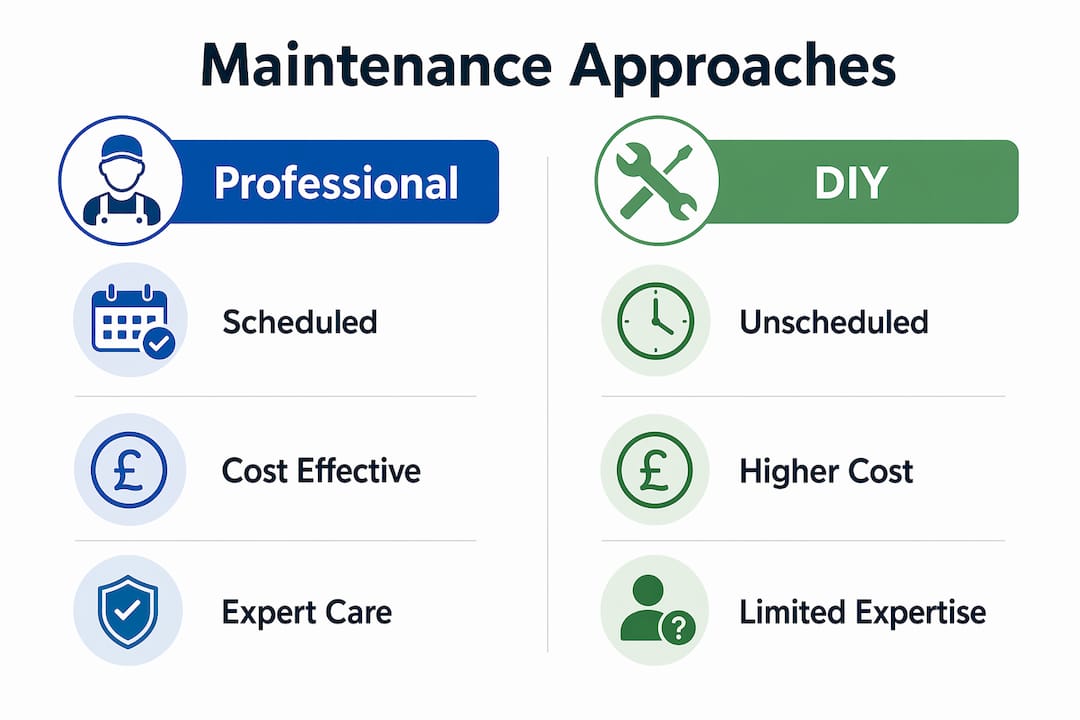
| Approach | Timing | Cost profile | Outcome |
|---|---|---|---|
| Professional scheduled | Seasonally planned | Predictable and lower | Consistent condition, high ROI |
| DIY | Ad hoc or reactive | Variable, often higher | Inconsistent results, timing errors |
| Reactive only | After problems appear | 4 to 5 times higher | Compounding damage, lower value |
Reactive maintenance operations cost 3 to 5 times more than preventive equivalents. Properties spending 4 to 6% of replacement asset value on maintenance annually are typically operating in reactive mode, compared to the 1.5 to 2.5% benchmark for best-in-class preventive programmes. The financial gap between these two approaches is significant and grows over time.
Professional services also bring equipment and expertise that DIY simply cannot replicate. Licensed chemical applications, calibrated spreaders, and specialist aeration machinery produce results that a standard garden centre product cannot match. Timing matters too. Six-seasonal application programmes with core aeration in autumn and pre-emergent weed control matched to growth conditions outperform sporadic treatments in measurable ways. A homeowner applying fertiliser at the wrong point in the growth cycle can cause more harm than good.
Pro Tip: Ask your grounds maintenance provider for a written schedule before work begins. A documented programme with service notes protects you during property sales, audits, and tenant disputes.
Documentation is another advantage that rarely gets discussed. Documented maintenance histories support proven upkeep during buyer tours and audits. A clear record of what was done and when reduces disputes and gives owners confidence in their property's condition. This is particularly relevant for commercial landlords in Dublin managing properties with multiple tenants.
Which services provide the most value for your property?
Not all grounds maintenance services deliver equal returns. The highest-impact services combine routine care with targeted treatments that protect structural elements and prevent compounding damage.

Routine lawn care forms the foundation of any effective programme. This includes mowing to the correct height for the grass variety, edging along paths and borders, fertilising at the right growth stage, weed control before establishment, and seasonal clean-up in autumn and spring. Each of these tasks is time-sensitive. Miss the pre-emergent weed control window in early spring and you spend the rest of the season managing an established problem.
Landscape upkeep covers the elements that frame the property. Pruning at the correct time of year prevents disease and encourages healthy growth. Mulching retains soil moisture, suppresses weeds, and improves the visual finish of beds and borders. Tree care, including crown management and deadwood removal, protects both the tree and the structures around it. Pest and disease control, applied by a professional who can identify the problem correctly, prevents the kind of rapid decline that can strip a mature hedge or shrub in a single season.
Specialised treatments are where professional care separates itself most clearly from DIY. Core aeration relieves compaction and allows water and nutrients to reach root zones. Overseeding after aeration thickens turf and fills bare patches. Soil conditioning and root-focused treatments produce longer-lasting lawn health, unlike superficial treatments that only improve appearance temporarily. These are not tasks most property owners can carry out effectively without the right equipment and knowledge.
For commercial properties in Dublin, grounds maintenance also protects hard surfaces. Leaf clearance prevents slip hazards. Drain maintenance reduces flood risk. Hedge trimming keeps sight lines clear for safety and security. These are not optional extras. They are part of responsible property management.
How does professional maintenance support budget predictability?
Scheduled maintenance programmes replace unpredictable emergency spend with planned, fixed costs. This matters particularly for Dublin landlords and property managers who need to forecast expenditure across a financial year.
- Establish a preventive baseline. Identify the key maintenance tasks for your property type and size, then schedule them across the year before problems appear.
- Track spend against asset value. Best-in-class properties spend 1.5 to 2.5% of replacement asset value on maintenance annually. If your spend is above 4%, you are likely operating reactively.
- Document every intervention. Service records reduce disputes, support insurance claims, and provide evidence of care during property transactions.
- Review the programme seasonally. Dublin's climate means spring and summer require more intensive attention. Adjust resource allocation accordingly rather than applying a flat monthly budget.
- Act on early warnings. A professional who visits regularly will spot a drainage issue, a diseased hedge, or a failing lawn section before it becomes a costly repair.
Pro Tip: Maintenance contracts typically cost less per visit than one-off call-outs and give you priority scheduling during peak seasons when demand is highest.
Neglect during peak growing season can cause rapid landscape decline, with properties looking unkempt within weeks if professional upkeep is missed during growth surges. In Dublin, the May to August period is the highest-risk window. Missing scheduled visits during this time creates a backlog that costs significantly more to correct than it would have to prevent.
Key takeaways
Professional grounds maintenance is the most cost-effective strategy for protecting property value, reducing repair costs, and maintaining kerb appeal in Dublin's competitive property market.
| Point | Details |
|---|---|
| ROI from lawn care | Routine lawn care returns approximately 217% at resale, making it one of the highest-returning property investments. |
| Preventive vs reactive cost | Reactive maintenance costs 3 to 5 times more than preventive programmes, with emergency repairs adding further premium. |
| Seasonal timing matters | Missing peak growing season visits causes rapid decline that costs more to correct than to prevent. |
| Documentation adds value | Written service records support property sales, tenant disputes, and insurance claims with evidence of consistent care. |
| Budget predictability | Scheduled programmes replace unpredictable emergency spend with fixed, plannable costs across the year. |
What I have learned from years of watching properties decline and recover
The most common mistake I see property owners make is treating grounds maintenance as something to address when it becomes visible. By the time a lawn looks patchy, a hedge looks ragged, or a border looks overgrown, the problem is already weeks or months old. The cost to restore is always higher than the cost to maintain.
There is also a persistent belief that DIY maintenance is equivalent to professional care, provided you put in the time. It is not. The difference is not effort. It is timing, equipment, and the ability to read what a plant or lawn actually needs at a given point in the season. I have seen well-intentioned owners apply the right products at the wrong time and set their lawn back by an entire season. A professional programme removes that risk entirely.
What I find most underappreciated is the administrative value of documented maintenance. When a Dublin property owner can hand a buyer or a tenant a clear record of every service visit, every treatment, and every seasonal intervention, it changes the conversation. It demonstrates care. It reduces negotiation leverage for the other side. It is a quiet but powerful advantage that costs nothing extra to build.
The properties that hold their value and attract the best tenants in Dublin are not necessarily the most expensive. They are the ones that look cared for, consistently, year after year. That is what a professional maintenance programme delivers.
— gerard
How Sherrypropertycare protects and enhances Dublin properties
Sherrypropertycare provides professional grounds maintenance for residential and commercial properties across Dublin, with services tailored to each property's specific needs and seasonal requirements.

From routine lawn care and landscaping to hedge trimming, seasonal clean-ups, and specialist treatments, Sherrypropertycare delivers the consistent, expert upkeep that protects your property's appearance and value. Every programme is built around your property. You send photos, and Sherrypropertycare provides a customised quote with a clear schedule. No guesswork, no generic packages. Just reliable, professional care from a team that knows Dublin's properties and growing conditions. Get in touch today to discuss a maintenance plan that works for your property.
FAQ
What does professional grounds maintenance include?
Professional grounds maintenance covers lawn mowing, edging, fertilising, weed control, hedge trimming, pruning, seasonal clean-ups, core aeration, and specialist treatments such as overseeding and soil conditioning. The exact scope depends on the property type and size.
How much does professional maintenance improve property value?
Standard lawn care returns approximately 217% ROI at resale, according to NAR's 2023 data. Kerb appeal improvements are recommended by 92% of real estate professionals before any property listing.
Is professional maintenance worth it for smaller residential properties?
Yes. Preventive programmes cost significantly less than reactive repairs, and even modest grounds maintenance improvements influence buyer perception and sale price. The importance of professional upkeep applies equally to smaller homes and larger commercial sites.
How often should a professional maintenance visit occur?
Frequency depends on the season and property type. During Dublin's peak growing season from May to August, fortnightly visits are standard for lawns. Autumn and winter programmes focus on clean-up, aeration, and preparation for the following spring.
What is the risk of skipping maintenance during summer?
Landscapes can look unkempt within weeks if professional upkeep is missed during growth surges. Skipping visits in peak season creates compounding problems that cost considerably more to correct than a regular scheduled programme would have prevented.