
Maintenance audits matter because they turn a routine site visit into a verifiable record that protects your property's value, cuts safety risk and keeps spending under control. Without that record, you're relying on memory and a contractor's word.
A proper audit, built on a standard landscape maintenance site audit form, gives you evidence you can act on. Here's what that evidence buys you:
- Aesthetics and value preservation — early warning on lawn decline, dying hedges and cracked paving before they hit resale or letting value.
- Safety and liability reduction — documented proof you spotted and dealt with trip hazards, tree defects and drainage faults.
- Budget control — a paper trail that stops repeat emergency call-outs and directs spend to what actually needs it.
Sherrypropertycare builds this documentation into every grounds-maintenance visit, because a garden that looks fine from the car isn't always fine underfoot.
Key Takeaways
Maintenance audits matter because documented, photo-backed inspections convert uncertain grounds upkeep into evidence that protects value, safety and budget.
| Point | Details |
|---|---|
| Audits create verifiable records | Timestamped, geotagged photos and scored forms prove what work was done and when. |
| Frequency depends on site type | Weekly for high-use sites, monthly for commercial estates, quarterly for smaller residential blocks. |
| Evidence drives contractor accountability | Photo-backed audit trails give managers leverage for work orders, cure notices and payment decisions. |
| Third-party audits cost 1 to 3% of contract value | Independent audits are typically worthwhile for larger contracts or contract disputes. |
| Sherrypropertycare builds documentation into service | Grounds-maintenance visits in Dublin come with photo-documented site reports and tailored quotes. |
Table of Contents
- Why regular grounds-maintenance audits matter for property value
- What does a grounds-maintenance audit actually inspect?
- How often should you audit, and who should do it?
- Turning audits into contractor accountability
- What do audits cost, and what's the return?
- How to run your first grounds-maintenance audit today
- Do audits affect compliance and insurance cover?
- How Sherrypropertycare handles audits and grounds maintenance
- Sources
- FAQ
Why regular grounds-maintenance audits matter for property value
A lawn that's thinning at the edges, a hedge losing shape, a patio with moss creeping across it. None of these problems arrive overnight, and none of them get fixed by hoping. Regular audits catch that slow decline while it's still cheap to reverse, which is the whole point.
Curb appeal and value sit at the top of the list for landlords and managers because first impressions decide rents and sale prices before anyone opens a door. A grounds audit flags fading planting schemes or uneven surfaces early, while a quick trim or reseed still solves it.
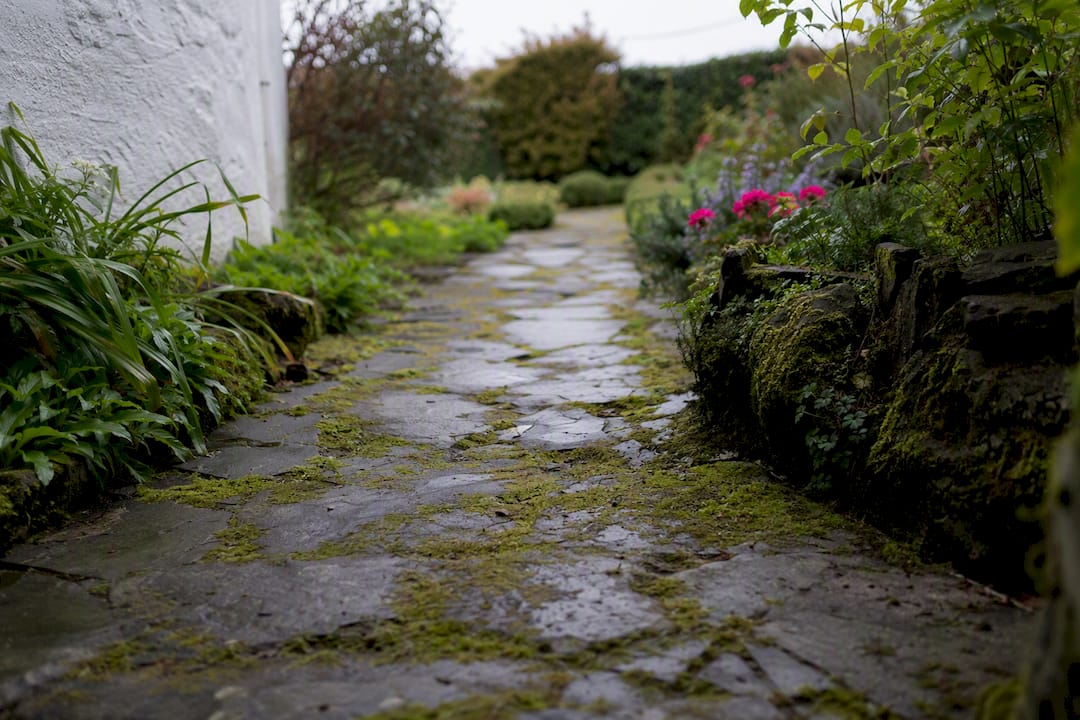
Safety and liability follow close behind. Slip hazards on mossy paving, trip risks from heaved slabs, and tree limbs with hidden defects are the kind of thing that turns into an insurance claim if nobody's looking. External condition surveys exist precisely because facilities managers need a data-led view of outdoor assets rather than a guess based on the last drive-by.
Budget control is where audits earn their keep financially. A documented history reveals which parts of a site fail repeatedly, whether it's a drain that blocks every autumn or a stretch of fencing that keeps needing patching.
Pro Tip: Stop treating recurring issues as one-off jobs. If the same drain blocks three times in a year, an audit trail proves it's a design or maintenance problem worth fixing properly, not paying for again and again.
What does a grounds-maintenance audit actually inspect?
A useful audit isn't a vague walk around the garden. It follows a checklist, scores each item, and records enough detail that someone reading it later understands exactly what was found and where.
At minimum, cover these areas on every visit:
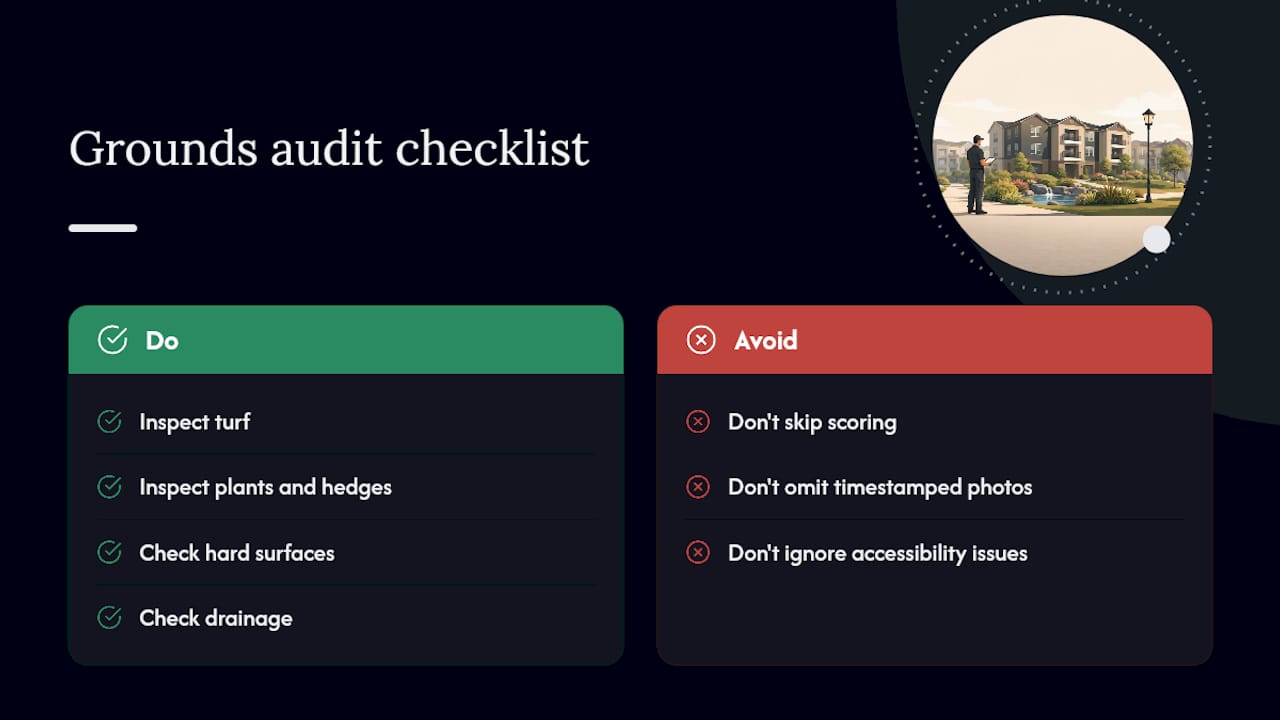
- Turf condition — colour, density, weed presence, bare patches. Record a condition score (1 to 5), a photo, and whether it needs immediate treatment or ongoing monitoring.
- Plant and hedge health — disease signs, overgrowth encroaching on paths or boundaries, dead specimens needing replacement.
- Hard surfaces — cracking, subsidence, moss or algae build up on patios, driveways and paths.
- Drainage — standing water, blocked gullies, evidence of surface run-off pooling near buildings.
- Irrigation — leaks, blocked heads, dead zones where coverage has failed.
- Signage, lighting and furniture — damage, faded visibility, loose fixings.
- Accessibility — obstructed routes, uneven thresholds, overgrowth narrowing paths.
For each flagged item, log a unique ID, a location tag, a timestamped photo and a short caption describing what's wrong. That combination is what transforms a site visit into a property report card, giving you a record of when crews were there and what condition the site was actually in.
A simple spreadsheet with columns for item, score, photo reference, action needed and date closed is enough to start.
How often should you audit, and who should do it?
Frequency depends on how much foot traffic and risk a site carries. As a working guide:
- Weekly for high-use commercial estates, retail forecourts and busy communal residential grounds.
- Monthly for standard commercial properties and larger residential developments.
- Quarterly for smaller residential blocks with lower footfall.
Step up the cadence after severe weather. Estate managers are routinely advised to run thorough external checks after winter, when frost damage, waterlogging and storm debris tend to surface all at once.
On who should carry it out:
- In-house staff handle day-to-day visual checks between formal audits, catching obvious issues fast.
- Contractor-conducted audits, built into the maintenance agreement, keep documentation consistent and tied directly to the work being billed.
- Third-party audits suit high-value contracts or disputes, offering independent evidence for contract review when trust has broken down or the numbers are large enough to justify it.
After any audit, agree a short acknowledgement window (48 hours is typical) and a clear cure period before escalating.
Turning audits into contractor accountability
An audit that sits in a folder unread does nothing. Its value comes from a clear workflow that runs from inspection to resolution:
- Score the item against the agreed standard.
- Photograph it with a timestamp and location tag.
- Log the finding with a unique reference.
- Notify the contractor formally, in writing.
- Set a defined cure period for the fix.
- Confirm the work once completed.
- Close the ticket and archive the evidence.
Geotagged, timestamped photos are the backbone of this process. A scored form paired with a photo record gives you something a contractor can't easily argue with, and a log of repeat issues over several months shows a pattern rather than a one-off complaint. That kind of trail is exactly what a landscape maintenance site audit form is designed to produce: documentation solid enough to support payment decisions and enforcement action.
Pro Tip: Keep every audit in one accessible archive tied to the property, not to whichever staff member ran it. That history is what justifies a bigger maintenance budget next year, because you can show the board exactly what's been recurring and why.
Write the response-time and audit-handling terms into your service agreement up front. It avoids arguments later about what counts as a fair notice period.
What do audits cost, and what's the return?
Audit cost scales with how formal the process is. Internal audits cost you staff time and little else. Contractor-supplied audit reports are often folded into the existing maintenance fee.
The return shows up in several places:
- Fewer emergency repairs, because problems get caught while they're still cheap.
- Longer asset life for hard landscaping, irrigation systems and planting.
- Fewer tenant or occupier complaints tied to poor grounds appearance.
- A stronger negotiating position at contract renewal, backed by a documented performance record.
External condition surveys exist for exactly this reason: they give managers prioritised, RAG-style recommendations that turn a vague sense of "the grounds need work" into a ranked list a board can actually approve. If you're pitching audit spend upward, frame it as reduced surprise cost, not an added expense, because that's the argument that lands.
How to run your first grounds-maintenance audit today
You don't need software or training to start. You need a form, a camera and thirty focused minutes.
- Prepare your form — use the checklist above, or adapt this property maintenance checklist for Dublin landlords.
- Walk the site systematically — front to back, section by section, so nothing gets skipped.
- Photograph everything flagged — timestamp and geotag each image where your device allows.
- Score each item and assign a unique ID to anything needing action.
- Issue work orders or contractor notices based on what you've found.
- Follow up on the agreed cure date and close each ticket once resolved.
Name your photo files consistently, something like sitename_area_date_id.jpg, so a folder of hundreds of images stays searchable months later.
For your first audit, keep it simple:
- One form, one property, one pass.
- A phone camera is sufficient.
- Store everything in a single dated folder per site.
If you'd rather have this done professionally from the start, you can request a tailored quote from Sherrypropertycare and get a documented audit alongside your regular grounds-maintenance visit.
Do audits affect compliance and insurance cover?
Regulatory and insurance exposure is one of the most overlooked reasons audits matter. Insurers increasingly expect evidence that a property owner took reasonable steps to identify and address hazards, not just that maintenance happened at some point.
A documented audit trail is the clearest way to demonstrate that. If someone slips on a mossy path or a branch fails and causes damage, the question that follows is always the same: did you know about the risk, and what did you do about it? An audit log with dated photos and closed-out action items answers that directly. Without one, you're relying on a contractor's memory of a visit from several months ago.
Compliance obligations vary by property type and use, and this article isn't a substitute for checking your specific insurance policy or local regulatory requirements. What holds true broadly, though, is that insurers and legal advisers view structured, photo-backed audit records far more favourably than informal notes or verbal assurances. A documented audit trail should stay with the property, not with whichever staff member happened to run it, because handovers between managers or landlords are exactly when gaps in evidence appear.
If you're managing multiple properties, the same discipline that keeps grounds records straight applies to other building systems. Portfolios that track roof maintenance across multiple properties using centralised, dated records face the same audit logic: consistency across sites is what protects you when a claim or dispute arises.
A provider's view on why documented audits change the relationship
We run audits because clients stop having to take our word for it. A scored form and a dated photo answer the question before it's asked: what did you actually do, and does the garden show it? That shift, from trust to evidence, is what keeps the relationship straightforward.
How Sherrypropertycare handles audits and grounds maintenance
Sherrypropertycare is the alternative to guessing whether your grounds contractor is actually doing the job, because every visit comes with photo-documented evidence, not just an invoice. For property owners, landlords and managers in Dublin, that means a tailored maintenance visit, a scored site report and timestamped photos showing exactly what was done and what still needs attention.

The process starts simply: send photos of your garden, lawn or grounds, and Sherrypropertycare puts together a quote suited to what the site actually needs, not a generic package. Landscaping, lawn care, hedge trimming, patio cleaning and power washing are all covered, with audit-style documentation built into the service rather than charged as an extra. If you manage a property in Dublin and want grounds maintenance that leaves a paper trail you can actually use, request a personalised quote from Sherrypropertycare and send through a few photos to get started.
Sources
- How to Complete and Submit a Landscape Maintenance Site Audit Form - LegalClarity
- Your Property Report Card: Data-Driven Maintenance | MSNW
- Third-Party Landscaping Audit Services | Landscaping Audit Authority
- From whack-a-mole to under control: OUTCO considers how FM's can reduce the cost of unexpected reactive maintenance with External Condition Surveys – BFM Magazine
FAQ
Why do maintenance audits matter for landlords?
They give you documented proof of grounds condition and contractor performance, which protects property value, reduces safety liability and supports insurance and compliance requirements.
What should a grounds-maintenance audit checklist include?
Cover turf, plants and hedges, hard surfaces, drainage, irrigation, lighting, signage and accessibility, scoring each item and recording it with a timestamped photo.
How often should grounds audits be carried out?
High-use commercial sites benefit from weekly checks, standard commercial properties monthly, and smaller residential blocks quarterly, with extra checks after severe weather.
Can audits help with insurance claims?
Yes. A dated, photo-backed audit trail demonstrates that hazards were identified and addressed, which insurers and legal advisers view favourably over informal or verbal records.
Does Sherrypropertycare provide documented audits with its service?
Sherrypropertycare builds photo-documented site reporting into its Dublin grounds-maintenance visits, giving clients a tailored quote alongside a clear record of the work carried out.