
Scheduling regular property repairs is the single most effective way to protect your asset's value, keep costs predictable, and stay on the right side of UK landlord law. Under Section 11 of the Landlord and Tenant Act 1985, you are legally required to keep the structure, exterior, and key installations in repair and proper working order. That duty exists whether or not you have a schedule. The difference is that a schedule means you meet it proactively rather than scrambling after a tenant complaint.
Two things you can do this week:
- Book your annual gas safety check if it is due within the next three months.
- Open a spreadsheet and log every major installation at your property with its age and last service date.
Pro Tip: Check every smoke alarm and carbon monoxide detector on your next property visit. It takes under five minutes, costs nothing, and is one of the most commonly missed items during informal inspections.
Key takeaways
Scheduling regular property repairs protects asset value, reduces long-term costs, and keeps UK landlords legally compliant under Section 11 and related legislation.
| Point | Details |
|---|---|
| Legal duty is non-negotiable | Section 11 LTA 1985 requires landlords to maintain structure, exterior, and key installations regardless of tenancy terms. |
| Planned work costs far less | Reactive repairs cost significantly more than equivalent planned work due to emergency premiums and collateral damage. |
| Statutory tests are your anchors | Gas safety (annual) and EICR (every five years) are fixed legal requirements; build your full schedule around these dates. |
| Records are your legal defence | Keep dated certificates, photos, and repair logs; they protect you in disrepair claims and enforcement visits. |
| Sherrypropertycare covers the grounds | Dublin landlords can outsource external upkeep, including hedge trimming, power-washing, and gutter clearing, with personalised quotes based on submitted photos. |
Table of Contents
- Why scheduling repairs matters for your property
- What is a maintenance schedule, and how does it differ from reactive repairs?
- What should your routine maintenance checklist include?
- How to create and run a maintenance schedule step by step
- What do repairs cost, and how does scheduling save you money?
- What are your legal obligations as a UK landlord?
- When should you hire a contractor, and how do you vet them?
- Practical guidance for external and grounds maintenance
- Why the scheduled approach works better than most landlords expect
- Grounds and exterior maintenance for Dublin landlords
- Sources
- FAQ
Why scheduling repairs matters for your property
The case for planned maintenance comes down to four things: value, cost, tenants, and compliance.
Preserving capital value is the most straightforward argument. A well-maintained property commands a stronger sale price and a higher rental yield. Deferred repairs compound. A £200 gutter clear left undone becomes a £2,000 damp remediation job within two or three winters. The connection between routine upkeep and valuation outcomes is well documented for UK residential property.
The cost argument is stark. Reactive repairs cost more than equivalent planned preventative work, driven by emergency labour premiums, expedited parts, and collateral damage. An undetected leak that soaks into timber joists does not just need a plumber. It needs a carpenter, a plasterer, and possibly a damp specialist too. Catching it early costs a fraction of that.
Tenant outcomes improve measurably when repairs happen on a schedule. Tenants who rarely have to chase for fixes stay longer, complain less, and treat the property better. Fewer voids and lower turnover costs are a direct financial benefit.
Planned maintenance reduces emergency call-outs, lowers repeat repairs, and gives landlords far better visibility over their assets. The shift from reactive to planned is one of the highest-return operational changes a landlord can make.
Compliance and reputation round out the picture. A documented repair history is your best defence if a tenant raises a disrepair claim or a local authority inspector visits. Prompt repairs reduce the risk of enforcement action, civil claims, and the reputational damage that follows a poorly managed property.
What is a maintenance schedule, and how does it differ from reactive repairs?
A maintenance schedule is a structured document listing every system, surface, and installation at your property, the tasks required to keep each in good order, how often those tasks should happen, who is responsible for carrying them out, and where the records are kept. Think of it as a living checklist rather than a one-off survey.
Planned (preventative) maintenance works by anticipating failure before it happens. You service the boiler in September so it does not break down in January. You clear gutters in October so winter rain does not back up behind the fascia. Tasks are scheduled, budgeted, and assigned in advance.
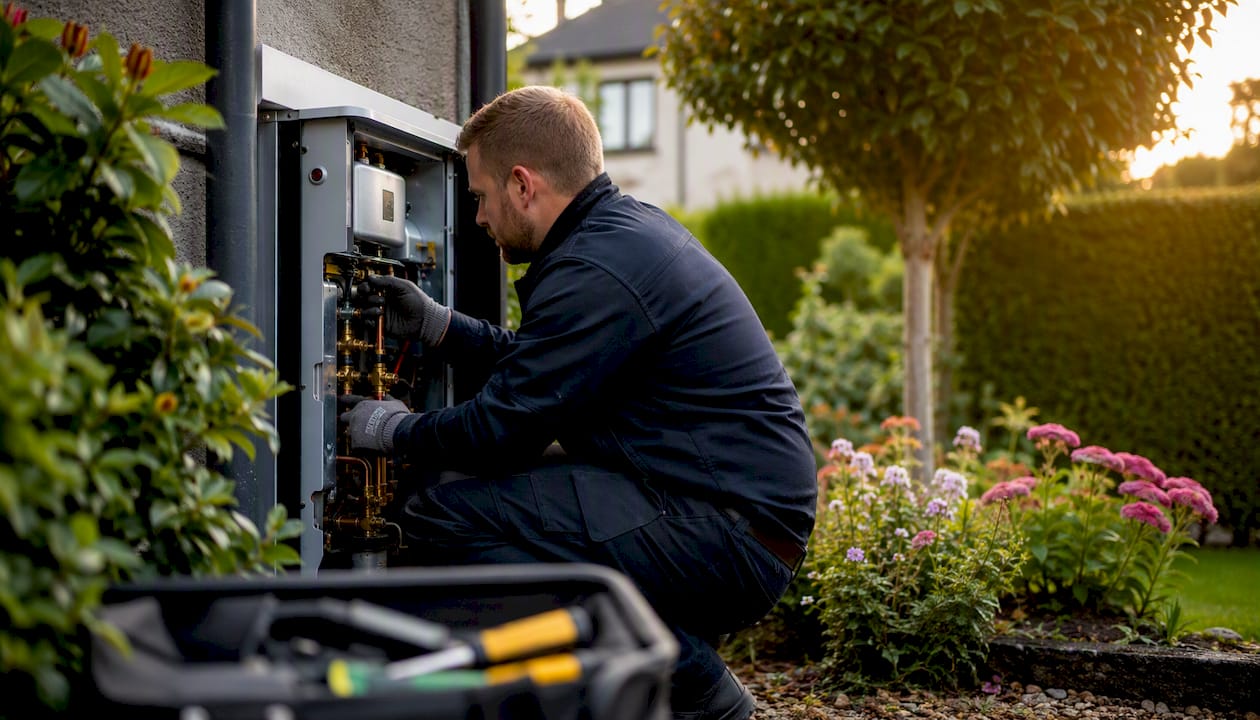
Reactive maintenance is the opposite: you respond after something fails. It is unavoidable for genuinely unpredictable events, but relying on it as your primary approach is expensive and legally risky. A documented, risk-based planned maintenance schedule converts reactive spend into a predictable, budgeted expense and supports conversations with your insurer and mortgage lender.
| Approach | Trigger | Cost profile | Legal risk | Best for |
|---|---|---|---|---|
| Planned preventative | Calendar or condition | Lower, predictable | Lower | Routine systems and fabric |
| Reactive | Failure or complaint | Higher, unpredictable | Higher | Genuine emergencies |
| Hybrid | Both | Moderate | Moderate | Most landlords in practice |
Most landlords operate a hybrid model. The goal is to push as many tasks as possible into the planned column, leaving reactive capacity only for true emergencies.
Better asset data — installation dates, warranties, previous repair records — is the single most important enabler of targeted planned maintenance. Poor data causes repeat visits and higher costs.
What should your routine maintenance checklist include?
The checklist below covers statutory anchors, routine tasks, and external items relevant to Dublin properties. Frequencies are typical UK guidance; always check current statutory requirements for your specific property type.
| Task | Frequency | Notes |
|---|---|---|
| Gas safety check | Annual | Statutory; keep records for two years |
| Electrical Installation Condition Report (EICR) | Every 5 years | Statutory for private rentals |
| Smoke alarm test | At start of each tenancy; monthly recommended | Statutory from day one of tenancy |
| CO detector check | At start of each tenancy | Required where solid fuel or gas appliances present |
| Boiler service | Annual | Extends lifespan; often a warranty condition |
| Legionella risk assessment | As required by risk level | Particularly relevant for HMOs and longer void periods |
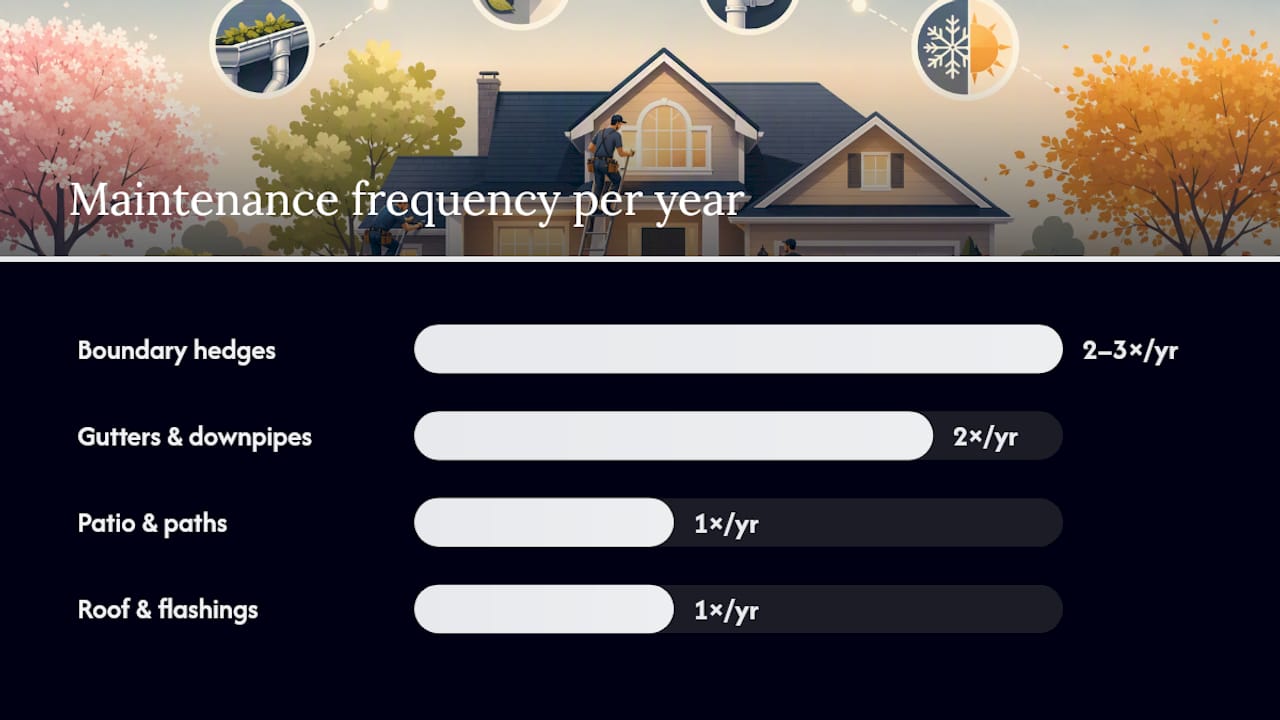
| Gutter and downpipe clearance | Twice yearly (spring and autumn) | Critical in Dublin's wet climate |
| Roof and flashings inspection | Annual | Best done before winter |
| Boundary hedge trimming | 2–3 times per growing season | Keeps boundaries clear and avoids neighbour disputes |
| Patio and path power-washing | Annual (spring) | Prevents algae build-up and slip hazards |
| Damp and ventilation check | Biannual | Ties to HHSRS hazard categories |
| Window and door seals | Annual | Reduces heat loss and damp ingress |
| Drainage and inspection chambers | Annual | Prevents blockages and subsidence risk |
Statutory tests are non-negotiable anchors. Build your entire schedule around the gas safety and EICR dates, then layer everything else around them.
For documentation, keep:
- Dated certificates and reports for all statutory checks.
- Photographs before and after any repair or maintenance visit.
- Contractor invoices and guarantees.
- A log of tenant-reported issues and your response dates.
Records for gas safety certificates must be kept for at least two years. EICR reports should be retained for the full five-year cycle and beyond.
How to create and run a maintenance schedule step by step
Building a schedule from scratch is straightforward. Follow these five steps and you will have a working plan within a couple of hours.
-
Create a property inventory. List every system, installation, and surface: boiler, electrics, plumbing, roof, gutters, windows, doors, flooring, external paths, boundaries, and garden areas. Note the age, installation date, and any warranty expiry for each item. Effective maintenance scheduling starts with this inventory.
-
Risk-rate each item. Score each element by age, usage intensity, moisture exposure, and the vulnerability of your tenants. An ageing boiler in a property with elderly tenants scores high; a new composite front door scores low. High-risk items need more frequent checks.
-
Set frequencies and anchor to statutory tests. Treat gas safety and EICR dates as fixed points. Schedule everything else relative to those. Group tasks that can share a contractor visit to reduce call-out fees.
-
Assign responsibilities clearly. Decide which tasks go to a qualified contractor, which you handle yourself, and which are reasonable tenant responsibilities (such as replacing light bulbs or keeping drains clear of debris). Put this in writing, ideally in the tenancy agreement or a welcome pack.
-
Track, review, and update annually. Use a simple spreadsheet, a property management app, or a calendar with recurring reminders. Review the whole schedule once a year: check what was missed, what cost more than expected, and whether any new statutory requirements have come into force.
The benefits of preventive maintenance compound over time. A schedule you review and refine each year becomes progressively more accurate and cost-efficient.
What do repairs cost, and how does scheduling save you money?
Cost has two shapes in property maintenance: fixed and variable. Fixed costs include annual inspection fees, service contracts, and scheduled contractor visits. Variable costs are the reactive ones: emergency call-outs, expedited parts, and the collateral damage that comes with delayed repairs.
Reactive repairs cost roughly three to five times more than equivalent planned work. The drivers are straightforward:
- Emergency labour commands a premium, often 50–100% above standard rates.
- Parts ordered urgently cost more than parts sourced in advance.
- Delayed repairs cause secondary damage that multiplies the original scope.
Practical response timeframes give you a useful planning framework. Landlord guides recommend 24 hours for emergencies, 3–7 days for urgent matters, and 14–28 days for non-urgent repairs. Emergency slots are the most expensive. Keeping more of your work in the non-urgent band through scheduled maintenance is where the savings accumulate.
A simple illustration: A boiler service costs roughly £80–£120 per year. A boiler breakdown in January, requiring an emergency call-out, parts, and possibly temporary heating for tenants, can easily reach £500–£1,500 or more. A blocked drain cleared on a scheduled visit costs a fraction of the same drain causing a sewage backup that damages flooring and requires specialist clean-up.
Planned maintenance reduces emergency call-outs and lowers repeat repairs, giving landlords better control over annual spend.
Scheduling also helps with insurance. Insurers may reduce premiums or support claims more readily when you can demonstrate a documented maintenance history. A property with no records is harder to defend when a claim is disputed.
What are your legal obligations as a UK landlord?
UK landlords carry statutory duties that a maintenance schedule directly supports.
Section 11 of the Landlord and Tenant Act 1985 is the foundational repairing covenant. It requires you to keep the structure and exterior of the property in repair, and to maintain installations for water, gas, electricity, and heating in repair and proper working order. The duty cannot be contracted out to the tenant, and failure to comply exposes you to enforcement action, disrepair claims, and specific performance orders.
The Housing Health and Safety Rating System (HHSRS) gives local authorities a framework for assessing hazards in rented homes. Hazard categories include damp and mould, excess cold, fire risk, and falls. A scheduled programme of damp checks, heating servicing, and fire alarm testing maps directly onto the HHSRS categories most likely to trigger enforcement.
The Homes (Fitness for Human Habitation) Act 2018 requires that properties remain fit for habitation throughout the tenancy. Planned preventative maintenance (PPM) is the clearest way to demonstrate you took reasonable steps to meet this duty.
The Renters' Rights Act and the expansion of Awaab's Law have tightened investigation and remediation deadlines for private landlords. For certain hazards, landlords must investigate within 14 days and begin remediation within seven. A schedule that catches hazards early means you are rarely starting from zero when a tenant reports a problem.
Access and records. You must give tenants at least 24 hours' written notice before entering for inspections or repairs, except in genuine emergencies. Keeping a log of every access request, visit, and repair completed protects you if a tenant later disputes whether work was done or access was refused.
When should you hire a contractor, and how do you vet them?
Some tasks must go to a qualified professional. Others can be handled by a competent tenant or a careful landlord. Knowing the difference saves money and avoids liability.
Always use a qualified contractor for:
- Gas work (Gas Safe registered engineer only).
- Major electrical work (Part P or NICEIC/NAPIT registered).
- Structural repairs, including roof work beyond minor maintenance.
- Damp remediation where the cause is structural.
- Asbestos-containing materials (licensed contractor required).
Tenant or landlord-level tasks typically include replacing light bulbs, clearing debris from paths, basic garden tidying, and reporting issues promptly.
Vetting a contractor: Ask these questions before you book:
- Are you insured for public liability and employers' liability?
- Do you hold the relevant qualification for this work (Gas Safe, NICEIC, etc.)?
- Can you provide references from similar properties?
- Do you offer a written guarantee on your work?
- What is your policy on spare parts — do you carry common parts on the van?
That last question matters more than most landlords realise. A contractor who arrives without common parts and has to return for a second visit doubles your call-out cost and your tenant's inconvenience.
Pro Tip: Before requesting a quote for any external or grounds work, take a short video walking the perimeter of the property and close-up photos of specific problem areas. Contractors who quote from photos give more accurate fixed prices and are less likely to revise upwards on the day.
For professional grounds maintenance, outsourcing to a specialist removes the scheduling burden entirely and gives you documented evidence of regular upkeep.
Practical guidance for external and grounds maintenance
External maintenance is where many landlords fall behind, partly because it feels less urgent than a broken boiler and partly because the consequences are slower to appear. They do appear, though.
High-impact external tasks for Dublin properties include:
- Gutter and downpipe clearing (twice yearly, spring and autumn) to prevent water ingress and fascia damage.
- Boundary hedge trimming (two to three times during the growing season) to maintain clear boundaries and avoid encroachment disputes.
- Patio and path power-washing (annually in spring) to remove algae and reduce slip hazards.
- Paving joint repointing where weeds or frost have opened gaps, preventing water tracking under paving.
- Roof and flashing inspection before winter, particularly relevant given Dublin's Atlantic weather exposure.
Suggested cadence for Dublin properties: A pre-winter visit in October or November covers gutters, roof, and boundary hedges in one contractor call. A spring visit in March or April handles power-washing, patio cleaning, and the first hedge trim of the year. Aligning these with your statutory checks reduces the number of separate contractor visits and the associated disruption to tenants.
Synchronising gutter clears, roof checks, and boundary hedge work before winter cuts the risk of storm damage and simplifies any subsequent insurance claim. Dublin's coastal exposure makes this particularly relevant for properties in south Dublin and along the bay.
Pro Tip: When gathering evidence for a grounds maintenance quote, walk the full perimeter and photograph each elevation, the gutters from ground level, any overgrown boundaries, and the condition of paths and patios. A short video clip of a blocked downpipe or a cracked paving slab is worth more than a written description and typically results in a more accurate, fixed-price quote.
For seasonal scheduling and local examples relevant to Dublin properties, aligning grounds work with other scheduled checks is the simplest way to keep costs down and contractor visits manageable.
Why the scheduled approach works better than most landlords expect
The conventional wisdom on property maintenance tends to frame it as a cost. That framing is wrong. A maintenance schedule is a financial instrument. It converts unpredictable, high-cost reactive spend into a planned, budgeted line item. It also converts legal liability from a lurking risk into a documented defence.
What most landlords underestimate is the compounding effect of small, consistent checks. A landlord who clears gutters twice a year, services the boiler annually, and trims hedges before winter is not just avoiding individual repair bills. They are preventing the cascade failures that turn a £150 job into a £3,000 one. The boiler that gets serviced does not fail in January. The gutter that gets cleared does not back up and saturate the wall behind it.
From a grounds maintenance perspective, the pattern is consistent. Properties where external upkeep is scheduled, rather than requested after a problem appears, have fewer drainage complaints, fewer boundary disputes, and better kerb appeal at tenancy renewal. The schedule does not need to be elaborate. A simple annual calendar with six to eight recurring tasks, reviewed once a year and updated when something changes, is enough to shift a property from reactive to planned.
Treat the schedule as a living document. When a repair reveals an underlying issue, add a check for that issue to the schedule. When a statutory requirement changes, update the frequency. The landlords who get the most value from planned maintenance are the ones who review it honestly each year and adjust.
Grounds and exterior maintenance for Dublin landlords
If managing external upkeep alongside statutory checks and tenant communications feels like too much to coordinate, Sherrypropertycare handles the grounds side for residential and commercial properties across Dublin.

Services include lawn care, hedge trimming, patio and path cleaning, power-washing, and general grounds upkeep. Every job starts with a personalised quote based on your property's specific needs. Send photos of your garden, boundaries, and external areas and Sherrypropertycare will provide a clear scope, timeline, and price before any work begins. There are no hidden charges and no guesswork on the day.
For Dublin landlords who want their external maintenance documented, consistent, and off their to-do list, request a quote from Sherrypropertycare and get your grounds schedule sorted before the next season.
Sources
The following sources support the guidance in this article and are worth bookmarking for ongoing reference.
- Landlord and Tenant Act 1985, section 11
- Housing Health and Safety Rating System: guidance for landlords and property professionals
- Agile
- Preventative vs reactive property maintenance UK 2026: 5 truths - Citywide Maintenance Solutions
- Landlord maintenance responsibilities: Complete 2026 guide | SelfLandlord
Dublin landlords looking for professional grounds maintenance support can contact Sherrypropertycare directly. Submit photos of your property's external areas and receive a personalised quote covering the specific tasks your schedule requires.
This article is general information, not a substitute for advice from a qualified lawyer. Consult a qualified legal professional about your own circumstances before acting on anything here.
FAQ
Is scheduled maintenance always necessary for landlords?
Yes, in practice. Section 11 of the Landlord and Tenant Act 1985 imposes a repairing duty that applies throughout the tenancy, and a schedule is the most reliable way to demonstrate compliance and avoid costly reactive repairs.
What does a schedule of repairs typically include?
A schedule of repairs lists every system and surface at the property, the maintenance task required, how often it should happen, who is responsible, and where records are kept. Statutory checks such as gas safety and EICR are always included as fixed annual or five-yearly anchors.
What are five items that a routine maintenance schedule should cover?
A well-structured schedule covers: annual gas safety checks, five-yearly electrical inspections (EICR), smoke and CO detector testing, boiler servicing, and gutter clearance. These five address the most common sources of tenant complaints, legal liability, and emergency repair costs.
What is the main benefit of a planned maintenance schedule?
The primary benefit is cost control. Planned preventative maintenance typically costs three to five times less than reactive repairs of equivalent scope, and it reduces the emergency call-outs that carry the highest labour premiums.
How quickly must landlords respond to repair reports?
Practical guidance recommends 24 hours for emergencies, 3–7 days for urgent matters, and 14–28 days for non-urgent repairs. Under the Renters' Rights Act and expanded Awaab's Law provisions, certain hazards require investigation within 14 days and the start of remediation within seven.